
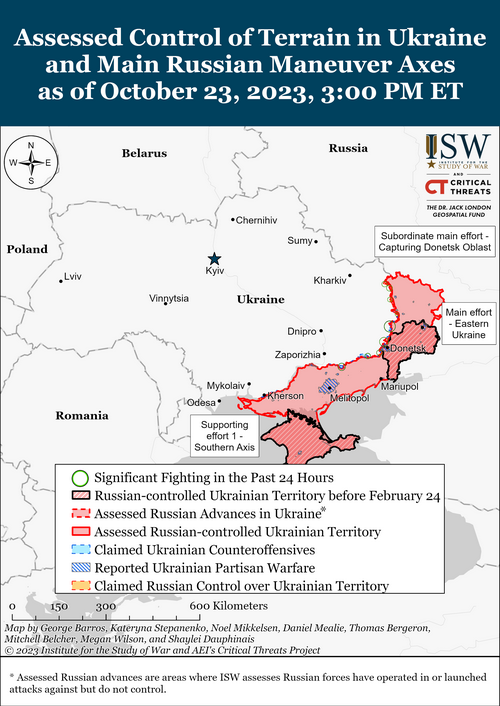
From The Institute For The Study of War:
Russian Offensive Campaign Assessment, October 23, 2023
Karolina Hird, Christina Harward, Angelica Evans, Nicole Wolkov, and Mason Clark
October 23, 2023, 5:15pm ET
Click here to see ISW’s interactive map of the Russian invasion of Ukraine. This map is updated daily alongside the static maps present in this report.
Click here to access ISW’s archive of interactive time-lapse maps of the Russian invasion of Ukraine. These maps complement the static control-of-terrain map that ISW produces daily by showing a dynamic frontline. ISW will update this time-lapse map archive monthly.
Note: The data cut-off for this product was 1:30pm ET on October 23. ISW will cover subsequent reports in the October 24 Russian Offensive Campaign Assessment.
Russia’s domestic production of artillery shells, supplemented by increased ammunition imports from North Korea, will likely allow Russian forces to sustain sufficient rates of artillery fire in Ukraine in 2024, albeit at a relatively lower level than during 2022. Estonian Defense Forces Intelligence Center Head Colonel Ants Kiviselg stated on October 20 that Russia still has around four million artillery shells remaining, which Russian forces can use for “low intensity” warfare for an additional year.[1] Kiviselg noted that there are reports that North Korea has shipped up to 1,000 containers of ammunition to Russia, each containing between 300-500 pieces of artillery ammunition.[2] Kiviselg estimated that North Korea may have therefore provided between 300,000-500,000 pieces of ammunition to Russia, which can last up to one month at the current daily rate of consumption of around 10,000 shells a day.[3] Ukrainian military analyst Colonel Petro Chernyk reported on October 23 that Russian forces are currently firing between 10,000-15,000 shells a day, significantly lower than rates of fire in summer 2022 of 45,000-80,000 shells per day.[4] However, Western sources and satellite imagery have confirmed that North Korean deliveries, likely mostly comprised of artillery shells, have drastically increased since Russian and North Korean authorities likely began more official military-technical cooperation in September, as ISW previously reported, and North Korea is likely to provide further deliveries.[5] Based on Western estimates of Russian artillery production capacity and continued North Korean artillery exports, Russia will likely be able to maintain generally sufficient rates of fire in the foreseeable future. While an overall decrease in Russian fire rates could impede the ability of Russian forces to conduct large scale offensive operations, Russian forces are unlikely to face widespread shortages which would chronically undermine defensive operations, and the drop in the rate of fire will not inherently provide Ukrainian forces an advantage. The degree to which Ukraine’s international partners sustain Ukraine’s ability to sustain an effective weight of fire relative to Russian forces will be a key determiner of respective capabilities in 2024.
Russian forces conducted another series of missile and drone strikes against Ukraine on the night of October 22 to 23. The Ukrainian Air Force reported that Russian forces launched 13 Shahed-131/136 drones, one unspecified drone, and one Kh-59 cruise missile and that Ukrainian forces destroyed all targets.[6] Ukrainian Southern Operational Command reported that Russian forces conducted nine airstrikes using an unspecified number of Kh-31 anti-radar air-to-surface missiles.[7] Ukrainian Southern Operational Command also reported that Ukrainian forces shot down nine Shahed drones that Russian forces aimed at port infrastructure in Odesa Oblast.[8] Russian forces have routinely targeted port and grain infrastructure in Odesa Oblast, and Ukrainian officials reported that Russia will likely renew strikes against Ukrainian critical infrastructure in the fall and winter.[9] Russia will likely continue to target Ukrainian port and grain infrastructure in an attempt to disrupt Ukrainian grain exports as Russia tries to expand its own grain exports, most recently through a 2.7 trillion-ruble (about $26.5 billion) grain contract with China signed on October 17.[10]
Ukrainian forces advanced south of Bakhmut on October 23 amid continued counteroffensive operations near Bakhmut and in western Zaporizhia Oblast. Geolocated footage published on October 22 indicates that Ukrainian forces advanced across the railway line north of Klishchiivka (7km southwest of Bakhmut), confirming prior statements by the Ukrainian General Staff and Russian milbloggers.[11] The Ukrainian General Staff reported that Ukrainian forces continued offensive operations in the Melitopol (western Zaporizhia Oblast) direction.[12]
The Russian government appears to be emphasizing defense spending over social programs in the 2024 federal budget despite contrary messaging intended to reassure the Russian populace. The United Kingdom Ministry of Defense (UK MoD) reported on October 23 that the Russian government’s proposed 2024 budget includes a 68 percent increase in planned defense spending compared to 2023, increasing defense spending to six percent of Russian GDP.[13] The UK MoD noted that the Russian government will likely spend more money on payments and healthcare costs for wounded servicemen, a large portion of whom will likely require lifelong medical care, and for families of Russian servicemen killed in combat. The UK MoD stated that consistently heightened military spending will likely contribute to greater inflation within Russia. The UK MoD added that the Russian government has not proposed increased civilian education or healthcare spending in the 2024 budget, effectively cutting those budgets considering inflation rates. Russian Finance Minister Anton Siluanov notably claimed on October 16 that the Russian 2024-2026 draft budget is “not a military budget” during a State Duma Budget and Tax Committee meeting.[14] Siluanov added that the fulfillment of social obligations is one of the highest priority areas of the Russian federal budget, 30.5 percent of which is allocated to social issues. Siluanov’s statement indicates that Russian authorities still feel the need to downplay increased defense spending ahead of the March 2024 Russian presidential elections due to concerns about how the Russian population views this issue and the war in Ukraine as a whole. ISW previously reported that Russian President Vladimir Putin reportedly intends to discuss the war in Ukraine as little as possible in political messaging leading up to the presidential election.[15] Russian authorities may increasingly highlight social spending over defense spending as the presidential election draws closer, despite the reality of increased defense spending.
Ukrainian Air Force Command Spokesperson Colonel Yuriy Ihnat stated on October 22 that the first group of Ukrainian pilots will begin training with instructors on F-16 fighter jets “in the near future.”[16] The pilots are currently training on F-16 simulators. Politico reported on October 13 that an unnamed US official stated that the pilots’ training may be accelerated due to Ukrainian forces’ urgent need for fighter jets.[17]
Key Takeaways:
- Russia’s domestic production of artillery shells, supplemented by increased ammunition imports from North Korea, will likely allow Russian forces to sustain sufficient rates of artillery fire in Ukraine in 2024, albeit at a relatively lower level than during 2022.
- Russian forces conducted offensive operations near Avdiivka and made confirmed advances northeast of Avdiivka.
- Russian sources claimed that Russian forces pushed Ukrainian forces back from some newly captured positions on the east (left) bank of Kherson Oblast but noted that Ukrainian forces maintain a presence on the east bank.
- Russian forces conducted another series of missile and drone strikes against Ukraine on the night of October 22 to 23.
- Ukrainian forces advanced south of Bakhmut on October 23 amid continued counteroffensive operations near Bakhmut and in western Zaporizhia Oblast.
- The Russian government appears to be emphasizing defense spending over social programs in the 2024 federal budget despite contrary messaging intended to reassure the Russian populace.
- Ukrainian Air Force Command Spokesperson Colonel Yuriy Ihnat stated on October 22 that the first group of Ukrainian pilots will begin training with instructors on F-16 fighter jets “in the near future.”
- Russian forces conducted offensive operations near Kupyansk, along the Svatove-Kreminna line, near Bakhmut, south of Donetsk City, in the Donetsk-Zaporizhia Oblast border area, and in western Zaporizhia Oblast and made confirmed gains in some areas.
- Russian Defense Minister Sergei Shoigu met with Russian Federation Council Speaker Valentina Matvienko and the Federation Committee on Defense and Security on October 23.
Go here to read the rest.
From Strategy Page:
October 23, 2023: The four-month-old Ukrainian offensive in southern Ukraine recently achieved a major objective. Ukrainian forces advanced to within GMLRS missile range of the only Russian rail line that carried supplies to occupied Crimea. Ukraine had already disabled the other rail supply route to Crimea, which used the Kerch Strait bridge. Ukraine used various types of UAVs (unmanned aerial vehicles), USVs (unmanned surface vessels) and UUVs (unmanned underwater vessels) to do this, as well as destroy Russian air defenses in Crimea and drive the remaining ships of the Black Sea fleet to port on the east coast of the Black Sea. The largest of these is Novorossiysk, which had a small naval base facility added in 2012. Now it is being used to host the surviving remnants of the Black Sea Fleet. While Novorossiysk is mainly a commercial port, exporting oil and other goods produced in the area and handling most of the imports, most of that has been halted because of the Ukrainian unmanned weapons that now make the Black Sea a dangerous place for Russian ships of any type.
Russia’s loss of its last rail supply line to the Crimea (which also means rail supply is cut off to much of Russian-occupied Ukraine east of the Crimea) is particularly critical concerning diesel and other liquid fuels because those are necessary for Russian tactical communications, which are largely based on vehicles because Russian man-portable field radios are scarce and insecure due to lack of effective encryption. Russian vehicle-mounted radios and associated electronics, such as computerized sights for tanks, must be charged by the vehicles’ own batteries as Russian military vehicles lack the auxiliary power units (APUs) that Western military vehicles use. So Russian vehicles must run their motors for about an hour a day to charge their batteries even when they are not in action. That burns up a lot of fuel, so the Russian forces in Crimea and just to the east of it will have their combat power reduced by 50-80% in ten or so days. In addition to being out of ammunition.
The Russians are not giving up and are refurbishing roads outside of GMLRS range to keep supplies getting into Crimea. That can’t work because they already lack the trucks, particularly fuel trucks, to adequately supply their forces in that area. Suddenly the round-trip distance their supply trucks have to travel has more than doubled while the number of available trucks is steadily decreasing.
The Ukrainian offensive in the south is mainly about disrupting Russian supply lines and logistics in general. Ukrainian forces have been quite successful at this, using the GMLRS missiles and various unmanned aircraft and vessels to destroy Russian supplies where they are stored or while in transit. Even though Russia has air superiority, they have never been able to use it decisively. Part of this is poor leadership in the Russian air force and part of it is the growing number of air defense systems Ukraine is receiving as well as UAVs making surprise attacks on Russian air bases and factories that make key components for Russian weapons and aircraft.
The Ukrainian concentration on Russian logistics and transportation has meant that Russian troops are chronically short of essential supplies, like food, fuel, munitions and medical items. This has been demoralizing for Russian troops who often go hungry, run out of ammunition and don’t have enough medical supplies. The cumulative impact of these shortages made Russian forces less capable and more cautious. Ukraine has taken advantage of this and managed to keep moving south through Russian fortified areas manned by demoralized Russian soldiers.
Ukraine has concentrated on Russian logistical capabilities since the beginning of the war. The initial Russian offensive in the north was halted not just because of heavy tank losses but because the Ukrainians were also going after Russian supply trucks, especially those carrying fuel. Hit one of those and any nearby trucks are also lost.
In the south Ukraine also took advantage of their more effective surveillance and intelligence system. Many Ukrainian civilians in occupied areas have their cell phones at the ready to report where Russian supply trains were and where they would be in the next hour or so. That was enough time for Ukrainian forces to organize a UAV or GMLRS attack. Ukraine had also received long range (up to 500 kilometers) guided bombs from Britain and France. These were launched far from any Russian air defenses and were often accompanied by Americans MALD, self- propelled aerial decoys that included electronic devices that made the MALD appear to be more of a threat than the smaller guided bombs. For closer targets the U.S. also provided GPS guided 155mm Excalibur shells that made life difficult for Russian troops and any Russian artillery operating too close to the front lines. While 155mm artillery has only about half the range of GMLRS, the two weapons cover much of the combat zone. This is something Russian artillery and rockets have been unable to do, in part because all those Ukrainian civilians are quietly passing on target information. Russia outlawed the use of cell phones that could be used for fire control but that just forced Ukrainian civilians to be more cautious about when or where they carried these phones. The phones remained turned off and hidden most of the time, with the civilians carrying older phones that lacked cameras.
Go here to read the rest. The Russian effort in the Ukraine has many weaknesses: lack of combat infantry, low troop morale, not enough troops to go on the offensive across the front, not enough troops to mount a strong defense over the entire front, political dissension at home, etc. One factor that has been overlooked is that the War is being conducted on a logistical shoe string, with vulnerable rail lines being key to the Russians keeping their forces in supply. Cut the supply lines to the Crimea and the Russians are on a trajectory to lose this War.
Update: Rumors are flying that Putin went into cardiac arrest last Sunday and had to be revived in an emergency room where he was taken by his guards. True? Who knows, but you can be certain that a huge number of people in Ukraine and Russia are going to believe its true.

