
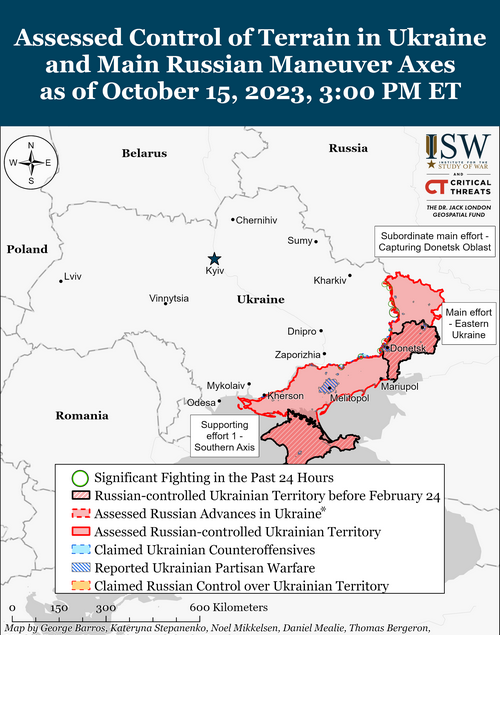
From The Institute For The Study of War:
Russian Offensive Campaign Assessment, October 15, 2023
Riley Bailey, Nicole Wolkov, Christina Harward, Grace Mappes, and Mason Clark
October 15, 2023, 5:30pm ET
Click here to see ISW’s interactive map of the Russian invasion of Ukraine. This map is updated daily alongside the static maps present in this report.
Click here to access ISW’s archive of interactive time-lapse maps of the Russian invasion of Ukraine. These maps complement the static control-of-terrain map that ISW produces daily by showing a dynamic frontline. ISW will update this time-lapse map archive monthly.
Note: The data cut-off for this product was 12pm ET on October 15. ISW will cover subsequent reports in the October 16 Russian Offensive Campaign Assessment.
Russian President Vladimir Putin may be trying to temper expectations of significant Russian advances around Avdiivka in Donetsk Oblast. Putin claimed in an interview on Russian state television on October 15 that Russian forces are conducting an “active defense” in the Avdiivka, Kupyansk, and Zaporizhia directions.[1] Putin’s characterization of Russian offensive operations near Avdiivka as an “active defense,” instead of “active combat operations” as Russian UN Ambassador Vasily Nebenzya claimed on October 13, or discussing Russian operations as an “offensive” as some milbloggers have, may be an attempt to temper expectations of significant Russian advances.[2] Russian operations including intensive artillery and airstrikes are likely intended to degrade Ukrainian forces around Avdiivka.[3] Russian forces are unlikely to make significant breakthroughs or cut off Ukrainian forces in the settlement in the near term, and potential advances at scale would likely require a significant and protracted commitment of personnel and materiel.[4]
The Russian information space writ large is also metering its initial optimism about the prospects of Russian offensive operations around Avdiivka. Russian milbloggers initially reported maximalist and unverifiable claims of Russian advances over 10km, likely exaggerated the degree of Russian successes near Avdiivka during initial offensive operations, and expressed optimism for rapid Russian advances.[5] Some Russian milbloggers have since acknowledged difficulties in the Russian advance near Avdiivka and noted that Russian forces decreased their pace of offensive operations around the settlement.[6] Russian milbloggers have also begun to claim that intense and attritional fighting is ongoing around Avdiivka.[7] Many Russian milbloggers also continue to self-censor by limiting reports of Russian tactical actions and problems specific to individual sectors of the frontline.[8] A Russian milblogger claimed that unspecified actors, possibly the Russian military leadership and some subset of milbloggers, agreed to stop reporting on the Avdiivka operations, but reiterated complaints about general problems in the Russian military not specific to any sector of the front.[9]
Russian forces continued offensive operations aimed at encircling Avdiivka on October 15 but have yet to make further gains amid a likely decreasing tempo of Russian operations in the area. The Ukrainian General Staff reported that Ukrainian forces repelled more than 15 Russian assaults near Avdiivka, as well as northwest and southwest of the settlement.[10] ISW has not yet observed visual confirmation of previous claims of Russian advances in the area or geolocated footage of any other Russian gains. Russian sources claimed notably fewer Russian advances in the area on October 15 compared to previous days and described these new alleged advances as marginal.[11] A Russian milblogger acknowledged that Ukrainian forces still maintain a presence at the Avdiivka Coke Plant following conflicting Russian claims about Russian control of the plant.[12]
Both Ukrainian military observers and Russian sources stated that Russian forces did not achieve their desired immediate breakthrough, and Russian forces faced initial high losses and a likely slower than anticipated rate of advance.[13] Avdiivka City Military Administration Head Vitaliy Barabash stated on October 12 that Russian forces conducted assaults with air support in 10 to 12 directions around the settlement, whereas the Ukrainian General Staff reported on October 15 that fighting occurred near only six settlements.[14] Ukrainian Tavriisk Group of Forces Spokesperson Colonel Oleksandr Shtupun stated on October 14 that the pace of Russian offensive operations near Avdiivka declined and that Russian forces have lost more than 300 pieces of military equipment and 3000 personnel since intensifying offensive operations in the area on October 9.[15]
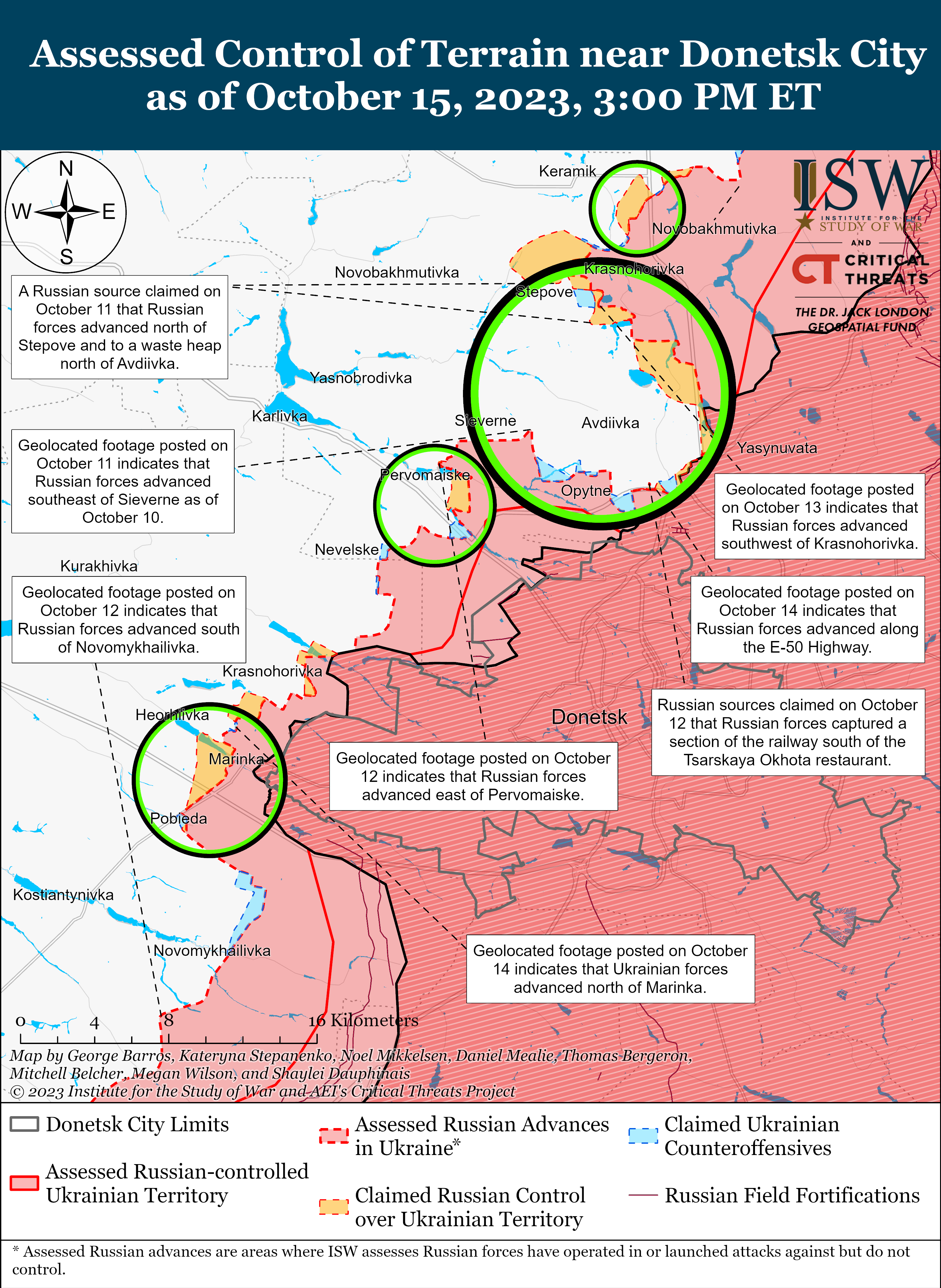
Russian forces will likely continue offensive operations at this decreased tempo in the near term, however, and will remain a threat to Ukrainian forces in the area despite being unlikely to achieve a decisive breakthrough or encircle Avdiivka at this time. Any decrease in the tempo of Russian offensive operations may be the result of a temporary adjustment to the tactical situation, and Russian forces may intensify their attempts to encircle Avdiivka in the coming days. A Ukrainian military observer noted that Russian forces have penetrated Ukrainian flanks around Avdiivka and pose a significant threat to Ukrainian positions despite being unlikely to encircle Avdiivka in the near term.[16] Ukrainian military observers indicated that Russian forces had concentrated a significant grouping of forces consisting of elements of 15 motorized rifle regiments and 11 rifle regiments to the Avdiivka-Donetsk City front and have already executed regiment-size offensive operations in the area (meaning three or more battalions conducting cohesive assaults, a scale beyond that of most Russian or Ukrainian attacks at this stage in the war).[17] This reported Russian grouping will likely be able to sustain offensive operations aimed at encircling Avdiivka if Russian commanders are willing to sustain relatively high losses, despite being insufficient for an immediate breakthrough.
A prominent Russian milblogger and frontline unit commander complained that the Russian military leadership is uninterested in battalion level problems, supplementing other Russian milblogger complaints about general problems in the Russian military.[18] Russian “Vostok” Battalion Commander Alexander Khodakovsky, who has previously complained about problems affecting Russian forces’ ability to conduct effective combat operations, claimed on October 15 that Russian infantry on the front in Ukraine face problems with insufficient counterbattery capabilities, commander competency, medical support, rotations, and supplies.[19] Khodakovsky claimed that a lack of communication between Russian battalions and headquarters is common, so much so that (in an undated and unspecific anecdote) when Ukrainian forces struck a Russian headquarters building, a Russian battalion did not realize that the headquarters had been disabled and continued conducting operations independently. Another Russian milblogger, who said on October 14 that he concurred with the “agreement” to stop any commentary about Russian operations in Avdiivka, complained a few hours later that Russian forces, in general, are experiencing ammunition shortages and continued issues combating Ukrainian drones.[20] These complaints indicate that a wider disdain for the Russian military command persists despite likely top-down attempts to censor discussion about certain areas of the front.
Ukrainian forces continued offensive operations near Bakhmut and in western Zaporizhia Oblast on October 15 and slightly advanced south of Bakhmut. Geolocated footage published on October 15 shows that Ukrainian forces marginally advanced towards the railway line north of Klishchiivka (7km southwest of Bakhmut), and Russian sources reported continued Ukrainian ground attacks south of Bakhmut on the Klishchiivka-Kurdyumivka-Andriivka line (7-13km southwest of Bakhmut).[21] Ukrainian military observer Kostyantyn Mashovets stated that Ukrainian forces took advantage of recent Russian counterattacks in western Zaporizhia Oblast to gradually advance near Kopani (5km northwest of Robotyne), east of Nesteryanka (10km northwest of Robotyne), and near Verbove (18km southeast of Orikhiv).[22] Ukrainian officials have not yet commented on any recent Ukrainian advances along the Robotyne-Novoprokopivka-Verbove line (20km southwest to 18km southeast of Orikhiv), however. Russian sources reported continued Ukrainian attacks on the Robotyne-Novoprokopivka-Verbove line on October 15.[23]
Key Takeaways:
- Russian President Vladimir Putin may be trying to temper expectations of significant Russian advances around Avdiivka in Donetsk Oblast.
- The Russian information space writ large is also metering its initial optimism about the prospects of Russian offensive operations around Avdiivka.
- Russian forces continued offensive operations aimed at encircling Avdiivka on October 15 but have yet to make further gains amid a likely decreasing tempo of Russian operations in the area.
- Russian forces will likely continue offensive operations at this decreased tempo in the near term, however, and will remain a threat to Ukrainian forces in the area despite being unlikely to achieve a decisive breakthrough or encircle Avdiivka at this time.
- A prominent Russian milblogger and frontline unit commander complained that Russian military leadership is uninterested in battalion level problems, supplementing other Russian milblogger complaints about general problems in the Russian military.
- Ukrainian forces continued offensive operations near Bakhmut and in western Zaporizhia Oblast on October 15 and slightly advanced south of Bakhmut.
- Russian forces conducted offensive operations along the Kupyansk-Svatove-Kreminna line, near Bakhmut, along the Avdiivka-Donetsk City line, in the Donetsk-Zaporizhia Oblast border area, and in western Zaporizhia Oblast on October 15 and advanced in some areas.
- A Russian milblogger claimed that Russian forces have “significant” reserves comprised of new divisions currently located in rear areas, though these formations are highly unlikely to be fully staffed at this time.
- The Russian Orthodox Church (ROC) is sending a reportedly Kremlin-affiliated priest to Crimea, likely as part of continued Russian efforts to persecute religious communities in occupied Ukraine.
Go here to read the rest. The Russians are obviously hoping to run out the clock on this year until bad weather shuts down campaigning. The Ukrainians claim they will continue their offensive through the winter, but it is hard for me to see how that is possible. Their frontline troops are eventually going to need time to rest and refit.

