
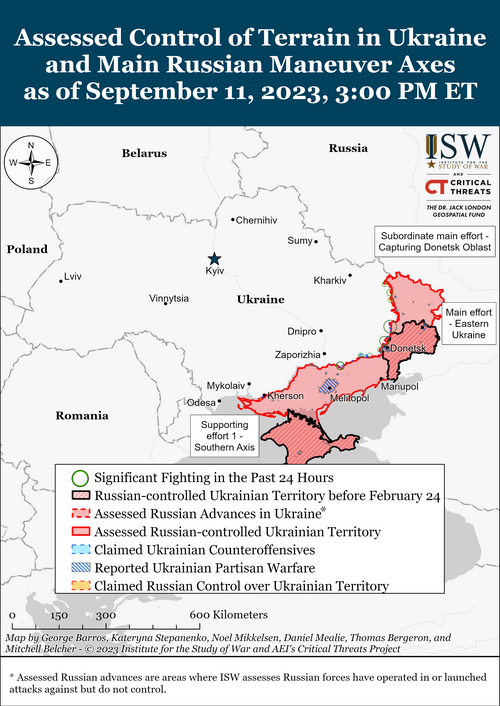
From The Institute For The Study of War:
Russian Offensive Campaign Assessment, September 11, 2023
Karolina Hird, Nicole Wolkov, Christina Harward, Angelica Evans, and Mason Clark
September 11, 2023, 4:15pm ET
Click here to see ISW’s interactive map of the Russian invasion of Ukraine. This map is updated daily alongside the static maps present in this report.
Click here to access ISW’s archive of interactive time-lapse maps of the Russian invasion of Ukraine. These maps complement the static control-of-terrain map that ISW produces daily by showing a dynamic frontline. ISW will update this time-lapse map archive monthly.
Note: The data cut-off for this product was 12:30pm ET on September 11. ISW will cover subsequent reports in the September 12 Russian Offensive Campaign Assessment.
Ukrainian forces continued counteroffensive operations in Donetsk and Zaporizhia oblasts on September 11 and have reportedly advanced near Bakhmut and in western Zaporizhia Oblast. Ukrainian military officials announced on September 11 that Ukrainian forces have liberated 2 square kilometers of territory in the Bakhmut direction over the past week and have made gains near Klishchiivka (6km southwest of Bakhmut) and Andriiivka (9km southwest of Bakhmut).[1] Ukrainian Deputy Defense Minister Hanna Malyar also stated that Ukrainian forces have gained a total of 4.8 square kilometers in the Tavriisk (Zaporizhia) operational direction over the past week, particularly south of Robotyne (10km south of Orikhiv) and west of Verbove (20km southeast of Orikhiv).[2]
The Rosgvardia may be recruiting previously imprisoned former Wagner Group fighters, likely to further subsume Wagner remnants while bolstering Russia’s domestic security apparatus. Russian opposition outlet iStories reported on September 11 that relatives of previously imprisoned former Wagner fighters revealed that some of their relatives received invitations to serve in the Rosgvardia following a series of tests and certifications.[3] iStories noted that the Rosgvardia is asking former Wagner fighters to pass a security check and provide documentation of official pardons of their prison sentences, as well as documentation of the conclusion of their contracts with Wagner. iStories also amplified the claims of a Rosgvardia servicemember from the 2nd Battalion of an unidentified Moscow-based Rosgvardia unit that ex-Wagner fighters are serving in his unit, including those without any conventional military experience. Another Rosgvardia servicemember from Rostov-on-Don alleged that his unit has sent ex-Wagner fighters to guard “strategic objects” in occupied Ukraine. The Rosgvardia’s possible active recruitment of former Wagner fighters is noteworthy in the wake of recent efforts by the Russian leadership to strengthen the Rosgvardia’s role as a domestic security organ following Wagner’s June 24 armed rebellion.[4] ISW has previously reported on the transfer of “Grom” units (elite anti-drug special units of the Russian Ministry of Internal Affairs) and heavy weaponry to the Rosgvardia following the rebellion.[5] The Rosgvardia may be recruiting former Wagner fighters to maximize its force generation pool, or potentially to exert more direct control over former Wagner elements in the hopes of consolidating domestic security following the rebellion.
Russian border guards expressed similar grievances about limited capabilities and equipment to those voiced by Russian troops serving in Ukraine and continued to express concern over potential Ukrainian raids into Russia. A Russian milblogger who serves on the Kremlin’s human rights council amplified complaints that the Russian had authorities poorly equip border guard units and failed to supply them with sufficient digital communications systems, reconnaissance and strike drones, mobile transport, and medical supplies.[6] The milblogger noted that these grievances come from almost all border service departments within the Russian Federal Security Service (FSB).[7] The milblogger noted that border service units formed task forces to participate in the Soviet war in Afghanistan and were equipped with artillery, aviation, and armored vehicles, implying modern FSB border guard units need similar capabilities.[8] The milblogger claimed that border guard units only receive anti-tank missiles and mortars from personal connections with Russian military units, and advocated for Russian authorities to provide better equipment — including self-propelled artillery systems and electronic warfare systems — to current border guards, especially those in Bryansk, Kursk, and Belgorod oblasts, which border Ukraine.[9] The milblogger’s reference to the Soviet border guards’ participation in the war in Afghanistan and call for the provision of more complex systems suggest that Russian border guards continue to be concerned about the threat of possible Ukrainian cross-border raids into Russia and Ukrainian drone attacks on Russian territory.
Russian forces conducted a series of Shahed-131/136 drone strikes targeting southern Ukraine on the night of September 10 to 11. The Ukrainian General Staff reported that Ukrainian forces shot down 12 Shaheds over Zaporizhia, Dnipropetrovsk, and Mykolaiv oblasts and another unspecified drone.[10] Ukrainian Main Military Intelligence Directorate (GUR) Head Kyrylo Budanov stated on September 11 that Russian forces are changing tactics and using drones “en masse.”[11] The Ukrainian General Staff also reported that Russian forces launched 10 missiles, including Kh-31P anti-radar missiles and Ka-59 guided cruise missiles, at Dnipropetrovsk Oblast.[12]
The Kremlin’s ruling United Russia party unsurprisingly achieved most of its desired results in highly fraudulent local elections in Russia and occupied Ukraine. The Russian Central Election Commission (CEC) claimed that United Russia won gubernatorial elections in 13 regions and is leading in six regions where votes are still being counted.[13] United Russia gubernatorial candidates won over 72 percent of the vote in 13 out of 20 regions in Central Russia, the Russian Far East, and Siberia.[14] All three of the candidates that Russian President Vladimir Putin publicly endorsed — Nizhny Novgorod Governor Gleb Nitkin, Moscow Mayor Sergei Sobyanin, and Smolensk Governor Vasily Anokhin — won or are leading by major margins.[15] United Russia reportedly received 83 percent of the vote in occupied Zaporizhia Oblast in Ukraine, 78 percent in Donetsk Oblast, 74 percent in Luhansk Oblast, and 74.8 percent in Kherson Oblast.[16] Non-United Russia gubernatorial candidates won in only two regions, Khakassia and Oryol oblasts, where Communist Party incumbents were re-elected.[17] ISW has previously reported on the Kremlin’s extensive preparations to intimidate voters and directly falsify results to ensure a United Russia victory throughout Russia and in highly fraudulent “elections” in occupied Ukraine.[18]
North Korean leader Kim Jong Un and Russian President Vladimir Putin will meet in Vladivostok in the coming days, likely to discuss bilateral relations and North Korea’s supplies of artillery munitions to Russia.[19] The Kremlin announced on September 11 that Kim will meet with Putin in the coming days, and Kim has reportedly left Pyongyang and is traveling to Russia.[20] ISW will continue to follow developments in the lead-up to the meeting.
US and Armenian forces began joint military exercises in Armenia on September 11. The Armenian Ministry of Defense stated that the joint US-Armenian “Eagle Partner 2023” exercises will prepare Armenian forces to take part in international peacekeeping missions and will last until September 20.[21] 85 US personnel and 175 Armenian personnel are participating in exercises at the Zar and Armavir training grounds near Yerevan.[22] “Eagle Partner 2023” will occur against the backdrop of increasingly tense relations between Moscow and Yerevan, as well as heightened tensions between Armenian and Azerbaijani forces in Nagorno-Karabakh.[23]
Key Takeaways:
- Ukrainian forces continued counteroffensive operations in Donetsk and Zaporizhia oblasts on September 11 and have reportedly advanced near Bakhmut and in western Zaporizhia Oblast.
- The Rosgvardia may be recruiting previously imprisoned former Wagner Group fighters, likely to further subsume Wagner remnants while bolstering Russia’s domestic security apparatus.
- Russian border guards expressed similar grievances about limited capabilities and equipment to those voiced by Russian troops serving in Ukraine and continued to express concern over potential Ukrainian raids into Russia.
- The Kremlin’s ruling United Russia party unsurprisingly achieved most of its desired results in highly fraudulent local elections in Russia and occupied Ukraine.
- North Korean leader Kim Jong Un and Russian President Vladimir Putin will meet in Vladivostok in the coming days, likely to discuss bilateral relations and North Korea’s supplies of artillery munitions to Russia.
- US and Armenian forces began joint military exercises in Armenia on September 11.
- Russian forces conducted offensive operations along the Kupyansk-Svatove-Kreminna line, near Bakhmut, along the Avdiivka-Donetsk City line, in the western Donetsk-eastern Zaporizhia Oblast border area, and in western Zaporizhia Oblast and advanced in some areas on September 11.
- Ukrainian forces conducted offensive operations in at least one sector of the front on September 11 and advanced near Bakhmut, along the Avdiivka-Donetsk City line, in the western Donetsk-eastern Zaporizhia Oblast border area, and in western Zaporizhia Oblast.
- Russian Central Election Committee Head Alexander Sidyakin unsurprisingly claimed that United Russia received the majority of votes in occupied Luhansk, Donetsk, Zaporizhia, and Kherson oblasts.
- Ukrainian and United Kingdom military officials reported on September 11 that the Russian military intends to mobilize over 400,000 personnel by the end of 2023.
Go here to read the rest. Cuba has arrested 17 people involved in attempting to enlist Cubans to fight in Ukraine. During the eighties the Cubans served as Janissaries for the Soviets in Africa, in exchange for economic goods. Cuba is broker than broke these days, but it is significant that they are unwilling to sell their subjects like so many Hessians to fight in Ukraine.

