
From The Institute For The Study of War:
Russian Offensive Campaign Assessment, August 28, 2023
Riley Bailey, Kateryna Stepanenko, Nicole Wolkov, Christina Harward, and Mason Clark
August 28, 2023, time 7:10pm ET
Click here to see ISW’s interactive map of the Russian invasion of Ukraine. This map is updated daily alongside the static maps present in this report.
Click here to access ISW’s archive of interactive time-lapse maps of the Russian invasion of Ukraine. These maps complement the static control-of-terrain map that ISW produces daily by showing a dynamic frontline. ISW will update this time-lapse map archive monthly.
Note: The data cut-off for this product was 1:30pm ET on August 28. ISW will cover subsequent reports in the August 29 Russian Offensive Campaign Assessment.
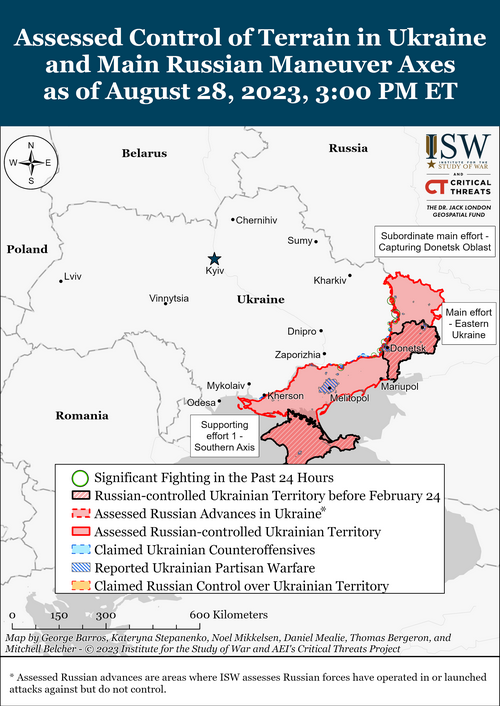
Ukrainian officials formally acknowledged that Ukrainian forces had liberated Robotyne amid continued Ukrainian advances in western Zaporizhia Oblast and near Bakhmut. Ukrainian Deputy Defense Minister Hanna Malyar reported on August 28 that Ukrainian forces have liberated Robotyne, achieved unspecified successes southeast of Robotyne (10km south of Orikhiv) and south of Mala Tokmachka (7km southeast of Orikhiv), and are advancing in the directions of Novodanylivka (4km south of Orikhiv), Novopokropivka (15km south of Orikhiv), Mala Tokmachka, and Ocheretuvate (25km southwest of Orikhiv).[1] Heat anomalies from NASA FIRMS/VIIRS sensors and Russian claims of Ukrainian advances likely indicate that Ukrainian forces advanced near Verbove.[2] Malyar also stated that Ukrainian forces pushed Russian forces out of positions east of Klishchiivka (7km southwest of Bakhmut) and in the center of the settlement and have made unspecified progress near Orikhovo-Vasylivka (11km northwest of Bakhmut).[3]
Malyar reported that Ukrainian forces continue offensive operations in the southern direction, which she specified is the main direction of Ukrainian offensive operations.[4] Malyar’s statement is consistent with the scale of Ukrainian offensive operations that ISW has observed in southern and eastern Ukraine. Ukrainian forces are currently conducting two operational efforts in southern Ukraine in western Zaporizhia Oblast and in the Donetsk-Zaporizhia Oblast border area, and Malyar did not indicate one effort as the main offensive direction.
The Russian military command continues to expend relatively elite Russian airborne forces by deploying these troops to defend vulnerable positions against Ukrainian counteroffensives. Geolocated footage published on August 27 indicates that the Russian military command deployed elements of the Russian 76th Guards Air Assault (VDV) Division to reinforce Russian positions near Robotyne likely from the Kreminna area in Luhansk Oblast.[5] ISW had previously observed that elements of almost all Russian VDV formations are operating in areas where Ukrainian forces are conducting counteroffensive operations, and this lateral redeployment further suggests that Russian forces may be using relatively elite units to reinforce critical sectors of the frontline.[6] Russian forces previously redeployed the 7th Guards Mountain VDV Division from Kherson Oblast to support Russian defenses in eastern and western Zaporizhia Oblast and have transferred other VDV forces from Luhansk Oblast to defend against Ukrainian counteroffensives on Bakhmut’s flanks.[7] The Russian military command has consistently relied on VDV formations as both an offensive and a defensive force and they are likely degraded from their high operational tempo. The degradation of these forces will likely weaken Russia’s ability to sustain complex defensive operations and almost certainly disrupt any Russian intent to resume offensive operations at scale, which have predominantly relied on relatively elite infantry that Russia now lacks.
Russian forces conducted a missile strike on the rear areas of Ukraine on August 28. Ukrainian officials reported that Russian forces launched four Kalibr cruise missiles from the Black Sea and two Kh-59 cruise missiles from the airspace above occupied Kherson Oblast in the direction of Kryvyi Rih on the night of August 28 and that Ukrainian air defenses intercepted all but two Kalibr missiles.[8] The Ukrainian Air Force reported that the Russian missiles struck a civilian industrial facility in Poltava Oblast.[9]
A Ukrainian intelligence official indicated that Russian forces may have marginally replenished their stocks of high-precision missiles through conservation in the summer of 2023. Ukrainian Main Military Intelligence Directorate (GUR) Spokesperson Vadym Skibitskyi stated on August 28 that Russian forces have a total of 585 missiles left in their stocks that have a range of more than 500km.[10] Ukrainian Defense Minister Oleksii Reznikov last provided official Ukrainian figures on Russian missile stocks in early January 2023 in the closing months of the Russian strike campaign that targeted critical infrastructure from roughly October 2022 to March 2023.[11] Skibitskyi offered new figures for Russian missile stocks, compared with Reznikov’s January 2023 figures as follows:
- 270 Iskander ballistic and cruise missiles (+126 from January)
- 140 sea-based Kalibr cruise missiles (+81 from January)
- Roughly 100 Kh-101/Kh-55/Kh-555 cruise missiles (-18 from January)
- Roughly 75 Kinzhal ballistic missiles (+22 from January)
- 150 Kh-22/32 missiles (-12 from January).[12]
It is unclear if these figures are estimates or exact amounts, but they nevertheless suggest that Ukrainian intelligence assesses that Russian forces have been able to marginally replenish their stocks of high precision missiles since the end of the larger Russian air campaign in the fall and winter of 2022. Russian forces launched a new air campaign in May 2023 focused on maintaining a more regular pace of strikes against Ukraine with fewer missiles, and Skibitskyi suggested that this allowed Russian forces to replenish their stocks.[13] Ukrainian officials have previously reported that Russia is able to produce roughly a hundred missiles across various types per month, and this has likely allowed Russian forces to either maintain or marginally replenish their stocks during the summer air campaign.[14] Skibitskyi stated that Russian defense enterprises are struggling to produce several dozens of specific types of missiles a month due to foreign component shortages.[15]
Ukrainian officials stated that Russian forces may intend to resume a wider campaign against Ukrainian critical infrastructure in the fall of 2023, but assessed Russia likely has not replenished its missile stocks to sustain a campaign on the scale of the winter 2022-2023 strikes. Skibitskyi stated that Russian forces are conducting reconnaissance on Ukrainian infrastructure facilities and may begin a massive strike series with missiles and drones at the end of September or in October.[16] Russian forces conducted strikes with up to 100 missiles in a single strike series during the air campaign in the fall and winter of 2022, and the marginal replenishment of their missile stocks will likely prevent them from conducting an air campaign at anywhere near that scale.[17] Ukrainian Air Force Spokesperson Colonel Yuriy Ihnat stated that Russia is increasing its missile production but not enough to maintain the same intensity of strikes as the fall and winter of 2022.[18]
Ukrainian officials assessed that any upcoming Russian strike campaign may employ new tactics that use fewer missiles and more drones. Skibitskyi stated that Russian forces are improving their targeting and decision-making speed, are more carefully selecting targets, and are meticulously searching for flight routes that can bypass Ukrainian air defense systems.[19] ISW has previously reported on Russian forces’ ability to innovate and learn over the course of the war.[20] Skibitskyi stated that possible upcoming large-scale Russian strikes may use only about 10 to 30 missiles but will be accompanied by a much larger number of Iranian Shahed-131/136 drones.[21] Skibitskyi and Ihnat stated that a larger number of drones would allow Russian forces to further bypass Ukrainian air defenses, allowing other projectiles to reach their targets.[22] Ihnat stated that drones will likely be used in strikes on Ukrainian energy infrastructure, and Skibitskyi noted that Russian forces have previously used Shahed drones to widely damage Ukrainian electrical substations.[23] Russia has reportedly begun domestically producing modified versions of Shahed-131/136 drones but is reportedly struggling to produce them at the pace and quality it desires.[24] ISW previously assessed that the Russian command may believe that a large number of strike drones will allow Russian forces to overwhelm Ukrainian air defenses, although Shahed drones remain Russia’s high precision weapon system most vulnerable to Ukrainian air defenses.[25]
Ukrainian strikes reportedly damaged Russian aircraft and equipment at an airfield in Kursk Oblast on August 27. RBK-Ukraine cited Ukrainian Security Service (SBU) sources that SBU military counterintelligence conducted a drone strike on an airfield near Kursk City on the night of August 27, damaging four Russian Su-30 fighter aircraft, one MiG-29 fighter aircraft, and radars for a S-300 missile system and two Pantsir missile systems.[26] Kursk Oblast Governor Roman Starovoyt claimed that Ukrainian drones damaged an apartment building, and Russian milbloggers claimed on August 28 that satellite imagery of the airfield showed no visible damage to Russian military equipment.[27] ISW cannot independently confirm the results of the Ukrainian strikes.
Russian milbloggers continued to criticize the Russian Ministry of Defense (MoD) for ignoring ultranationalists’ complaints over the mistreatment of a Southern Military District (SMD) brigade operating in the Kherson direction. Russian milbloggers continued to claim that the Russian military command chose to ignore and silence reports about elements of the 205th Separate Motorized Rifle Brigade (49th Combined Arms Army, Southern Military District) suffering significant losses with inadequate artillery support and poor leadership in the Kherson direction.[28] One milblogger claimed that the Russian MoD continues to face bureaucratic problems that prevent the Russian military from ingesting criticism and undergoing reforms.[29] The milblogger claimed that Russian ultranationalists were hopeful that the Russian military command would improve its management of the war effort after Wagner Group financier Yevgeny Prigozhin’s armed rebellion that sought to change Russia’s military command – but such hopes did not materialize.[30] The milblogger claimed that the outrage over the treatment of the 205th Separate Motorized Rifle Brigade divided the Russian information space into milbloggers who are loyal to the Russian MoD and those who oppose the Russian MoD. Another milblogger claimed that he refrains from sharing 90 percent of his information on Russian military failures, noting that Russian officials perceive the limited amount of criticism as a personal attack on them instead of thinking on how to improve conditions for Russian servicemen.[31]
Key Takeaways:
- Ukrainian officials formally acknowledged that Ukrainian forces liberated Robotyne amid continued Ukrainian advances in western Zaporizhia Oblast and near Bakhmut.
- The Russian military command continues to expend relatively elite Russian airborne forces by deploying these troops to defend vulnerable positions against Ukrainian counteroffensives.
- A Ukrainian intelligence official indicated that Russian forces may have marginally replenished their stocks of high-precision missiles through conservation in the summer of 2023.
- Ukrainian officials stated that Russian forces may intend to resume a wider campaign against Ukrainian critical infrastructure in the fall of 2023, but assessed Russia likely has not replenished its missile stocks to sustain a campaign on the scale of the winter 2022-2023 strikes.
- Ukrainian officials assessed that any upcoming Russian strike campaign may employ new tactics that use fewer missiles and more drones.
- Russian milbloggers continued to criticize the Russian Ministry of Defense (MoD) for ignoring ultranationalists’ complaints over the mistreatment of a Southern Military District (SMD) brigade operating in the Kherson direction.
- Russian forces conducted offensive operations on the Kupyansk-Svatove-Kreminna line, near Bakhmut, along the Avdiivka-Donetsk City line, and in western Donetsk, and did not make any confirmed advances.
- Russian lawmakers and the Russian information space expressed varied opinions about a proposed Russian State Duma bill that would deprive individuals of their acquired Russian citizenship for evading military registration and mobilization.
- The Ukrainian Main Military Intelligence Directorate (GUR) reported on August 28 that partisans created an explosion at the barracks of a Chechen “Akhmat-1” Rosgvardia riot police (OMON) unit in Enerhodar in occupied Zaporizhia Oblast.
Go here to read the rest. With the seizure of Robotyne the Ukrainians are making progress in their goal of cutting off Crimea from Russia. An advance of another ten miles south and Ukrainian guns could devastate with fire the narrow land bridge connecting the Crimea with Russia. Stay tuned.

