
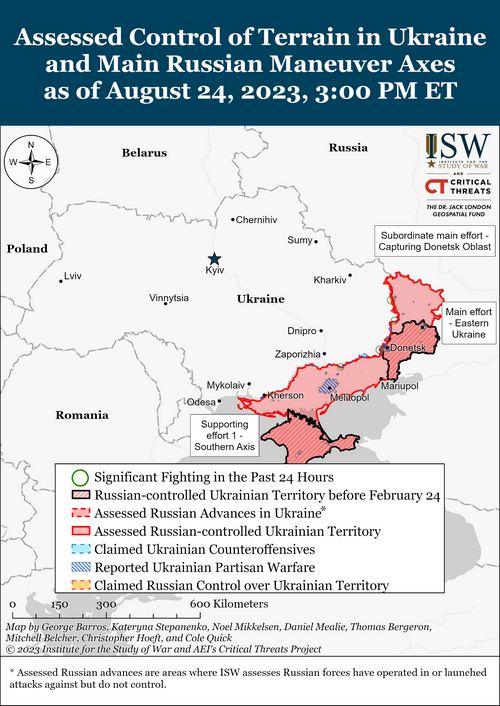
From The Institute For The Study of War:
Russian Offensive Campaign Assessment, August 24, 2023
Riley Bailey, Grace Mappes, Angelica Evans, Christina Harward, Kateryna Stepanenko, and Frederick W. Kagan
August 24, 2023, 7:50pm ET
Click here to see ISW’s interactive map of the Russian invasion of Ukraine. This map is updated daily alongside the static maps present in this report.
Click here to access ISW’s archive of interactive time-lapse maps of the Russian invasion of Ukraine. These maps complement the static control-of-terrain map that ISW produces daily by showing a dynamic frontline. ISW will update this time-lapse map archive monthly.
Note: The data cut-off for this product was 2:00pm ET on August 24. ISW will cover subsequent reports in the August 25 Russian Offensive Campaign Assessment.
The Wagner Group will likely no longer exist as a quasi-independent parallel military structure following Russian President Vladimir Putin’s almost certain assassination of Wagner financier Yevgeny Prigozhin, Wagner founder Dmitry Utkin, and reported Wagner logistics and security head Valery Chekalov on August 23. The death of Wagner’s central leadership disrupts Wagner’s ability to reverse the effects of the Kremlin’s and the Russian Ministry of Defense’s (MoD) campaign to weaken, subsume, and destroy the organization following the June 24 armed rebellion.[1] The Russian MoD has reportedly established private military companies (PMCs) that have been recruiting current and former Wagner personnel to assume control over Wagner’s operations abroad.[2] Russian sources claimed that the Kremlin refused to pay the Belarusian government for Wagner’s deployment to Belarus and that financial issues were already leading to reduced payments that were causing Wagner fighters to resign.[3] Satellite imagery from August 1 and 23 shows that Wagner had dismantled almost a third of the tents at its camp in Tsel, Asipovichy, Belarus in the previous month, suggesting that the effort to weaken Wagner may have resulted in a notable flight of Wagner personnel from the contingent in Belarus.[4] Some milbloggers denied claims that Wagner fighters are dismantling their camp in Tsel, however.[5] The Ukrainian Resistance Center reported on August 23 that an unspecified number of Wagner personnel at camps in Belarus began preparations to return to Russia following Prigozhin’s death.[6] The central Wagner leadership had brought Wagner to the height of its independence during the offensive to capture Bakhmut and was attempting to retain some semblance of that independence in the aftermath of Wagner’s rebellion.[7] The elimination of this central leadership likely ends any remaining means Wagner had to operate independently of the Russian MoD. It remains unclear whether the Kremlin intends for Wagner to completely dissipate or intends to reconstitute it as a much smaller organization completely subordinate to the Russian MoD. A third option—restoring Wagner as a quasi-independent organization under a new commander loyal to the Kremlin—is possible but unlikely.
Putin delivered a brief de facto eulogy of Prigozhin and reportedly deceased Wagner leadership on August 24, and portrayed Prigozhin as his loyal subordinate up until his death, the armed rebellion notwithstanding. Putin characterized Prigozhin as having a “difficult fate” in which he made “serious mistakes,” and Putin noted that he had known Prigozhin since the early 1990s. Putin notably stated that Prigozhin “achieved the necessary results both for himself and what I [Putin] asked him for – for a common cause, as in these last months.” Putin’s comment implies that Prigozhin had been fulfilling Putin’s orders recently and throughout their acquaintance and notably refrains from suggesting that Prigozhin had ever betrayed Putin, but subtly indicates that Prigozhin’s loyalty through the years was not enough to offset the “serious mistake” of launching a rebellion against the Russian military leadership. Putin’s speech largely confirms ISW’s prior assessment that Prigozhin did not intend to oust Putin during his June 24 rebellion and instead saw himself as loyal to Putin while seeking to force Putin to fire the Russian military leadership as he had been demanding.[8] A Russian insider source, citing an unnamed individual who knew Prigozhin, claimed that Prigozhin was confident that Putin would forgive him.[9] Prigozhin likely underestimated how seriously his rebellion had personally humiliated Putin. Prigozhin had also apparently overestimated the value of his own loyalty to Putin. Putin places significant value on loyalty and has frequently rewarded loyal Russian officials and military commanders even when they have failed. Prigozhin’s rebellion was an act of significant insubordination despite his claim that he rebelled out of loyalty to Russia.[10] Putin’s statement was therefore a warning to those currently loyal to Putin that some mistakes are too serious for loyalty to overcome.
The exact cause of Prigozhin’s plane crash remains unclear as US and Russian sources offered varying explanations, while Wagner-affiliated channels continued to call on Russian sources to stop speculating. US officials have provided different preliminary unconfirmed explanations for the plane crash: surface-to-air missiles, a bomb aboard the aircraft, or other sabotage.[11] Pentagon Spokesperson Brigadier General Patrick Ryder stated that the Pentagon currently has no indication that a surface-to-air missile downed the plane.[12] Russian state news outlet Kommersant reported on August 23 that sources close to the Russian Investigative Committee stated that there is no reason to believe that a terrorist attack downed Prigozhin’s plane, contradicting a Russian official who immediately blamed terrorism.[13] A Russian insider source previously reported that Russian authorities are setting conditions to blame the attack on terrorism.[14] The Russian information space largely continued to speculate about the potential causes of the crash, including mechanical failure, sabotage, surface-to-air missiles, and air-to-air missiles but noted the lack of information from Russian officials.[15] Some sources claimed that Russian authorities are investigating the possibility of an explosive device planted on the wing or landing gear, and one insider source claimed that Russian authorities are investigating Prigozhin’s personal pilot and the cofounder of MNT Aero, which owned the plane.[16] Many Wagner-affiliated channels tried to minimize this speculation by calling on the information space to wait until confirmed Wagner sources publish official information.[17]
The Wagner Council of Commanders have notably not released a public statement following the downing of Prigozhin’s plane. A Russian news aggregator claimed that the Wagner Council of Commanders met on the evening of August 23 to prepare a joint statement and announce what would happen to Wagner in the near future.[18] The Wagner Council of Commanders has not released any statement as of this publication, and several Wagner-affiliated sources emphasized that circulating reports about the contents of the expected statement are false.[19] The Wagner Council of Commanders’ silence may be due to chaos and confusion within their ranks following Prigozhin’s and Utkin’s assassination or due to explicit instructions from Russian authorities to remain silent. The Kremlin may view a public statement from the Wagner Council of Commanders as an attempt to organize and reconstitute an independent Wagner force that could continue to threaten the Kremlin and the Russian MoD. Putin’s willingness to publicly assassinate the Wagner leadership is likely prompting the Wagner Council of Commanders to refrain from publicly appointing successors to Prigozhin and Utkin at this time. A member of the Wagner Council of Commanders personally selected by Putin to replace Prigozhin now would risk becoming the focus of the ire of Wagner rank and file upset about the assassination of Wagner’s leadership.
Putin’s almost certain assassination of Wagner’s leadership has made it very clear that the Kremlin will be outwardly hostile to those who attempt to secure independence for their own parallel military structures. ISW previously assessed that Putin’s demonstrative assassination of Wagner’s leadership was meant to reassert his dominance and exact vengeance for the humiliation of Wagner’s rebellion, and specific individuals who may have planned to oppose Putin, the Kremlin, or the MoD likely took note.[20] The Kremlin will likely view any future efforts to establish independent parallel military structures explicitly through the prism of its experience with Wagner and Prigozhin. The assassination of Wagner’s leadership will likely serve as a standing threat against those with designs on creating parallel military structures reminiscent of Wagner.
The June 24 agreement between Putin, Prigozhin, and Belarusian President Alexander Lukashenko was likely invalidated by the destruction of Prigozhin’s aircraft, and Lukashenko will likely remain silent on the matter to avoid provoking Putin and further risking his already vulnerable position. Prigozhin’s safety and survival were likely crucial to the June 24 agreement in which Putin allegedly promised unspecified “security guarantees” to Prigozhin and the Wagner Group in Belarus.[21] Prigozhin’s death likely canceled a key pillar of this agreement, rendering the rest of it moot. Lukashenko will likely remain silent on the matter so as to not provoke Putin, especially since Lukashenko’s act of directly negotiating with Prigozhin in June and then bragging about the role he had played notably embarrassed Putin. Prigozhin’s assassination has likely signaled to Lukashenko both a dramatic reduction of his negotiating space with the Kremlin and an implicit threat against his continued attempts to resist Union State integration efforts.[22]
Putin may avoid making Prigozhin a martyr, but Utkin’s assassination will likely become a long-term grievance for Wagner personnel. ISW had long assessed that Putin refrained from eliminating Prigozhin out of fears of angering Wagner personnel, and he may have determined that he had sufficiently separated Wagner from Prigozhin in the months since the rebellion and could assassinate Prigozhin without prompting a serious backlash.[23] Putin’s likely calculus for killing Utkin probably focused more on the immediate opportunity to destroy Wagner’s leadership completely and less on the ramifications of Utkin’s death. There has been an outpouring of support and condolences for both Prigozhin and Utkin following the downing of the plane on August 23, although Wagner-affiliated sources appear to be more heavily focusing on their loss of Utkin.[24] A prominent Wagner-affiliated channel posted primarily about Utkin on August 24 and stated that Utkin will be forever inscribed in Russian military history.[25] Grievances over Utkin’s assassination may become a focal point for future conflicts between the Russian military establishment and current and former Wagner personnel. Wagner personnel are unlikely to conduct immediate reprisals against those they view as responsible for Utkin’s death, however.
The Russian information space largely refrained from linking the Kremlin and the Russian MoD to Prigozhin’s and Utkin’s assassination. Russian milbloggers and insider sources largely discussed new reports about the ongoing investigation and entertained theories that an explosive device may have led to the crash.[26] One milblogger criticized the other milbloggers for devaluing the work of the departments responsible for preventing terrorist attacks by promulgating a narrative of a terrorist attack on board Prigozhin’s plane.[27] Another milblogger claimed that Wagner is a household name that will not be forgotten in Russia even if Wagner is disbanded and its personnel is persecuted.[28] A Wagner-affiliated milblogger claimed that Russia had lost its military elite – the Wagner Group – as a result of Prigozhin’s death.[29]
Ukrainian forces advanced closer to the Russian second line of defense in the Robotyne area in western Zaporizhia Oblast on August 24, further widening their breach of Russian defensive lines in the area. Geolocated footage published on August 24 shows that Ukrainian forces advanced further towards the Russian defensive lines west of Verbove (18km southeast of Orikhiv) and into southern Robotyne (10km south of Orikhiv).[30] Some Russian milbloggers indicated that Russian forces maintain limited if any, positions in southern Robotyne and that fighting continues east of Robotyne.[31] A prominent Russian milblogger expressed concern at the Ukrainian breach of Russian defensive lines in western Zaporizhia Oblast and stated that this is a critical moment on the battlefield.[32] The milblogger stated that Russian forces need to hold their positions for at least another month and a half to try to make gains in another area of the frontline and attempt to shift the battlefield situation in favor of Russian forces.[33] Ukrainian Commander-in-Chief General Valeri Zaluzhnyi responded to criticisms about the Ukrainian counteroffensive by stating that it was not a counterinsurgency but the Battle of Kursk, referencing a weeks-long World War II battle that ultimately allowed the Soviet army to regain the battlefield initiative and recapture significant swaths of territory.[34]
Ukrainian Southern Operational Command Spokesperson Captain First Rank Nataliya Humenyuk reported that Russian forces are conducting additional lateral redeployments from Kherson Oblast to the frontline in Zaporizhia Oblast, suggesting that Ukrainian forces have further degraded Russian defensive lines in the area. Humenyuk reported on August 23 that Russian forces are transferring units from the Kherson direction to the Zaporizhia direction due to the large number of wounded personnel among forces defending in Zaporizhia Oblast.[35] Humenyuk did not specify the Russian formations or units that are laterally redeploying to the Zaporizhia direction, nor did she specify whether the Russian forces are transferring to western Zaporizhia Oblast or to the Donetsk-Zaporizhia Oblast border area.[36] Russian forces laterally redeployed elements of the 7th Guards Airborne (VDV) Division from the Kherson direction to the Donetsk-Zaporizhia Oblast border area following the start of the counteroffensive in June and additional elements to the Robotyne area in western Zaporizhia Oblast in early August.[37] Humenyuk’s reporting supports ISW’s previous assessment that Russia’s lack of operational reserves will force the Russian command to conduct additional redeployments as Ukrainian counteroffensive operations continue to degrade defending Russian forces in several sectors of the front.[38] Russian lateral redeployments will likely weaken the Russian defensive lines in aggregate as these transfers offer Ukrainian forces additional opportunities for exploitation.[39] Exploiting these opportunities or preventing further lateral reinforcements will likely require Ukrainian forces to continue efforts in several sectors of the front that either pin Russian forces to a certain area or present the Russian command with dilemmas about which axes to reinforce.[40] A Ukrainian offensive focused exclusively on a single axis would allow Russian forces to laterally redeploy forces from elsewhere in Ukraine without worrying about the consequences of weakening other sectors of the front as ISW has previously observed.
Russian President Vladimir Putin reiterated boilerplate anti-Western rhetoric at the BRICS summit on August 24 despite some members’ statements against turning BRICS into an “anti-Western” organization. Putin made claims about the BRICS countries’ “unanimous” support for the formation of a multipolar world and reiterated boilerplate Russian rhetoric aimed at painting Russia and its partners as opposing the West.[41] Some founding BRICS countries seemed less willing to fully align with Russia and its anti-Western rhetoric during the BRICS summit; Brazilian president Luiz Inacio Lula da Silva said that he did not want BRICS to be a “counterpoint to the G7, G20, or the United States.” South Africa’s representative in the BRICS negotiations, Anil Sooklal, stated that “BRICS is not anti-West.”[42] The BRICS countries adopted the Johannesburg II Declaration on August 24 which included standard statements promoting multilateralism and more representation for developing countries in international organizations.[43] The BRICS countries also announced that they invited Argentina, Egypt, Ethiopia, Iran, Saudi Arabia, and the United Arab Emirates to join the organization in 2024.[44]
Russian forces conducted a missile strike on Dnipro City, Dnipropetrovsk Oblast on August 24. Ukrainian Air Force Spokesperson Colonel Yuriy Ihnat reported that Russian forces launched two Iskander-M ballistic missiles from Rostov Oblast, an Iskander-K ballistic missile from Crimea, and likely S-300 missiles from occupied Tokmak at Dnipro City.[45] Dnipropetrovsk Oblast Head Serhiy Lysak reported that Ukrainian Eastern Air Command shot down one missile but that the other Russian missiles struck transportation infrastructure in the city.[46]
Ukrainian forces conducted a limited raid on the western shore of occupied Crimea on August 24. Ukrainian Main Military Intelligence Directorate (GUR) posted footage and announced that Ukrainian forces landed on the shores near Olenivka and Mayak (both 116km northeast of Sevastopol).[47] The GUR reported that Ukrainian forces skirmished with Russian forces and raised a Ukrainian flag prior to leaving the shore.[48] Most Russian sources dismissed the landing as insignificant, but some prominent milbloggers expressed concern about Russian defensive vulnerabilities in the western Black Sea and western Crimea.[49]
Key Takeaways:
- The Wagner Group will likely no longer exist as a quasi-independent parallel military structure following Russian President Vladimir Putin’s almost certain assassination of Wagner financier Yevgeny Prigozhin, Wagner founder Dmitry Utkin, and reported Wagner logistics and security head Valery Chekalov on August 23.
- Putin delivered a brief de facto eulogy of Prigozhin and reportedly deceased Wagner leadership on August 24, and portrayed Prigozhin as his loyal subordinate up until his death, the armed rebellion notwithstanding.
- The Wagner Council of Commanders have notably not released a public statement following the downing of Prigozhin’s plane.
- Putin’s almost certain assassination of Wagner leadership has made it very clear that the Kremlin will be outwardly hostile to those that attempt to secure independence for their own parallel military structures.
- The Russian information space largely refrained from linking the Kremlin and the Russian MoD to Prigozhin’s and Utkin’s assassination.
- Ukrainian forces advanced closer to the Russian second line of defense in the Robotyne area in western Zaporizhia Oblast on August 24, further widening their breach of Russian defensive lines in the area.
- Ukrainian Southern Operational Command Spokesperson Captain First Rank Nataliya Humenyuk reported that Russian forces are conducting additional lateral redeployments from Kherson Oblast to the frontline in Zaporizhia Oblast, suggesting that Ukrainian forces have further degraded Russian defensive lines in the area.
- Russian forces conducted offensive operations along the Kupyansk-Svatove-Kreminna line, near Bakhmut, along the Avdiivka-Donetsk City line, and in western Zaporizhia Oblast on August 24, and reportedly advanced.
- Ukrainian forces conducted offensive operations along at least two sectors of the front on August 24 and advanced near Bakhmut and in western Zaporizhia Oblast.
Go here to read the rest. Putin assumes he has solved his problem with Wagner. I would not be quick to assume that and I would be wary, in his shoes, not to take extra steps against assassination. Odd how Putin made his murderous move against Wagner, just as the war in Ukraine seems to be reaching a potential turning point.


Ukraine lost some ground today (and the road to Huliapole!) … Let’s hope it’s because they’re gearing up for a big push.