
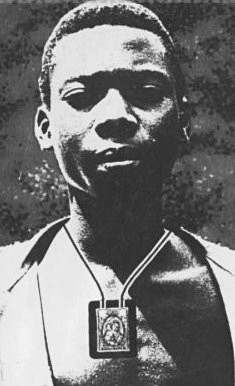
Bakanja accepted the Christian faith at eighteen years of age through the ministry of Cistercian missionaries in the Belgian Congo. He was a very devout convert and catechist. Bakanja had a great love for the Blessed Virgin Mary that he expressed through recitation of the rosary and by being invested in the Brown Scapular of Our Lady of Mount Carmel. His Belgian colonist employers had ordered him to cease sharing the gospel as well as remove the scapular that he wore as a witness to his faith. Isidore’s refusal to comply with the demands of his supervisor resulted in his being brutally beaten and chained.
As a result of the beating and persistent ill treatment he received, Bakanja’s wounds became severely infected. As his condition worsened his supervisor sought to keep him from the view of the plantation’s inspector. However, Bakanja was discovered and taken to the inspector’s home for treatment. His condition had deteriorated so severely, however, that no further medical attention could help him.
At this point Isidore told the inspector “tell them that I am dying because I am a Christian.” Missionaries in the area visited Isidore and urged him to forgive the supervisor. He assured them that he already had, declaring “When I am in heaven, I shall pray for him very much.”[1]
Go here to read the rest.


An excerpt from John Paul II’s homily (via Google translate, sorry):
You were a man of heroic faith, Isidore Bakanja, a young layman from Zaire. As a baptized person, called to spread the Good News, you knew how to share your faith and you bore witness to Christ with such conviction that, to your companions, you appeared as one of those valiant lay faithful who are catechists. Yes, Blessed Isidore, fully faithful to the promises of your Baptism, you were truly a catechist, you worked generously for “the Church in Africa and her evangelizing mission”.
…
Isidore, your participation in Christ’s Paschal Mystery, in the supreme work of his love, was total. Because you wanted to remain faithful at all costs to the faith of your baptism, you suffered the scourging like your Master. You have forgiven your persecutors, like your Master on the Cross; and you have shown that you are an architect of peace and reconciliation.
In an Africa painfully tried by ethnic strife, your shining example is an invitation to harmony and rapprochement among the children of the same heavenly Father. You have practiced fraternal charity towards all, without distinction of race or social condition; You earned the respect and respect of your companions, many of whom were not Christians. In this way he shows us the path of the necessary dialogue among men.
Thank you S-3049 for the find.