
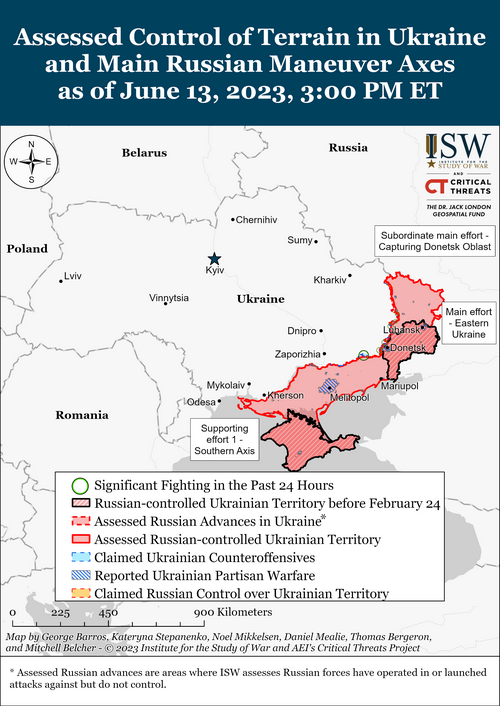
From The Institute For The Study of War:
Russian Offensive Campaign Assessment, June 13, 2023
Kateryna Stepanenko, Riley Bailey, Nicole Wolkov, George Barros, and Mason Clark
June 13, 2023, 8:35pm ET
Click here to see ISW’s interactive map of the Russian invasion of Ukraine. This map is updated daily alongside the static maps present in this report.
Click here to access ISW’s archive of interactive time-lapse maps of the Russian invasion of Ukraine. These maps complement the static control-of-terrain map that ISW produces daily by showing a dynamic frontline. ISW will update this time-lapse map archive monthly.
Note: The data cutoff for this product was 2:30 pm ET on June 13. ISW will cover subsequent reports in the June 14 Russian Offensive Campaign Assessment.
Ukrainian forces continued counteroffensive operations in at least three directions and made further limited territorial gains on June 13. Ukrainian Deputy Defense Minister Hanna Malyar reported that Ukrainian forces advanced by 250 meters northeast of Bakhmut and by 200 meters south of Bakhmut.[1] Malyar also reported that Ukrainian forces advanced 500-1,000m in the past 24 hours around the administrative border between Zaporizhia and Donetsk oblasts, liberating around three square kilometers of territory in the area.[2] Ukrainian General Staff Spokesperson Andriy Kovalev reported that Ukrainian forces have liberated over 100 square kilometers of territory since beginning counteroffensive operations.[3] Wagner financier Yevgeny Prigozhin claimed on June 13 that he assesses that Ukrainian forces have likely liberated more than 100 square kilometers.[4] Russian sources claimed that Ukrainian forces continued ground assaults southwest of Orikhiv and south of Hulyaipole in western Zaporizhia Oblast on the night of June 12 to 13.[5] Russian sources widely reported that the tempo of Ukrainian operations in the Orikhiv area has declined in recent days.[6]Ukrainian Ministry of Defense Environmental Safety Department and Mine Action representative Major Vladyslav Dudar reported on June 13 that Russian forces are regularly destroying small dams in localized areas of southern Ukraine to disrupt Ukrainian counteroffensive operations.[7]
Russian President Vladimir Putin met with 18 prominent Russian milbloggers and war correspondents to discuss the progress of the Russian invasion of Ukraine on June 13.[8] Putin largely met with milbloggers closely associated with the All-Russia State Television and Radio Broadcasting Company and other state-owned outlets, notably excluding milbloggers who have been more critical of Putin’s war effort.[9] Putin addressed several key milblogger concerns relating to the Ukrainian counteroffensive, Russian objectives in Ukraine, Russian mobilization and the possibility of imposing martial law, the formalization of private military companies (PMCs), and hostile incursions into Belgorod Oblast.
Putin discussed the progress of the Ukrainian counteroffensive and signaled that he believes Russia can outlast Western military support for Ukraine. Putin stated that Russian objectives have not fundamentally changed, reiterating boilerplate rhetoric and false narratives accusing Ukraine and NATO of initiating the war.[10] Putin added that the West can push Ukraine into negotiations with Russia by stopping the supplies of military aid to Ukraine.[11] Putin noted that Ukrainian forces launched a ”massive” counteroffensive on June 4 and noted that Ukrainian forces attacked in southwestern Donetsk and Zaporizhia oblasts, claiming they suffered significant losses. Putin claimed that Ukraine has lost 160 tanks and claimed that 30 percent of Ukraine’s casualties are killed in action, whereas Russian forces have lost only 54 tanks. Putin may be attempting to systematically amplify and misrepresent Ukrainian losses of Western military equipment to portray Ukraine’s counteroffensive as failed and discourage the West from continuing to support Ukraine. Former Russian officer and ardent ultranationalist Igor Girkin observed that Putin’s comments indicate that the Russian Ministry of Defense (MoD) continues to misinform him about the true situation on the battlefield.[12]
Putin indicated that he is unwilling to announce a second wave of mobilization or declare martial law, despite maintaining his maximalist objectives in Ukraine. Putin acknowledged that some Russian “public figures” are discussing the urgent need for mobilization but noted that there “is currently no need today” for mobilization. Putin boasted about Russian contract service recruitment efforts using rhetoric consistent with ISW’s previous assessments that Putin is disinterested in announcing another mobilization wave and is instead prioritizing volunteer recruitment.[13] Putin also downplayed milbloggers’ concern over the Kremlin’s decision to not declare full-scale martial law throughout Russia, stating that Russia needs to expand its law enforcement rather than declare martial law. ISW continues to assess that Putin is a risk-averse actor who is hesitant to upset Russian society by ordering another mobilization wave or establishing martial law throughout Russia, indicating that Putin has not yet decided to fully commit to fighting a total war. Putin’s statements likely aim to reassure his constituencies that he does not intend to expand the “special military operation” further.
Putin aimed to assuage widespread discontent in the Russian information space about limited cross border raids by pro-Ukraine forces into Belgorod Oblast, drone strikes across Russia, and border security in general. Putin stated that Russian forces do not plan to divert forces from other sectors of the frontline in Ukraine to Belgorod and other border oblasts in response to border incursions and drone strikes on Russian territory.[14] Putin stated that Russian leadership is considering creating a buffer zone within Ukraine to prevent Ukrainian forces from reaching Russian territory, but caveated the suggestion by saying that Russian officials will not immediately create a buffer zone and will examine how the situation develops.[15] Russian officials have previously responded to limited tactical activity in Belgorod Oblast and other border oblasts by calling for a Russian offensive to push Ukrainian forces away from the international border with Russia in Kharkiv Oblast.[16] Putin’s comments indicate that the Kremlin does not intend to react to cross-border operations in an effort to preserve forces for combat in Ukraine, despite growing discontent within Russia prompted by the raids. Putin also confirmed that Russian conscripts are serving in Belgorod Oblast and that Colonel General Alexander Lapin commanded conscripts to repel the pro-Ukrainian all-Russian limited raids in Belgorod Oblast. Russian forces are likely deploying conscripts to serve in border oblasts due to a lack of reserves and an unwillingness to transfer forces away from the frontline elsewhere in Ukraine. ISW previously assessed that limited raids and border shelling in Belgorod Oblast have become a notable focal point for criticism against the Russian military leadership, and Putin is likely attempting to address critiques that he has ignored the situation there in order to insulate himself from further criticism.[17]
Putin discussed the importance of formalizing volunteer formations, supporting the Russian MoD’s measures to centralize its control over operations in Ukraine. Putin claimed that all volunteer formations serving in Ukraine must sign military contracts with the Russian MoD to “bring everything in line with common sense, established practice, and the law” and to ensure that individual volunteers can legally receive state social benefits.[18] Putin emphasized that the Russian government cannot provide social guarantees to volunteer structures without signed contracts.[19] Putin’s emphasis on the legality of volunteer formations suggests that Putin may be intending to either assert direct control over or set conditions to ban state assistance to select private military organizations (PMCs) such as the Wagner Group, which are technically illegal under the Russian law.
Putin is likely continuing to publicly engage with, and platform select pro-Kremlin milbloggers to further leverage the community to expand his support among Russian ultranationalists. Putin previously held a closed-door meeting with milbloggers on June 17, 2022, to defuse growing discontent about Russian setbacks in Ukraine, and has occasionally interacted with the pro-Kremlin milblogger community since.[20] ISW previously assessed that the milblogger community rose to prominence likely as a direct result of the Kremlin’s failure to establish an effective social media presence as well as its general failure to prepare the Russian public for a serious and protracted war.[21] The Kremlin has protected Russian milbloggers from criticism and calls for censorship and has rewarded select milbloggers with official positions to co-opt their audience and gain access to their close ties to prominent nationalist and pro-war groups.[22] Putin’s highly publicized meeting with the milbloggers is reflective of the Kremlin’s promotion of this group in the previous year and suggests that Putin intends to further elevate their standing. Putin is likely setting information conditions to prevent potential lines of attack against the Kremlin in the event of Russian failure. Putin may also be increasingly aware that committed pro-war figures are his key constituency as he calls on the Russian public to prepare for a protracted war in Ukraine. The Kremlin is likely aware that key pro-war figures will be crucial to rallying the rest of society to that effort, and Putin’s engagement with these milbloggers may suggest that the Kremlin will increasingly rely on the wider ultranationalist community to maintain support for the war effort.
Russian sources claimed that a Ukrainian missile strike killed Chief of Staff of the 35th Combined Arms Army (Eastern Military District) Major General Sergei Goryachev in Zaporizhia Oblast.[23] ISW has observed other elements of the Eastern Military District including elements of the 58th Combined Arms Army and 5th Combined Arms Army operating in western Zaporizhia Oblast.[24] Goryachev’s reported death in Zaporizhia Oblast could suggest that Russian forces have dedicated elements of the 35th Combined Arms Army to operations in Zaporizhia Oblast and that some Russian senior military command officials continue to operate close to the frontline and remain exposed to accurate Ukrainian strikes.[25]
Russian forces conducted missile and drone strikes across Ukraine on June 13. The Ukrainian General Staff reported that Russian forces launched 16 Kh-101/555 cruise missiles and four Shahed 131/136 drones that targeted infrastructure facilities in Kharkiv Oblast and residential buildings in Kryvyi Rih.[26] The Ukrainian General Staff reported that Ukrainian forces destroyed 11 Kh101/555 missiles and one Shahed drone.[27]
Russian authorities continue to express increasing concern over information related to Russia’s defense industrial base (DIB). The Russian Federal Security Service (FSB) reportedly arrested two defense sector employees for allegedly collaborating with Ukraine and Germany.[28] A Russian milblogger claimed that the FSB arrested an engineer at the end of May who worked in the defense industry and collaborated with the Ukrainian Main Intelligence Directorate (GUR).[29] Russian opposition news outlet SOTA reported that the FSB arrested a former employee of a defense enterprise for allegedly providing information to Germany about the Russian defense industry.[30] ISW has previously reported on Russian authorities arresting individuals with reported access to DIB-related information.[31]
Key Takeaways
- Ukrainian forces continued counteroffensive operations in at least three directions and made further limited territorial gains on June 13.
- Russian President Vladimir Putin met with 18 prominent Russian milbloggers and war correspondents to discuss the progress of the Russian invasion of Ukraine on June 13.
- Putin discussed the progress of the Ukrainian counteroffensive and signaled that he believes Russia can outlast Western military support for Ukraine.
- Putin indicated that he is unwilling to announce a second wave of mobilization or declare martial law, despite maintaining his maximalist objectives in Ukraine.
- Putin aimed to assuage widespread discontent in the Russian information space about limited cross-border raids by pro-Ukraine forces into Belgorod Oblast, drone strikes across Russia, and border security in general.
- Putin discussed the importance of formalizing volunteer formations, supporting the Russian MoD’s measures to centralize its control over operations in Ukraine.
- Putin is likely continuing to publicly engage with, and platform select pro-Kremlin milbloggers to further leverage the community to expand his support among Russian ultranationalists.
- Russian sources claimed that a Ukrainian missile strike killed Chief of Staff of the 35th Combined Arms Army (Eastern Military District) Major General Sergei Goryachev in Zaporizhia Oblast.
- Russian forces conducted missile and drone strikes across Ukraine on June 13.
- Russian authorities continue to express increasing concern over information related to Russia’s defense industrial base (DIB).
- Russian forces continued ground attacks on the Kreminna frontline but did not conduct offensive operations on the Kupyansk-Svatove line.
- Ukrainian forces continued to advance on Bakhmut’s northern and southern flanks, while Russian forces launched counterattacks in the vicinity of Bakhmut.
- Russian forces continued offensive operations on the Avdiivka-Donetsk City line and are transferring additional forces from east (left) bank Kherson Oblast to reinforce the direction.
- Russian forces conducted limited ground attacks near the administrative border of Donetsk and Zaporizhia oblasts.
- Russian President Vladimir Putin claimed that the Russian military has recruited 150,000 contract servicemembers as well as over 6,000 volunteers since January 2023.
- Russian occupation officials in east (left) bank Kherson Oblast are reportedly continuing evacuation efforts, although are likely continuing to deny services to some residents in flooded areas.
Go here to read the rest. A kettle battle of encirclement seems to be developing around Bakhmut. The Russians are unwilling to retreat. Keep your eyes on it.


Ukrainian blogger Denys Davidov, who has not sugarcoated the cost that Ukrainians are paying, says that heavy Ukrainian losses have occurred in the present counteroffensive, as of course, Ukrainians are attacking well-prepared Russian defensive lines.
There is evidence, however, of significant advancement in the south, generally north of Melitopol , around the town of Velyka Novosilka, where is the Ukrainians have penetrated at least the first Russian line of defense and the Russians seem to be falling back. Wagner commander Prigozhin has been warning that the Russian army will collapse if the Ukrainians are able to make any headway through the first lines of defense, of course, using this self-serving argument to try to take over more of the military complex armaments and manpower.
But apparently the Ukrainians have been very effectively targeting command centers, missile groups, and supply depots. They also have very superior Intel about where the Russian leadership and command centers are located. So besides taking out the Russian Major Gen. Sergey Goryachev, who had been
in charge of the Southern sector, until a few days ago when he was killed, yesterday they hit and likely killed Chechnyan dictator Kadyrov’s “right-hand man,” Adam Delimkhanov, in a drone attack. It is likely that he is dead, because Kadyrov has actually been forced to ask the Ukrainian command for information on Delimkhanov.
Needless to say that the Ukrainians have a special hatred for the mercenary Muslim Chechnyans, so information may not be quickly forthcoming