
From The Institute For The Study of War:
Russian Offensive Campaign Assessment, June 10, 2023
Riley Bailey, Grace Mappes, Karolina Hird, and Mason Clark
June 10, 2023, 6:45pm ET
Click here to see ISW’s interactive map of the Russian invasion of Ukraine. This map is updated daily alongside the static maps present in this report.
Click here to access ISW’s archive of interactive time-lapse maps of the Russian invasion of Ukraine. These maps complement the static control-of-terrain map that ISW produces daily by showing a dynamic frontline. ISW will update this time-lapse map archive monthly.
Note: The data cutoff for this product was 1:30pm ET on June 10. ISW will cover subsequent reports in the June 11 Russian Offensive Campaign Assessment.
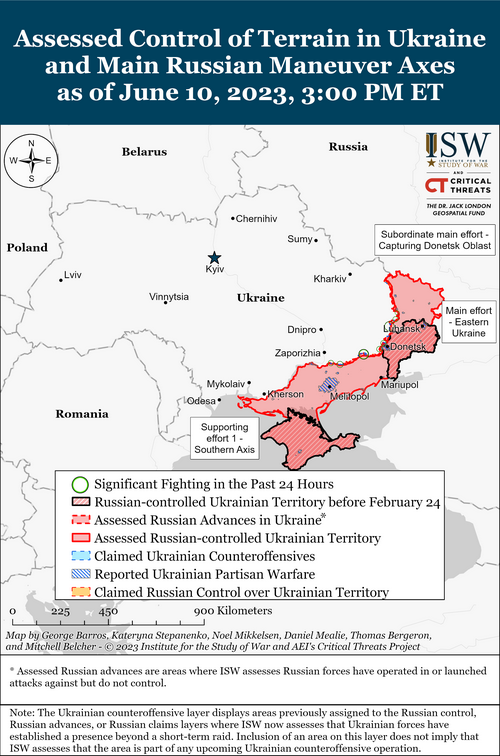
Ukrainian forces conducted counteroffensive operations in at least four areas of the front on June 10. Russian sources reported Ukrainian activity in Luhansk Oblast near Bilohorivka.[1] Ukrainian Eastern Group of Forces Spokesperson Colonel Serhiy Cherevaty noted that Ukrainian forces advanced up to 1,400m in unspecified areas of the Bakhmut front, and Russian milbloggers reported Ukrainian advances northwest and northeast of Bakhmut.[2] The Russian Ministry of Defense (MoD) and other Russian sources claimed that Ukrainian troops conducted localized attacks in the Donetsk-Zaporizhia Oblast border area, particularly in the Velyka Novosilka area.[3] Geolocated footage posted on June 10 additionally indicates that Ukrainian forces in western Zaporizhia Oblast made localized gains during counterattacks southwest and southeast of Orikhiv, and Russian milbloggers continued to claim that Russian forces in this area are successfully defending against attempted Ukrainian advances.[4]
Russian forces in Zaporizhia Oblast are continuing to defend against Ukrainian attacks in accord with sound tactical defensive doctrine. A Russian milblogger claimed that Russian defensive operations in southern Ukraine are relying on three main components: early detection and destruction of Ukrainian assault formations, massive use of anti-tank weapons, and mining of territories near Russian defensive positions.[5] The milblogger claimed that minefields have a twofold effect by initially damaging Ukrainian armored vehicles when they attempt to breakthrough the minefield and then again when they retreat from the area.[6] ISW previously assessed that Russian forces responded to the start of Ukrainian counteroffensive operations in western Zaporizhia Oblast following established Russian doctrine, which calls for a first echelon of troops to repel or slow attacking forces with minefields, fortifications, and strongpoints, and a second echelon of forces to counterattack against any enemy breakthrough.[7] Russian reporting of Ukrainian assaults in southern Ukraine in recent days suggests a pattern in which Ukrainian forces conduct limited breakthroughs and temporarily occupy new positions before Russian forces later recapture or push Ukrainian forces out of those positions.[8] This tactical pattern indicates that Russian forces have likely maintained doctrinally sound defensive operations in southern Ukraine, though as ISW previously reported, defending units of the 58th CAA are likely some of the most effective Russian units currently deployed in Ukraine.[9]
Russian milbloggers continue to highlight reported superior Russian electronic warfare (EW) capabilities as key to disrupting Ukrainian attacks. Russian milbloggers claimed that Russian EW units are disrupting Ukrainian communications as well as aviation units and alleged that some Ukrainian mechanized groups were not prepared to fight without communications or with suppressed GPS.[10] Another milblogger claimed that Ukrainian forces attempted their own “electronic counter measures” against Russian reconnaissance and control capabilities in areas where there are Ukrainian assaults but that these attempts were unsuccessful.[11] Russian forces have reportedly successfully improved their EW use throughout the invasion of Ukraine.[12]
Russian sources claimed that Ukrainian forces have tactical advantages in conducting assaults at night due to Western-provided equipment with superior night optics systems. A prominent Russian milblogger claimed that Ukrainian forces are launching assaults at night because Western-provided equipment provides Ukrainian forces with “excellent” night vision optics.[13] Zaporizhia Oblast occupation official Vladimir Rogov also claimed that night assaults allow Ukrainian forces to more effectively use Western-provided equipment.[14] Russian sources have widely claimed that Ukrainian forces have started or intensified assaults at night in recent days, and Ukrainian forces may be increasingly leveraging the advantages provided by Western systems.[15]
Russian sources continue to highlight the role of scarce military district-level Russian TOS-1A thermobaric artillery systems against Ukrainian attacks, though Ukrainian forces destroyed at least two of these key systems in recent days. Geolocated footage published on June 8 and 9 confirms that Ukrainian forces have used Western precision munitions (reportedly the Paladin 155mm artillery system) to destroy at least two Russian TOS-1A thermobaric artillery systems – highly destructive but scarce artillery assets controlled at the Russian military district level – in western and eastern Zaporizhia Oblast during the Ukrainian counteroffensive.[16] The Russian Ministry of Defense (MoD) highlighted the role of Russian thermobaric artillery systems in striking Ukrainian positions on the western Zaporizhia Oblast frontline.[17] A Russian milblogger claimed that Russian thermobaric artillery units have consistently fired on Ukrainian forces on the Donetsk-Zaporizhia Oblast administrative border and in western Zaporizhia Oblast for the past several days and characterized the units as essential to repelling Ukrainian frontal assaults.[18] Russian forces’ apparent reliance on specific artillery assets is noteworthy, as precision Ukrainian strikes on these systems could potentially complicate Russian defensive capabilities and Russian forces are unlikely to possess enough TOS-1A systems to provide the same level of fire support all along the front line.
Ukrainian forces are currently attempting an extraordinarily difficult tactical operation – a frontal assault against prepared defensive positions, further complicated by a lack of air superiority – and these initial assaults should not be extrapolated to predict all Ukrainian operations. Ukrainian forces are unsurprisingly taking casualties in initial attacks against some of the best-prepared Russian forces in Ukraine. However, initial attacks – and particularly selected footage that Russian sources are intentionally disseminating and highlighting – are not representative of all Ukrainian operations. The Russian military remains dangerous and Ukrainian forces certainly face a hard fight, but Ukraine has not yet committed the vast majority of its counteroffensive forces and Russian defenses are not uniformly strong along all sectors of the front line.
Chechen Republic Head Ramzan Kadyrov established a clear rhetorical line between criticizing the Russian MoD and criticizing Russian President Vladimir Putin in a statement on June 9. Kadyrov published a post to Telegram on June 9 outlining the details of a private phone call that occurred between Kadyrov and Wagner Group financier Yevgeny Prigozhin in late May after Kadyrov and Prigozhin reportedly reached an agreement for Chechen forces to replace Wagner in Bakhmut.[19] The interactions between Kadyrov and Prigozhin rapidly deteriorated in subsequent days, but Prigozhin claimed that he personally called Kadyrov on June 1 to resolve their dispute.[20] Kadyrov claimed on June 9 that he genuinely believed he was doing his best to help Prigozhin by offering for Chechen troops to replace Wagner fighters but that Prigozhin’s tone towards Kadyrov and the Chechen troops changed suddenly, and Kadyrov felt as though he had to personally mitigate.[21] Kadyrov also noted that he himself has occasionally criticized the Russian MoD but rhetorically drew a line against criticizing Putin directly, claiming he has always understood that Putin’s position as the Supreme Commander-in-Chief of the Russian Armed Forces means that Putin has the best understanding of battlefield realities.[22] Kadyrov then criticized Wagner for being a weak and ineffective force when faced with the same operational restraints as Chechen forces in previous phases of the war.[23] Kadyrov’s message likely sought to signal his loyalty to Putin and portray Prigozhin as further at odds with the overall Russian military leadership.
Russian forces targeted a Ukrainian operational airfield during another missile and drone strike on Ukraine on the night of June 9 to 10. Ukrainian Air Force Command reported on June 10 that Russian forces launched eight ground-based missiles of various types and 35 Shahed-type drones at Ukraine from the northern and southern directions and hit an operational airfield in Poltava Oblast with Iskander ballistic missiles, cruise missiles, and Iranian-made drones.[24] Poltava Oblast Head Dmytro Lunin noted that the strike damaged airfield infrastructure and other unspecified equipment.[25] Former Donetsk People’s Republic (DNR) spokesperson Eduard Basurin praised the strike for “finally” targeting Ukrainian airfields.[26] ISW recently assessed that Russia is conducting a new air campaign to target Ukrainian counteroffensive capabilities, and Russian sources will likely use reporting of such strikes to frame the current air campaign as proactive and effective over the backdrop of Ukrainian counterattacks throughout the theater.[27]
Key Takeaways
- Ukrainian forces conducted counteroffensive operations in at least four areas of the front on June 10.
- Russian forces in Zaporizhia Oblast are continuing to defend against Ukrainian attacks in accord with sound tactical defensive doctrine.
- Russian milbloggers continue to highlight reported superior Russian electronic warfare (EW) capabilities as key to disrupting Ukrainian attacks.
- Russian sources claimed that Ukrainian forces have tactical advantages in conducting assaults at night due to Western-provided equipment with superior night optics systems.
- Russian sources continue to highlight the role of scarce military district-level Russian TOS-1A thermobaric artillery systems in defending against Ukrainian counteroffensive operations, though Ukrainian forces destroyed at least two of these key systems in recent days.
- Ukrainian forces are currently attempting an extraordinarily difficult tactical operation – a frontal assault against prepared defensive positions, further complicated by a lack of air superiority – and these initial assaults should not be extrapolated to predict all Ukrainian operations.
- Chechen Republic Head Ramzan Kadyrov established a clear rhetorical line between criticizing the Russian Ministry of Defense (MoD) and criticizing Russian President Vladimir Putin.
- Russian forces targeted a Ukrainian operational airfield during another missile and drone strike on Ukraine on the night of June 9 to 10.
- Russian forces made marginal advances northeast of Kupyansk and continued ground attacks near Kreminna.
- Russian and Ukrainian forces both continued ground attacks in the Bakhmut area.
- Russian forces continued limited ground attacks along the Avdiivka-Donetsk City line.
- Ukrainian forces continued limited ground attacks near the administrative border between Donetsk and Zaporizhia oblasts and have made marginal gains in the area as of June 10.
- The Russian Ministry of Defense (MoD) announced on June 10 that it plans to formalize the organization of volunteer formations.
- Russia is further consolidating a centralized media apparatus in occupied areas.
Go here to read the rest. The Ukrainians making attacks at night is interesting. The Russians have never liked night operations.


Ukrainian blogger Denis Davidov reports that, besides limited Ukrainian advances in the southern front sector near the Dnipro River and Melitopol, a concerted Ukrainian missile attack on the Russian Southern Command HQ in Zaporizhia Oblast effected the killing of Major Gen. Sergey Vladimirovich Goryachev, who he says was head of the Russian Southern Command. Goryachev had a long history of military experience, being a former tank brigade commander and previously commanded in the 2nd Chechen War.
It is far too soon to predict the outcome of this Ukrainian counteroffensive, but so far Russian defensive forces have not broken and have not evidenced any signs of being routed.