
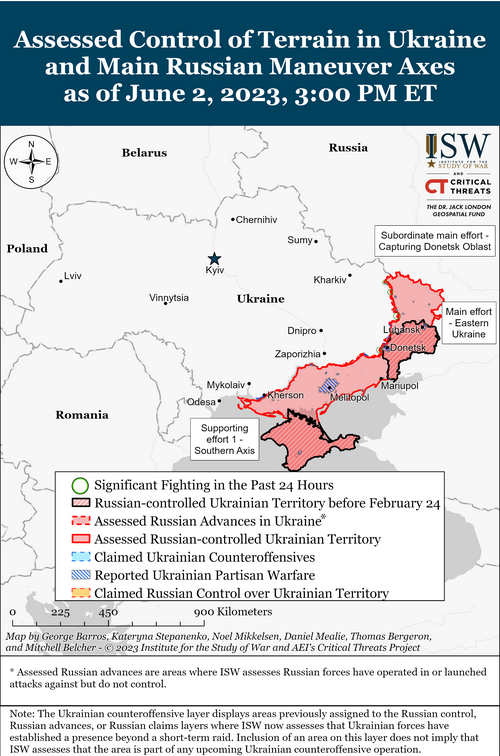
From The Institute For The Study of War:
Russian Offensive Campaign Assessment, June 2, 2023
Layne Philipson, Riley Bailey, Grace Mappes, Karolina Hird, and Fredrick W. Kagan
June 2, 2023, 6pm ET
Click here to see ISW’s interactive map of the Russian invasion of Ukraine. This map is updated daily alongside the static maps present in this report.
Click here to access ISW’s archive of interactive time-lapse maps of the Russian invasion of Ukraine. These maps complement the static control-of-terrain map that ISW produces daily by showing a dynamic frontline. ISW will update this time-lapse map archive monthly.
Note: The data cutoff for this product was 1pm ET on June 2. ISW will cover subsequent reports in the June 3 Russian Offensive Campaign Assessment.
The Russian Ministry of Defense (MoD) continues to respond disproportionately to limited raids into Russian territory, likely to project confidence and competence in the MoD’s ability to respond to perceived threats. The Russian MoD issued a second update about the June 1 Shebekino, Belgorod Oblast border raid, largely fixating on the timeliness and scope of the Russian response to the raid.[1] The MoD claimed that additional Russian Western Military District (WMD) elements reinforced the border area within an hour of the start of the raid and conducted heavy air, artillery, and flamethrower strikes against the raiding units and their reserves. The MoD claimed that over 135 people and 35 vehicles in total conducted the raids and that various Russian defensive efforts – including small arms fire and mines – repelled the raids. The MoD later celebrated the commander of an unspecified motorized rifle battalion, Lieutenant Colonel Alexander Nikitin, for leading the defensive effort, likely to preempt attempts to attribute the “victory” achieved by Belgorod border defense on Russian Colonel General Alexander Lapin as the information space did during the May 23 raid.[2] The Russian MoD’s fixation on portraying Russian forces and the Russian military command as capable defenders of Russia likely reflects internal and broader information space anxiety over the coming Ukrainian counteroffensive as well as any reverberating informational impacts from any failures to defend against Ukrainian counterattacks.
Select Russian milbloggers continue to use the situation in Belgorod Oblast to criticize Russian leadership while others downplayed the recent raids. A Wagner-affiliated milblogger stated that the Russian MoD is not treating Belgorod Oblast like Russian territory and claimed that it is only adding to the list of settlements affected by Ukrainian shelling.[3] A milblogger called on Russian forces to destroy increasingly well-equipped Ukrainian forces at their deployment points along the border and not to lie in their reports about the situation in the area.[4] Some milbloggers stated that Russian forces have responded well to the raids, which they claim are merely “terrorist attacks” aimed at creating a psychological impact as opposed to securing concrete territorial goals.[5] A prominent Russian milblogger absurdly claimed that Ukrainian forces have concluded that it is too risky to start the counteroffensive now after observing Russia’s responses to recent probing efforts.[6] The raids, any Ukrainian probing efforts, and Russian responses in the past few weeks have all been on an extremely small scale compared with the announced forces Ukraine is reportedly preparing for the counter-offensive. The Russian hyperfocus on minor tactical engagements highlights Russian nervousness and insecurity about the forthcoming counteroffensive.
Russian forces conducted another series of strikes against Ukraine using cruise missiles and Iranian-made drones on the night of June 1-2. The Ukrainian General Staff reported that Russian forces launched 15 Kh-101/555 missiles at Kyiv City from Tu-95 aircraft over the Caspian Sea and that Ukrainian air defense destroyed all 15 missiles.[7] The Ukrainian General Staff also reported that Ukrainian forces shot down all 21 Shahed 131/136 drones that Russian forces launched at Kyiv from southern Ukraine.[8] Ukrainian Air Force Spokesperson Colonel Yuriy Ihnat stated that Russian forces are attempting to attack in atypical patterns and at unexpected times to deceive Ukrainian air defense, but that newly supplied air defense systems nonetheless allow Ukrainian forces to shoot down all Russian missiles flying along a ballistic trajectory.[9] Ukrainian Southern Forces Joint Press Center Head Nataliya Humenyuk stated on June 2 that Ukrainian air defenses shot down a Russian drone over Mykolaiv Oblast during the June 1 to 2 overnight strikes.[10]
Head of the Russian Main Organizational and Mobilization Directorate of the General Staff Colonel General Yevgeny Burdinsky announced that the Russian military will form two new military districts and other new formations by the end of 2023. The Russian Ministry of Defense’s (MoD’s) “Military Commissariats of Russia” journal published an article by Burdinsky in its June 2023 edition in which he stated that it is necessary for Russian forces to create the Moscow and Leningrad military districts and organize and staff new combined arms and air armies, army corps, the Azov naval regional formation, five divisions, and 26 brigades in 2023.[11] Burdinsky emphasized that the main organizational task for the MoD remains contract service recruitment and the implementation of conscription, however.[12] Burdinsky did not expound upon how the Russian military plans to generate the necessary personnel and equipment required to form these new formations and it is unclear if Burdinsky’s statements were meant to represent a formal MoD deadline for the creation of the new formations.
Budinsky’s statements likely aim to reintroduce and reamplify Russian Defense Minister Sergei Shoigu’s standing proposals to significantly expand the Russian military. Shoigu delivered a series of public proposals at the MoD’s Collegium on December 21, 2022 aimed at significantly increasing the size of the Russian military which included the reestablishment of the Moscow and Leningrad military districts as well as the formation of a new army corps.[13] Shoigu proposed that the Russian Armed Forces increase its strength to 1.5 million servicemen, including 695,000 contract servicemen, but did not specify a timeline for any of his proposals.[14] Shoigu also proposed an increase in the age of conscription, a measure that Russian officials have decided to implement in a phased manner over the course of three years instead of by the end of the year.[15] The creation of two military districts and these formations is a significant undertaking, and the Russian MoD’s current force generation efforts do not signal that the MoD intends to generate the necessary number of personnel to fulfill these tasks by the end of 2023.
Both a Kremlin-affiliated milblogger and Igor Girkin, an ardent nationalist milblogger who is increasingly critical of the Kremlin, questioned where the MoD plans to acquire the personnel and equipment from to create these new formations. [16] Girkin stated that 26 brigades would require 80,000 personnel, a figure roughly correct if brigades were formed at full staff with 3,000 personnel per brigade.[17] Girkin added that five divisions would require another 40,000 personnel and argued that the MoD would have to conduct another mobilization wave to generate the roughly 120,000 required personnel.[18] ISW has previously assessed that Russian President Vladimir Putin is likely hesitant to launch another mobilization wave and that the MoD’s current hybrid force generation effort of contract service recruitment and crypto mobilization is aimed at avoiding such a mobilization wave.[19] The Russian MoD is highly unlikely to institute any of Shoigu’s long-term force restructuring and expansion proposals by the end of 2023 with the possible exception of re-establishing the Moscow and Leningrad military districts.
Russian sources appear to be reorienting the debate about the attribution of responsibility for small-scale tactical gains in the Bakhmut area to an ongoing offensive operation to capture Marinka, a small, almost leveled settlement where Russian forces have struggled to advance since the start of the full-scale invasion of Ukraine. A prominent Russian milblogger stated that there are disputes within the Russian information space over who took more control of Marinka even though Russian forces have not yet fully captured the settlement.[20] A Wagner-affiliated milblogger claimed the elements of the 150th and 20th Motorized Rifle Divisions (8th Combined Arms Army, Southern Military District) and the Donetsk People’s Republic (DNR) are primarily responsible for the gains around Marinka.[21] The milblogger claimed that the DNR‘s 100th Brigade, Sparta Battalion, and the ”Kaskad” and ”Rusich” Operational Tactical Combat Formations deserve responsibility for gains around Marinka as well.[22]
These discussions about responsibility coincide with the reported arrival of Chechen forces to assume responsibility of the Donetsk front and complete the capture of Marinka and other settlements in the area.[23] These discussions are likely aimed at undermining Kadyrov’s ability to use any subsequent tactical gains to elevate his standing and reintroduce his paramilitary forces as a main irregular offensive force following the culmination of Wagner forces and their withdrawal from the frontlines.[24] Many irregular formations, primarily DNR forces, have served on the Donetsk front and may be resentful of Kadyrov’s attempt to assume responsibility for any success following months of attritional offensives.[25] This discussion around Marinka also coincides with a concerted attack from Chechen commanders against Wagner Group financier Yevgeny Prigozhin, which has generated debates between Chechen and Wagner commanders about which forces have been more successful fighting in Ukraine.[26] Prigozhin routinely emphasized Wagner’s responsibility for tactical gains around Bakhmut throughout the offensive to capture the city to advocate for more supplies for Wagner and increased influence.[27] Other irregular forces may be trying to replicate this informational campaign in Marinka and elsewhere in Ukraine and are likely competing amongst each other for envisioned favor from the Kremlin. The capture of Bakhmut, despite offering no operational advantages, did allow the Kremlin to present a Russian victory, if only temporarily, to the Russian public. The capture of Marinka, a settlement with a pre-war population of 10,000 people and with no tactical or operational significance, would likely present marginal informational benefit to the Kremlin at most. Russian forces have advanced less than 2km from 2014-controlled territory around Marinka since the start of the full-scale invasion, suggesting that this entire conversation is premature.
US Secretary of State Antony Blinken said on June 2 that calls for a ceasefire are unacceptable because they will freeze the current lines in place and enable Putin to consolidate control of occupied areas and prepare for future attacks on Ukraine.[28] Blinken noted that the war is a strategic failure for Russia and Russia is worse off militarily, economically, and geopolitically than before the start of its full-scale invasion – all contrary to Russian President Vladimir Putin’s broader strategic aims. Blinken noted that the war undermined many of Putin’s broader goals, including to divide NATO, foster a partnership with China, and strengthen the Russian military. Blinken stated that Russian forces in Ukraine suffered 100,000 killed and wounded “in a meat grinder of its own making” just within the past six months. Blinken stated that Putin believes he can outlast Ukraine and its supporters but reiterated that NATO remains committed to supporting Ukraine, as “Ukraine will never be Russia.”
Key Takeaways
- The Russian Ministry of Defense (MoD) continues to respond disproportionately to limited raids into Russian territory, likely to project confidence and competence in the MoD’s ability to respond to perceived threats.
- Select Russian milbloggers continue to use the situation in Belgorod Oblast to criticize Russian leadership while others downplayed the recent raids.
- Russian forces conducted another series of strikes against Ukraine using cruise missiles and Iranian-made drones on the night of June 1-2.
- Head of the Russian Main Organizational and Mobilization Directorate of the General Staff Colonel General Yevgeny Burdinsky announced that the Russian military will form two new military districts and other new formations by the end of 2023. Budinsky’s statements likely aim to reintroduce and reamplify Russian Defense Minister Sergei Shoigu’s standing proposals to significantly expand the Russian military.
- Russian sources appear to be reorienting the debate about the attribution of responsibility for small-scale tactical gains in the Bakhmut area to an ongoing offensive operation to capture Marinka, a small, almost leveled settlement where Russian sources have struggled to advance since the start of the full-scale invasion of Ukraine. These discussions about responsibility coincide with the reported arrival of Chechen forces to assume responsibility of the Donetsk front and complete the capture of Marinka and other settlements in the area.
- US Secretary of State Antony Blinken said on June 2 that calls for a ceasefire are unacceptable because they will freeze the current lines in place and enable Putin to consolidate control of occupied areas and prepare for future attacks on Ukraine.
- Russian forces continued ground attacks in the Kupyansk and Kreminna directions.
- Russian forces conducted ground attacks in Marinka.
- A Russian source claimed that Ukrainian forces made territorial gains during limited counterattacks in western Donetsk Oblast.
- Russian sources claimed that Ukraine struck the port area in occupied Berdyansk, Zaporizhia Oblast, with Storm Shadow missiles.
- Ukrainian sources continue to report that Russian cadets from higher military academies are deploying to areas near the Ukrainian border within Russia.
- Russian occupation authorities continue to forcibly transport Ukrainian children to Russia under the guise of medical rehabilitation schemes.
Go here to read the rest. Everything again seems to be in a holding pattern awaiting the Ukrainian offensive.

