
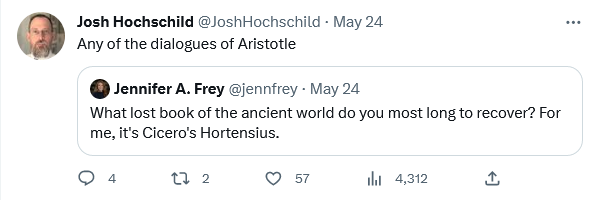
The lost books of Livy’s History of Rome. But, then again:
Most ancient historians agree that pre-battle speeches were made by Roman and Greek commanders in order to inspire the morale of their troops. Well and good. However, the speeches that have been handed down to us read suspiciously like what the historians have written rather than the actual speeches themselves. I have always wondered what those speeches were like. Robert Graves, a British novelist who survived serving as a combat infantry officer in the British Army on the Western Front, was curious also, and in his fictional memoir of the Roman Emperor Claudius gave an answer:
Livy: ‘Can’t I? Indeed I can,’ said Livy. ‘Do you mean to say that I mustn’t write a history with an epic theme because that’s a prerogative of poetry, or put worthy eve-of-battle speeches in the mouths of my generals because to compose such speeches is the prerogative of oratory?’
Pollio: ‘That is precisely what I do mean. History is a true record of what happened, how people lived and died, what they did and said; an epic theme merely distorts the record. As for your generals’ speeches they are admirable as oratory but damnably unhistorical: not only is there no particle of evidence for any one of them, but they are inappropriate. I have heard more eve-of-battle speeches than most men and though the generals that made them, Caesar and Antony especially, were remarkably fine platform orators, they were all too good soldiers to try any platform business on the troops. They spoke to them in a conversational way, they did not orate. What sort of speech did Caesar make before the Battle of Pharsalia? Did he beg us to remember our wives and children and the sacred temples of Rome and the glories of our past campaigns? By God, he didn’t! He climbed up on the stump of a pine-tree with one of those monster-radishes in one hand and a lump of hard soldiers’ bread in the other, and joked, between mouthfuls. Not dainty jokes but the real stuff told with the straightest face: about how chaste Pompey’s life was compared with his own reprobate one. The things he did with that radish would have made an ox laugh. I remember one broad anecdote about how Pompey won his surname The Great – oh, that radish! – and another still worse one about how he himself had lost his hair in the Bazaar at Alexandria. I’d tell you them both now but for this boy here, and but for your being certain to miss the point, not having been educated in Caesar’s camp. Not a word about the approaching battle except just at the close: “Poor old Pompey! Up against Julius Caesar and his men! What a chance he has”!’
Livy: ‘You didn’t put any of this in your history,’ said Livy.
Pollio: ‘Not in the public editions,’ said Pollio. ‘I’m not a fool. Still, if you like to borrow the private Supplement which I have just finished writing, you’ll find it there. But perhaps you’ll never bother. I’ll tell you the rest: Caesar was a wonderful mimic, you know, and he gave them Pompey’s dying speech, preparatory to falling on his sword (the radish again – with the end bitten off). He railed, in Pompey’s name, at the Immortal Gods for always allowing vice to triumph over virtue. How they laughed! Then he bellowed: “And isn’t it true, though Pompey says it? Deny it if you can, you damned fornicating dogs, you!” And he flung the half-radish at them. The roar that went up! Never were there soldiers like Caesar’s. Do you remember the song they sang at his French triumph?
“Home we bring the bald whoremonger,
Romans, lock your wives away.” ’
I, Claudius, Robert Graves


I’d like to find the lesser books associated with the Troy cycle, from which passages are quoted here and there in the Greek poets. I’d like Chinese experts to find the old books burned by their crazy first emperor, to erase memories of the times of the Warring States he didn’t want.
Great. Now I have Graves’ Leion song inextricably bound together in my mind with the melody of “Men of Harlech”, possibly for perpetuity. And that’s what great writing will do to you.
That scene in I, Claudius is my favorite. I love ten-year-old Claudius’ response to the question of whose writing of history is better- Livy’s or Pollio’s? Claudius responded that both have their merits, Pollio’s to tell the truth, and Livy’s to persuade men to virtue. Pollio laughs and exclaims “Why boy, you’re an orator!” Randomly picked that up in high school, and loved it ever since.
I have just finished reading Julius Caesar by Philip Freeman.
https://www.amazon.com/Julius-Caesar…/dp/0743289544…
I highly recommend this book. I once thoroughly favored the Optimates under Cato and Cicero because generally they were Stoics. But they didn’t always practice Stoicism. And while I had once disliked Caesar’s support, ingratiating himself with the Populares, I have found he wasn’t so much a populist in the modern sense, but a man of his times, ready to forgive and dispense mercy on the first offense, but cruel and tyrannical on the second.
Caesar’s assassination did nothing to restore the Republic. It only caused more blood letting in another civil war between members of the 2nd Triumvirate and Cicero did finally lose his head; his Philippics wasn’t well received by Fulvia, Mark Anthony’s wife. Nevertheless, I do think Gaius Julius Caesar was one of the greatest men to have ever lived, but I would never have wanted to serve under him or be anywhere near him.
PS, the calendar that we use today was devised by Julius Caesar and his astronomer Sosigenes. And yes, Caesar was an unrepentant womanizer.
LQC- If you’re interested in more reading about Caesar and the Late Roman Republic, I can recommend a few books. My personal favorite is “Rubicon” by Tom Holland. Holland also has some other great books to check out, but Rubicon is his best. Holland is a great writer and highly recommended from me. Two biographies of Caesar I enjoy are Adrian Goldsworthy’s “Caesar” which cover Caesar’s campaigns pretty extensively, which is not surprising since Goldsworthy is a military historians. Also, Christian Meier’s Caesar, which is a German work translated into English.
Theodore Dodge considered Caesar the greatest man of all antiquity. Not as great a general as Hannibal or Alexander, but far above them in statesmanship and politics. His lasting impact is greater than the other two. Anyway, happy reading!