
From The Institute For The Study of War:
Russian Offensive Campaign Assessment, May 19, 2023
Riley Bailey, Grace Mappes, Nicole Wolkov, Karolina Hird, Layne Philipson, and Mason Clark
May 19, 2023, 7:30pm ET
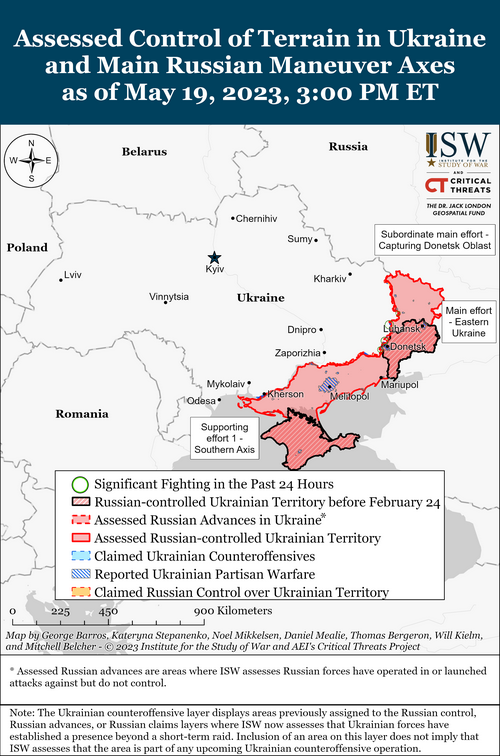
Click here to see ISW’s interactive map of the Russian invasion of Ukraine. This map is updated daily alongside the static maps present in this report.
Click here to access ISW’s archive of interactive time-lapse maps of the Russian invasion of Ukraine. These maps complement the static control-of-terrain map that ISW produces daily by showing a dynamic frontline. ISW will update this time-lapse map archive monthly.
Note: The data cutoff for this product was 3pm ET on May 19. ISW will cover subsequent reports in the May 20 Russian Offensive Campaign Assessment.
A Ukrainian official stated that Russian forces have concentrated most of their available reserves to the Bakhmut area and slowed Ukrainian counterattacks in the past 24 hours. Ukrainian Deputy Defense Minister Hanna Malyar stated on May 19 that Russian forces concentrated most of their reserves in the Bakhmut direction, which has slowed the rate of Ukrainian advances.[1] Malyar also stated that Ukrainian forces continue to counterattack on the northern and southern outskirts of Bakhmut and advanced 500 meters on one flank and 1,000 meters on the other.[2] Some Russian milbloggers celebrated the slowed Ukrainian rate of advance and claimed that the Ukrainian forces are unable to sustain prolonged localized counterattacks around Bakhmut.[3] Russian forces on Bakhmut’s flanks likely remain weak, however; Wagner Group financier Yevgeny Prigozhin continued to criticize the Russian 4th Motorized Rifle Brigade (2nd Luhansk People’s Republic Army Corps) on May 19 for retreating from defensive lines southwest of Ivanivske (6km west of Bakhmut).[4] Ukrainian counterattacks near Bakhmut have notably likely eliminated the threat of a Russian encirclement of Ukrainian forces in Bakhmut and forced Russian troops to allocate scarce military resources to defend against a limited and localized offensive effort, as Ukrainian command likely intended.
Russian forces conducted another series of drone and missile strikes across Ukraine on the night of May 18 to 19. Ukrainian military sources reported that Russia launched six Kalibr cruise missiles and 22 Shahed-131/136 drones at Ukraine from the direction of the Black Sea.[5] The Ukrainian General Staff noted that Ukrainian air defenses shot down 16 drones and three Kalibr missiles, despite the Russian Ministry of Defense (MoD)’s claim that Russian forces struck all intended targets.[6] Dnipropetrovsk Oblast Head Serhii Lysak reported explosions near Kryvyi Rih following Russian strikes in the area.[7] Ukrainian Main Intelligence Directorate (GUR) representative Vadym Skibitsky noted that the recent uptick in Russian drone and missile strikes, as well as artillery strikes along the entire frontline, are meant to disrupt Ukrainian counteroffensive plans and preparations.[8] ISW previously assessed on May 14 that the recent increase in Russian strikes on Ukrainian rear areas is likely part of a new air campaign premised on degrading Ukrainian counteroffensive capabilities in the near term.[9] Skibitsky additionally noted that Russia can only produce 25 Kalibr cruise missiles, 35 Kh-101s, two Kinzhals, and 5 ballistic 9M723 Iskander-Ms per month.[10] Considering that Russian forces have launched missile strikes at rear areas of Ukraine on a near daily-basis thus far in May, it is likely that they are rapidly expending their stocks of precision munitions, potentially at a rate that exceeds production capabilities.
President Joe Biden reportedly informed G7 leaders on May 19 that Washington will support a joint effort to train Ukrainian pilots on F-16s and other fourth generation aircraft. This decision marks a sharp turn in US policy vis a vis fourth generation aircraft in Ukraine and follows Biden’s meetings with various G7 leaders in Hiroshima, Japan on May 19. Yahoo News relatedly reported on May 18 that Ukrainian pilots outperformed standard Pentagon expectations for F-16 training time in a flight simulator and would be able to operate F-16s in only four months as opposed to the anticipated 18 months, citing an internal US Air Force assessment.[11]
The Kremlin reportedly spent 3.1 trillion rubles (approximately $38.7 billion) in an undisclosed section of the Russian budget in 2023, likely to fund the war and maintain occupied territories in Ukraine. Independent Russian news outlet The Bell reported that the Russian Ministry of Finance released data on May 16 on budget expenditures since the start of 2023 amounting to a total of 11.9 trillion rubles ($148.5 billion) with only 8.8 trillion rubles ($109.8 billion) accounted for in Russia’s public budget, leaving 3.1 trillion rubles – over a quarter of Russia’s expenditures – unaccounted for.[12] The Bell reported that most undisclosed budget items account for defense, national security, and law enforcement, and that some may fall onto social and other expenditures in occupied Ukraine. The Bell also reported that the unspecified spending is higher than in the same time period in previous years. ISW continues to assess that the Russian economy will struggle to meet the needs of the large-scale war that the Russian military is fighting in Ukraine and to sustain its occupation of Ukrainian territories.[13]
Moscow Mayor Sergey Sobyanin announced that he will run for reelection as a member of Russian President Vladimir Putin’s United Russia Party for the first time, prompting criticism from select Russian ultranationalists. Russian “Civil Solidarity” movement head Georgy Fedorov argued on May 19 that Sobyanin’s United Russia candidacy suggests that “all political processes in Russia are now only possible in the pre-existing political party system,” that Russia is set to experience “great turbulence,” and that Russia’s “non-systemic opposition has been crushed.”[14] Former Russian officer and ardent ultranationalist Igor Girkin amplified Georgy’s statements and sarcastically called United Russia the “party of crooks and thieves,” a well-known slogan used by Russian opposition figure Alexey Navalny.[15] Sobyanin has held the post of Moscow Mayor nominally as an independent since 2010, although his United Russia candidacy is likely simply a public formalization of his longstanding relationship with United Russia, as Sobyanin has been a member of the party since 2001. United Russia likely seeks to buttress its own popularity (which stands around 45% in Moscow) with that of Sobyanin, who has polled at 74%.[16] These select ultranationalists likely responded to Sobyanin’s announcement to critique what they view as United Russia’s attempt to monopolize support amongst the Russian ultranationalist constituency and were likely not genuinely reacting to the loss of an independent figure. The Kremlin may additionally have publicly linked Sobyanin to United Russia to remove a nominally independent figure, regardless of his actual independence. ISW previously assessed that the Kremlin will likely attempt to solidify United Russia as the definitive pro-war party during elections in 2023 and 2024, and Russian ultranationalist communities with their own political ambitions may increasingly seek to undercut these efforts.[17]
A Ukrainian source reported that elements of two spetsnaz brigades of the Main Directorate of the General Staff of the Armed Forces of the Russian Federation (GRU) have deployed to border areas of Kursk Oblast in order to conduct counter-sabotage activities and provocations. The Ukrainian Resistance Center stated on May 19 that the 3rd and 22nd Guards Special Purpose brigades have deployed to Tyotkino, Kursk Oblast to prevent cross-border Ukrainian partisan activities, carry out cross-border provocations, and raise the morale of Russian forces.[18] ISW has previously assessed that such Russian deployments to border areas are likely an attempt to fix a portion of Ukrainian forces to border regions and disperse them from critical frontline areas.[19] Elements of the 3rd Guards Special Purpose Brigade have been previously reported near the Kreminna area of Luhansk Oblast, while elements of the 22nd Guards Special Purpose Brigade were reportedly active in the Orikhiv area in western Zaporizhia Oblast.[20] It is unclear why Russian leadership may have made the decision to remove such elements from active sectors of the frontline to Russian rear areas, and it may be possible that these units suffered previous losses in recent operations and have been withdrawn and redeployed in order to rest and refit. The deployment of these units to border areas is unlikely to have the desired informational or operational effects.
Key Takeaways
- A Ukrainian official stated that Russian forces have concentrated most of their available reserves to the Bakhmut area and slowed Ukrainian counterattacks in the past 24 hours.
- Ukrainian counterattacks near Bakhmut have notably likely eliminated the threat of a Russian encirclement of Ukrainian forces in Bakhmut and forced Russian troops to allocate scarce military resources to defend against a limited and localized offensive effort, as Ukrainian command likely intended.
- Russian forces conducted another series of drone and missile strikes across Ukraine on the night of May 18 to 19.
- President Joe Biden reportedly informed G7 leaders on May 19 that Washington will support a joint effort to train Ukrainian pilots on F-16s and other fourth generation aircraft.
- The Kremlin reportedly spent 3.1 trillion rubles (approximately $38.7 billion) in an undisclosed section of the Russian budget in 2023, likely to on fund the war and maintain occupied territories in Ukraine.
- Moscow Mayor Sergey Sobyanin announced that he will run for reelection as a member of Russian President Vladimir Putin’s United Russia Party for the first time, prompting criticism from select Russian ultranationalists.
- A Ukrainian source reported that elements of two brigades of the Main Directorate of the General Staff of the Armed Forces of the Russian Federation (GRU) have deployed to border areas of Kursk Oblast in order to conduct counter-sabotage activities and provocations.
- Russian sources claimed that Russian troops continued offensive operations along the Kupyansk-Svatove line.
- Russian forces continued to conduct ground attacks in the Bakhmut area and slightly increased their tempo of ground attacks along the Avdiivka-Donetsk City line.
- Ukrainian officials stated that Russian forces are preparing defenses by flooding fields in Russian occupied Zaporizhia Oblast.
- Russian Security Council Deputy Chairman Dmitry Medvedev claimed that the Russian military has recruited 117,400 contract personnel in volunteer formations since January 1, 2023.
- The Russian State Duma adopted the final reading of a draft law authorizing regional elections under martial law.
Go here to read the rest. If the Ukrainians wanted to cause the Russians to mass their forces near Bakhmut, they have succeeded. Let’s see what happens next.

