
From The Institute For The Study of War:
Russian Offensive Campaign Assessment, April 24, 2023
Grace Mappes, Nicole Wolkov, Layne Philipson, Karolina Hird, Kateryna Stepanenko, George Barros, and Frederick W. Kagan
April 24, 7pm ET
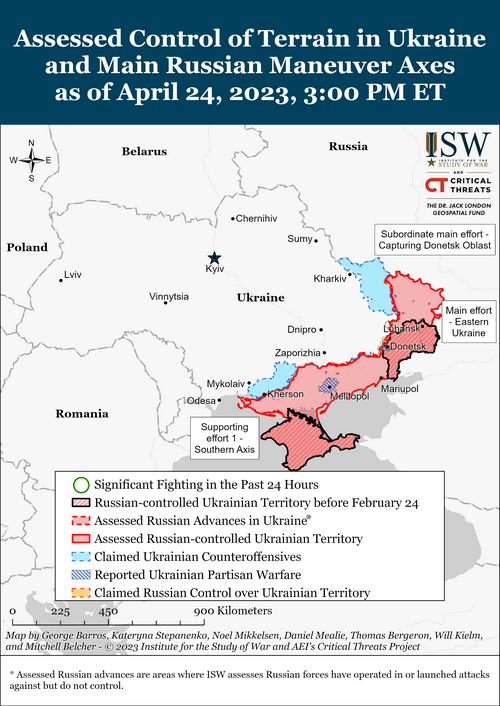
Click here to see ISW’s interactive map of the Russian invasion of Ukraine. This map is updated daily alongside the static maps present in this report.
Click here to access ISW’s archive of interactive time-lapse maps of the Russian invasion of Ukraine. These maps complement the static control-of-terrain map that ISW produces daily by showing a dynamic frontline. ISW will update this time-lapse map archive monthly.
Russian milbloggers speculated that Russian President Vladimir Putin ordered additional military command changes on April 20. A prominent Russian milblogger claimed that Putin signed a decree on April 20 about a series of military command changes and formally dismissed Commander of the Eastern Military District Colonel General Rustam Muradov.[1] The milblogger noted that Muradov’s dismissal likely resulted from his disastrous offensive on Vuhledar that resulted in many casualties among Russian personnel and the loss of much military equipment. The milblogger added that the decree also forced Army General Aleksandr Dvornikov — who reportedly commanded Russian forces in Ukraine in April 2022 — to retire. The milblogger claimed that Putin forced former commander of the Western Military District Colonel General Alexander Zhuravlyov into retirement alongside other unnamed commanders as well. The milblogger claimed that the Kremlin is now relying on newly reappointed Commander of the Russian Airborne Forces Colonel General Mikhail Teplinsky to achieve decisive results.
These reports about command changes and dismissals follow the Kremlin’s reported dismissal of Russian Pacific Fleet Commander Admiral Sergei Avakyants on April 19.[2] A Russian milblogger claimed that Avakyants was not fired as a result of poor performance during military drills in the Pacific, but that he will be forming a new “organization” under the rumored control of the “gas sector.”[3] It is unclear if this was an intentionally vague reference to the reports about Russian state-owned gas company Gazprom‘s formation of a private security company. The milblogger noted that he is not sure if the organization will cooperate with the Russian Volunteer Society for Assistance to the Army, Aviation, and Navy of Russia (DOSAAF) or the Young Cadets National Movement (Yunarmiya). ISW previously reported that Russian state gas companies — namely Gazprom — are forming new military formations and that DOSAAF has been proactive in Russian military recruitment efforts.[4]
Wagner Group financier Yevgeny Prigozhin has launched an information operation to undermine the credibility of Russian state-affiliated private military groups (PMCs). Prigozhin claimed to visit the positions of “Potok” and the “Alexander Nevsky” units – which Prigozhin characterized as “micro-PMCs” – and harshly criticized the poor condition of these units on April 24.[5] The Potok battalion is reportedly one of three volunteer detachments of the Russian state-owned energy company Gazprom and is analogous to the Russian State Combat Reserve (BARS).[6]The Potok battalion is reportedly subordinated to the Russian Ministry of Defense PMC Redut.[7] Prigozhin claimed that these units are supposed to cover Wagner‘s flanks and asked how these units can conduct combat operations if they lack the proper supplies and weapons. Prigozhin also criticized the general proliferation of such PMCs, which likely suggests that Prigozhin views these new entities as Wagner’s competition.
Wagner-affiliated sources claimed on April 24 that Wagner forces tasked Potok with defending unspecified newly captured positions to allow Wagner to regroup, but that Potok abandoned these positions and allowed Ukrainian forces to recapture the area.[8] Alleged personnel of the Potok unit posted a video message on April 24, blaming the leadership of Gazprom and PMC Redut for failing to provide Potok with proper weapons and supplies as well as blaming Wagner for forbidding the Potok personnel from leaving their positions.[9] Some milbloggers — including Wagner-affiliated milbloggers — criticized the Potok unit for blaming leadership and instead attributed their poor combat performance to their status as volunteers.[10] The milbloggers’ and Prigozhin’s reports indicate that Wagner has authority over Russian MoD-owned entities, which in turn indicates that Prigozhin has regained some favor with the Kremlin.
Kremlin authorities proposed equalizing pay between mobilized personnel and volunteers likely in an attempt to incentivize military service. Russian President Vladimir Putin met with United Russia Secretary Andrey Turchak on April 24 to discuss initiatives to provide benefits to Russian military personnel. Putin expressed support for Turchak’s proposal to equalize the salary of “all participants” of the war in Ukraine.[11] Turchak claimed that mobilized personnel currently receive 195,000 rubles (about $2,400) monthly no matter where they serve, whereas contract soldiers receive the same amount only when serving on the frontlines. Turchak claimed that contract soldiers serving in the rear are receiving salaries “several times less” than those received by soldiers in the same role on the front line. Turchak also proposed to implement other social benefits including: setting an admission quota at Russian universities for veterans, for those awarded Hero of Russia of three Orders of Courage, and for children of participants in the war; reducing or canceling the commission fees for withdrawing or transferring money; and extending or canceling loans for parents, spouses, and children of veterans in the event of death or severe disability. ISW previously reported on conflicts between different groups of Russian servicemen regarding unequal payments and social benefits, and the Kremlin is likely attempting to appear to resolve these discrepancies to encourage enlistment.[12]
The Saratov Oblast Investigative Committee detained a former Wagner Group commander who told Russian human rights organization Gulagu.net about Wagner’s murder of children and other civilians in Bakhmut. Gulagu.net founder Vladimir Osechkin reported on April 24 that the Saratov Oblast Investigative Committee arrested Wagner commander Azamat Uldarov, who detailed Wagner’s practice of killing children in Bakhmut and the group’s treatment of prisoners of war on Wagner Group financier Yevgeny Prigozhin’s orders (which Prigozhin denied).[13] Osechkin stated that four other Wagner mercenaries accompanied the Investigate Committee and threatened Uldarov with death for his testimony against Prigozhin.[14] Wagner’s cooperation with local investigative authorities indicates that Wagner and Prigozhin are able to influence certain local authorities and security organs. This anecdote further suggests that Wagner is deeply invested in encouraging participation in atrocities in order to build social cohesion among the group and indicates that Wagner uses the threat of retribution to discourage dissenting voices that expose Prigozhin to discredit the wider group.[15]
Ukrainian forces likely conducted a naval drone attack against the Russian Black Sea Fleet’s (BSF) base in Sevastopol in the early morning of April 24. Geolocated footage shows a likely Ukrainian naval drone detonating in the port of Sevastopol reportedly around 3:30am on April 24.[16] The extent of damage from the strike is unclear. The Russian Ministry of Defense announced on April 24 that Ukrainian forces attempted to attack the BSF base in Sevastopol with three unmanned surface vehicles and claimed that Russian forces destroyed all three vehicles.[17] Russian occupation governor of Sevastopol Mikhail Razvozhaev reported that of the two of the three unmanned surface vehicles entered Striletskyi Bay and that one of them detonated on its own, damaging four residential buildings.[18] Razvozhaev reported that the attack did not damage any military infrastructure.[19] Ukrainian forces have likely targeted the Russian BSF before: the Ukrainian forces likely attacked a Grigorovich-class frigate of the BSF near Sevastopol with unmanned surface vehicles on October 29, 2022.[20]
Russian Foreign Minister Sergei Lavrov arrived in New York City on April 24 to chair a session of the United Nations Security Council (UNSC).[21] Lavrov led a session on April 24 entitled “maintenance of international peace and security” and was met with widespread condemnation by other members of the session.[22] ISW has previously assessed that Russia uses its position at the UNSC as a method of power projection and forecasted that Russia would likely exploit its one-month UNSC presidency to amplify Kremlin talking points about the war in Ukraine.[23]
The Wall Street Journal (WSJ) reported on April 24 that Russian ships are ferrying Iranian ammunition across the Caspian Sea to resupply Russian troops fighting in Ukraine.[24] The WSJ, citing unnamed Middle Eastern officials, stated that cargo ships have carried over 300,000 artillery shells and a million ammunition rounds from Iran to Russia via the Caspian Sea over the past six months. The unnamed officials reportedly said that the last known shipment left Iran for Astrakhan in early March and carried 1,000 containers with 2,000 artillery shells. The WSJ noted that the Iranian Ministry of Defense (MoD) has a contract with Russian state-owned joint stock company Rosobronexport for the sale of 74,000 artillery shells at a price of $1.7 million. A prominent Russian milblogger responded to the report and claimed that he has not yet seen the arrival of this ammunition on the front despite continued Russian–Iranian defense cooperation.[25]
Krasnoyarsk Krai deputy Konstantin Senchenko resigned on April 24 following the resignation of Krasnoyarsk Krai Governor Aleksandr Uss on April 20. Senchenko reportedly left Russia over a year ago and actively criticized the war, earning himself a fine in January for “discrediting the army.”[26] Uss reportedly resigned following an offer by Russian President Vladimir Putin to work on the federal level.[27] Senchenko’s and Uss’s resignations may signal discontent with Kremlin leadership on more regional levels of Russian government.
Key Takeaways
- Russian milbloggers speculated that Russian President Vladimir Putin ordered additional military command changes on April 20.
- Wagner Group financier Yevgeny Prigozhin has launched an information operation to undermine the credibility of Russian state-affiliated private military groups (PMCs).
- Kremlin authorities proposed equalizing pay between mobilized personnel and volunteers, likely in an attempt to incentivize military service.
- Saratov Oblast Investigative Committee detained a former Wagner Group commander who told Russian human rights organization Gulagu.net about Wagner’s murder of children and other civilians in Bakhmut.
- Ukrainian forces likely conducted a naval drone attack against the Russian Black Sea Fleet’s (BSF) base in Sevastopol in the early morning of April 24.
- Russian Foreign Minister Sergei Lavrov arrived in New York City on April 24 to chair a session of the United Nations Security Council (UNSC).
- The Wall Street Journal (WSJ) reported on April 24 that Russian ships are ferrying Iranian ammunition across the Caspian Sea to resupply Russian troops fighting in Ukraine.
- Krasnoyarsk Krai deputy Konstantin Senchenko resigned on April 24 following the resignation of Krasnoyarsk Krai Governor Aleksandr Uss on April 20.
- Ukrainian forces have made marginal gains south of Kreminna as of April 24 and continue to target Russian logistics nodes in rear areas of Luhansk Oblast.
- Russian forces continued ground attacks in and around Bakhmut and along the Avdiivka-Donetsk City frontline.
- Some Russian sources denied claims from other Russian milbloggers that Ukrainian forces established enduring positions in east (left) bank Kherson Oblast.
- The Kremlin continues crypto-mobilization efforts likely in an attempt to avoid a second wave of formal mobilization.
- The Wagner Group may be attempting to fill law enforcement roles in occupied territories.
Go here to read the rest. Some sources are claiming that the Ukrainian offensive is underway in the south in Kherson province. Maybe. My best guess however is that this is a feint to draw off Russian forces and the Ukrainian offensive will be in the center. We shall see.

