
While He was present on Earth, Jesus gave us God’s view of our mortal condition, and it often startled those who heard of it. Typical was the trap lain for him involving paying tribute to Caesar. If Christ had said pay no tribute, he would swiftly have been arrested by the Romans and condemned as a rebel. Tell the people to pay the tribute, and He would have been regarded as a collaborator, one of those Jews who sided with the hated Roman rulers. I assume whoever thought up this trap regarded it as foolproof and perhaps, in human terms, it was. Jesus however demolished it with contemptuous ease. He asked to see a Roman denarius, which had the face of Emperor Tiberius. No doubt this made many Jews in the crowd squirm. They hated the Romans, but Roman coins were in common usage. Pious Jews would have hated handling the denarius because it blasphemously asserted that Tiberius was the son of the Divine Augustus, the Senate having proclaimed him a God. (Ironically Tiberius was personally uneasy with the idea of being a God and the Senate did not proclaim his divinity after his death.)
One can imagine the anticipation with which the crowd awaited what was about to happen. Christ had said almost nothing about the Roman occupation, as if it did not exist, or was simply too inconsequential for Him to notice. Now He was being forced to take a stand on the central political issue of Jewish life.
Jesus inquires whose face is on the coin. No doubt his interlocutor thought He was playing for time: “Caesar.”
The words that Christ then spoke are obscured by our familiarity with them. Israel had no tradition of separating religion from secular rule. The rulers of Israel were judged as good or bad depending upon whether they had adhered to the worship of Yahweh. The Kings of Israel and Judah had often been in severe conflict with prophets sent by God. The Maccabees were leaders of a religious revolt against the Seleucid Empire. Herod had been condemned for his many atrocities and impieties. The Jews longed for a Messiah to free them from the rule of Rome and bring about a Jewish utopia where God would rule His people.
Thus when Christ told the crowd to render unto Caesar the things that are Caesar’s and unto God the things that are God’s, He presented them with the stunning idea that there was a sphere of life which was a secular ruler’s, outside of the sphere of existence that was God’s. We have been working out the implications of this divine revolutionary idea ever since.


The Catholic world groaned, and was astonished to find itself caesaropapist.
The Pax Romana of the old empire had (in its last days) been very useful to the Church and it’s easy to see that an 8th century pope would see its restoration as also useful. The Holy Roman Empire kept the Lombards down, kept the Byzantines (then in the grip of iconoclasm) out of Italy and reduced in-fighting among the territorial nobles in its territory. It remained an ideal that echoed down the centuries, through Dante (as just one example) all the way to Hayden’s Kaiserlied. As Dawson noted, to medieval Christians unity meant peace, while separate states meant constant warfare. It didn’t work out, but I get their point.
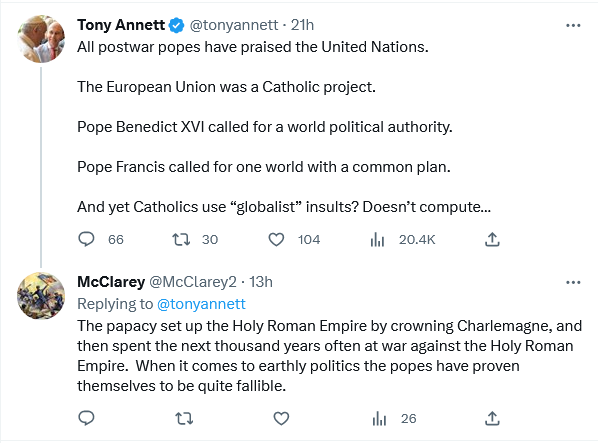
It’s mystifying to me why any faithful Catholic would zealously advocate for any ultimate political authority that did not expressly bow before the Lordship of Christ our King. Different systems may have one flaw or the other. But if not subject ultimately to God, what possible basis could there be for an endorsement of any global authority? After all we know from the devil’s temptation of Christ in the desert, who has power over the kingdoms of the earth. Why endorse them? No problem praising them for whatever good they may do. What more is called for beyond that?
Postwar Popes praising the United Nations are not paying attention.
I’m not seeing how the EU as currently constituted qualifies as a ‘Catholic project’ because there were Christian Democratic politicians engaged in setting up a customs union in 1957.
While we’re at it, Christian Democracy is a residue in Latin Europe, with a small corps of adherents operating within parties with a bigger tent. In Scandinavia, it is constitutionally protestant. In the Netherlands and in Eastern Europe, performing at its best it will animate a junior partner party good for a single-digit share of the vote. It’s only in Germany, Austria, Flanders, and the Swiss cantons that it is consequential. The German party was from its inception Catholic-Lutheran, not Catholic, and operates in the country where the Catholic hierarchy is as diseased as any. (Its not my impression the Lutheran Church is in great shape either).
The problem with creating an institution like the Holy Roman Emoire from the standpoint of the Church is that the benefits tend to be short term, while the detriments are long term. An institution is created to deal with current problems and over time takes on a life of its own with its own agendas. The Jesuits come strikingly to mind within the Church.
An institution is created to deal with current problems and over time takes on a life of its own with its own agendas.
If I were to follow the logic of your thinking here, I’d not create any institutions at all.
The soi-disant Scottish lawyer who used to post here said ‘the problem with entrenched clauses is that they’re never there when you need them’. We certainly have seen that in spades since 1937, bar in those instances when entrenched clauses were used as an excuse for our appellate judiciary to impose the views of law school faculty on a populace which wanted nothing of the kind.
As for the bench, the law professoriate, the prosecutors’ offices, and the BigLaw partnerships, a large fraction of those in such positions are a cultural malignancy.
Donald:
To paraphrase Chesterton the problem for Europe was how to have unity without uniformity: peace among states, a roughly common standard of justice, and end of territorial squabbles but without an all-powerful tyrant in charge. The medieval Western Christian had his common Catholic faith that served as a reference standard for all the above, so states could learn to cooperate while staying independent, so you really didn’t need an emperor. Imperfect as hell of course, but there was at least an ideal and model. The Reformation began the destruction of that unity. “Globalism” in an age where there is no standard of unity at all is a lunacy that can only end in tyranny followed by inevitable bloody rebellion.
The solution is to preach the Catholic Faith to the world, to restore the old principle of unity, but modern Catholics don’t seem to see that.
“If I were to follow the logic of your thinking here, I’d not create any institutions at all.”
Fewer would be better Art, and if they were not created assuming permanency. I rather like the mass volunteer armies created for the Civil War which were swiftly demobilized after the War.
America is the only people who institute their government by consent of the sovereign person as citizen. There you have a nation who recognizes and acknowledges the sovereign personhood of the individual citizen. Communication with and through Almighty God is an absolutely necessary condition for peace and prosperity. In Dr. Jordan B. Peterson’s words: “Listening” and learning what the other person needs and has to say. Brotherhood formed of patriotism and love of neighbor. Our Declaration of Independence and our Constitution for the United States of America state clearly that this nation is instituted under God “their Creator”, “and for the support of this Declaration with a firm reliance on divine Providence…”
Jesus is in our midst in the Real Presence. Jesus is a divine and sovereign person who enjoys civil rights endowed by His Father in heaven.
When every sovereign person is acknowledged and affirmed as a child of God and a sovereign unto himself then America will have acheived the standard for which it is created. A working experiment in freedom as endowed by “their Creator”.
They don’t need secular cred anyhow. And I didn’t need that horse’s fedora to prove popes have no expertise in Worldly matters.
Evidently, the current caudillo in the Vatican is not listening to the Holy Spirit, either.
Before I determined life is too short to annoy myself l used to see that credentialed moron at vox no brains. They were either MAs in philosophy [making up stuff about stuff] or MAs in theology [making up stuff about God]. God is not amused.
Note that the promised Messiah did not come while Israel was strong and united under great kings like David and Solomon; He came only after Israel had lost its sovereignty and been demoted to a backwater province (Judea) of a pagan empire (Rome). His coming also did not prevent the Temple from being destroyed — which, to Jews and many early Christians, represented the end of the world as they knew it (and explains why prophecies of the destruction of Jerusalem are closely intertwined with eschatological prophecies in the Gospels).
As Lincoln noted Elaine, the Almighty has His own purposes, which I rank as one of the most insightful observations about God which I have read.
“…and then the (people of God) handed Him over to the Romans to be crucified.” Looks like both sides had a hand in it. Has nothing changed at all?
“…and then the (people of God) handed Him over to the Romans to be crucified.” Looks like both sides had a hand in it. Has nothing changed at all?
————————-
There is nothing new under the sun!
Fewer would be better Art, and if they were not created assuming permanency. I rather like the mass volunteer armies created for the Civil War which were swiftly demobilized after the War.
————————
Exactly