
From The Institute For The Study of War:
Russian Offensive Campaign Assessment, March 29, 2023
Riley Bailey, Karolina Hird, Nicole Wolkov, Layne Philipson, and Frederick W. Kagan
March 29, 5:45pm ET
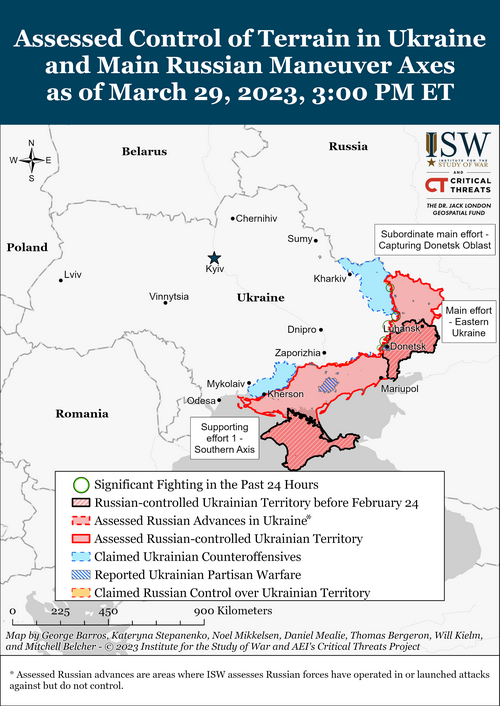
Click here to see ISW’s interactive map of the Russian invasion of Ukraine. This map is updated daily alongside the static maps present in this report.
Click here to access ISW’s archive of interactive time-lapse maps of the Russian invasion of Ukraine. These maps complement the static control-of-terrain maps that ISW produces daily by showing a dynamic frontline. ISW will update this time-lapse map archive monthly.
Iranian Foreign Affairs Minister Hossein Amir Abdollahian met with Russian Foreign Minister Sergei Lavrov in Moscow on March 29 to review strategic and long-term cooperation agreements that will likely intensify Russia and Iran’s bilateral security relationship. Abdollahian stated that Russian and Iranian officials are in the final stage of signing a cooperation agreement.[1] Lavrov promoted Iran’s “Hormoz Peace Plan” for security in the Persian Gulf and the Gulf of Oman and stated that the Kremlin demands an immediate return to the Joint Comprehensive Plan of Action (JCPOA).[2] Abdollahian and Lavrov likely discussed continued Russian efforts to procure Iranian weapon systems for use in Ukraine and a finalized agreement for Russia to provide Iran with Su-35 attack aircraft.[3] The Ukrainian Resistance Center reported on March 29 that Iranian Pouya Air Transport resumed regular flights between Tehran and Moscow on March 13 likely to support weapons transfers.[4] The Ukrainian Resistance Center also reported that Iranian officials are planning to deliver Shahed-131 drones to Wagner Group personnel and that Wagner personnel have started training to operate the drones, although ISW has not observed confirmation that Wagner Group personnel have used Iranian-made drones in Ukraine.[5] ISW previously assessed that Russia is relying on Iran for military and technological support in Ukraine and that some Iranian personnel are likely in Ukraine directly supporting Russian attacks on Ukrainian infrastructure.[6] Iran is likely attempting to solidify a bilateral security relationship with Russia in which the two are more equal partners and will likely increase weapons transfers to Russia in pursuit of this goal.
Wagner Group financier Yevgeny Prigozhin seized on the recent story of the sentencing of a Tula Oblast father for his 12-year-old daughter’s antiwar drawing to promote the Wagner Group’s reputation and ameliorate his own personal image. Prigozhin’s press service posted a letter on March 28 signed by Prigozhin, Wagner commander Dmitry Utkin, and Wagner-affiliated director of the “Liga” veteran’s organization Andrey Troshev addressed to Tula Oblast prosecutor Alexander Gritsaenko stating that the signatories consider Gritsaenko’s issuance of a two-year prison sentence to Aleksey Moskalev unfair.[7] Moskalev was charged with “discrediting the armed forces” after his 12-year-old daughter Masha drew an antiwar picture with a Ukrainian flag in her school art class in April 2022.[8] Masha was taken into state custody and now lives in a juvenile shelter, and Moskalev fled house arrest the night before his sentencing and was sentenced to two years in prison in absentia.[9] Prigozhin’s letter suggests that Tula Oblast check the legality of Gritsaenko’s sentencing and recommends that Wagner-affiliated lawyers participate in the case on Moskalev’s side, noting that it is tragic that both Masha and children of dead Wagner fighters end up in orphanages.[10] Prigozhin’s response to Moskalev’s sentencing is particularly ironic considering that Prigozhin was initially one of the biggest and loudest supporters of the law on punishing those who ”discredit” Russian forces.[11] It is therefore likely that Prigozhin seized on the discourse surrounding Moskalev to further his own reputation and advocate for the Wagner Group, especially by choosing to highlight the plight of orphans of Wagner fighters who die in Ukraine.[12] Prigozhin may seek to maintain his own domestic relevance by continuing to closely involve himself in such developing stories, especially by affiliating his newest campaign for relevance with Utkin and Troshev—two well-established and notorious Wagner-affiliated personalities. The letter attempts to portray Wagner’s leadership as a united front against elements of the Russian bureaucracy.[13]
Chechen Republic Head Ramzan Kadyrov’s demonstrative response to an attack on a police station in Chechnya suggests that he may be concerned about the stability of his authoritarian rule. Kadyrov claimed that Chechen authorities killed two unidentified men attempting to conduct an attack in Gudermes, Chechnya on the night of March 28, and Russian sources amplified footage purporting to show the two men shooting at a local police department.[14] Kadyrov’s Special Forces University is in Gudermes, although it is not clear if the attack was connected to the facility. Kadyrov published footage of himself, his 15-year-old son, and an entourage of Chechen officials and security personnel visiting the scene of the attack and inspecting the mangled bodies of the assailants.[15] Kadyrov likely meant this demonstrative inspection of the bodies to enhance his strongman image and signal to Chechens that any form of internal resistance to his rule will be eliminated. The fact that Kadyrov’s response to the attack was so immediate and heavy-handed suggests that he is concerned about the potential for internal resistance within Chechnya to undermine his authoritarian rule of the autonomous republic. Kadyrov recently meet with President Vladimir Putin on March 13 to promote Chechnya’s relevance in the Russian political and military sphere, and ISW assessed that Putin may seize upon Kadyrov‘s fears about falling out of favor with Putin to pressure Kadyrov into increasing the role of Chechen fighters in combat operations in Ukraine.[16] Kadyrov likely sees any sign of internal instability in Chechnya as a threat to Putin’s continued favor.
Russian authorities arrested Russian National Guard (Rosgvardia) naval department head Colonel Sergey Volkov for corruption-related charges. The 235th Garrison Military Court in Moscow arrested Volkov on March 29 for abuse of authority charges in connection with the sale of low-quality radar systems at heavily inflated prices, and an official investigation reportedly found that his actions amounted to damages of 395.5 million rubles (roughly $5 million).[17] The Russian Federal Security Service (FSB) and Rosgvardia recently launched a criminal case against the Deputy Commander of the Rosgvardia’s Central District, Major General Vadim Dragomiretsky, on March 20 for corruption-related charges.[18] The recent criminal proceedings against two Rosgvardia commanders may suggest that Russian authorities are conducting a sweeping corruption probe within Rosgvardia. The criminal proceedings are notable because commanders of conventional Russian forces have not been fired, let alone arrested, since the start of Russia’s invasion of Ukraine at the same rate or in such high-profile circumstances as the Rosgvardia cases. It is highly unlikely that corruption in the Rosgvardia is more pronounced than it is in the Russian Armed Forces. The Rosgvardia notably includes elements responsible for Russia’s domestic regime security. Putin likely pays very close attention to the reliability and loyalty of some Rosgvardia personnel, apart from concerns he may have about corruption in that organization.
Ukrainian Defense Minister Oleksii Reznikov stated on March 27 that Ukrainian forces may be planning to launch a counteroffensive in April or May depending on weather conditions. In an interview with Estonian news outlet ERR, Reznikov stated that the Ukrainian General Staff might decide to use recently received Leopard 2 tanks in a possible spring counterattack.[19] Leopard 2 and Challenger 2 tanks arrived in Ukraine on March 27, and US officials announced the acceleration of the deployment of Abrams tanks and Patriot missile systems to Ukraine on March 21.[20] The arrival of equipment in Ukraine likely sets conditions for a Ukrainian counteroffensive, although a delay is likely between the arrival of new equipment in Ukraine’s ability to use it in a counteroffensive.
Key Takeaways
- Iranian Foreign Affairs Minister Hossein Amir Abdollahian met with Russian Foreign Minister Sergei Lavrov in Moscow on March 29 to review strategic and long-term cooperation agreements that will likely intensify Russia and Iran’s bilateral security relationship.
- Wagner Group financier Yevgeny Prigozhin seized on the recent story of the sentencing of a Tula Oblast father for his 12-year-old daughter’s antiwar drawing to promote the Wagner Group’s reputation and ameliorate his own personal image.
- Chechen Republic Head Ramzan Kadyrov’s demonstrative response to an attack on a police station in Chechnya suggests that he may be concerned about the stability of his authoritarian rule.
- Russian authorities arrested Russian National Guard (Rosgvardia) naval department head Colonel Sergey Volkov for corruption-related charges.
- Ukrainian Defense Minister Oleksii Reznikov stated on March 27 that Ukrainian forces may be planning to launch a counteroffensive in April or May depending on weather conditions.
- Russian forces conducted limited ground attacks along the Kupyansk-Svatove-Kreminna line.
- Russian forces continued offensive operations in and around Bakhmut and along the Avdiivka-Donetsk City front.
- International Atomic Energy Agency (IAEA) Director General Rafael Grossi visited the Zaporizhzhia Nuclear Power Plant (ZNPP) for the second time.
- Russian occupation authorities continue to implement measures to integrate occupied territories into the Russian administrative and legal system.
- The Belarusian Ministry of Defense (MoD) reported that planned activities are ongoing to call up those liable for military service for military training and to retrain reserve servicemen in military registration specialties.
Go here to read the rest.
From Strategy Page:
March 29, 2023: Russia continues to have problems replacing the troops and tanks it lost during the first months of the fighting in Ukraine. Russian active duty forces were shattered by heavy personnel losses and most of their modern tanks were destroyed as well. These were replaced by older models and hastily mobilized troops who did not want to be in the army and were particularly reluctant to be sent to Ukraine. Russian forces in Ukraine are now outnumbered by better armed, trained and motivated Ukrainian forces that are planning another major offensive to drive all Russians out of Ukraine. Russian replacement troops sent to Ukraine are given little training and are poorly equipped. Some have been seen wearing World War II style steel helmets that Russia had kept in storage just in case of another military disaster. That was what Ukraine has turned out to be for Russia, which is also bringing ancient (1950s) T-55 tanks into Ukraine, where the Ukrainians have already received German Leopard 2 tanks and American M-1s are on the way. The Russian situation in Ukraine is desperate and Russian plans to rebuild its military are equally desperate.
Russia plans to rebuild and expand its army. Planners ran into a major problem upon discovering that, somehow, wartime losses and emigration had greatly reduced the number of men able to serve in the military. Another problem is the cost of this rebuilding. Russia hasn’t got the cash to pay for recruiting, equipping and training the new troops. The Russian plan calls for a force containing 600,000 volunteer (contract career) soldiers and several hundred thousand conscripts.
This latest and greatest new plan ignores past experience with contract soldiers. These men were willing to serve in a peacetime force that would defend the motherland. Invading a neighbor and running into very hostile and lethal locals was unexpected and unacceptable. Many of the contract soldiers who survived the initial weeks of the invasion quit the military, with many justifying this on the ground that their contracts had been violated. This was technically illegal but there were so many departing contract soldiers that the government just let them go. The government planners seem to have forgotten this but many of the military-age men they plan to recruit remember and are not interested. The government response to this is chiefly more attempts to deceive potential recruits into signing up.
Western harsh and aggressively enforced economic sanctions have greatly reduced the Russian ability to build new armored vehicles, military aircraft, as well as missiles and much else. It’s just as well because obtaining new soldiers is not working either. The current Russian strategy appears to consist of trying to maintain control over as much Ukrainian territory as possible for a few years in the hope that the NATO nations supplying Ukraine with weapons will tire of the expense and reduce that aid. While NATO nations are feeling the strain, they have not reduced their support and have recently been increasing it. That includes sending the last of their artillery ammunition (mostly 155mm shells) to Ukraine and increasing production of those munitions to replenish their own stockpiles while also keeping the Ukrainians supplied. Ukrainian troops now have more artillery ammunition than the Russians, which makes Russian troops even less willing to attack or even defend.
Russian leader Vladimir Putin seems to believe that defeat in Ukraine will also mean the end of his two decades of ruling Russia. Putin was recently indicted by the ICC (International Criminal Court) for war crimes in Ukraine and an international arrest warrant issued. The immediate response of Russia was that any effort to arrest Putin while he was outside Russia would be considered an act of war against Russia. If and when Putin is no longer head of state in Russia, he is more vulnerable to the ICC arrest warrant. Those warrants never expire and the ICC has brought former senior government officials to trial eventually. Russia has relieved a lot of generals in the past year for failure to achieve much success against the Ukrainians. The Ministry of Defense and the government is also criticized for not undertaking some major reforms of Russian forces. In Ukraine these consist largely of recently mobilized men who were given little training and inadequate weapons and equipment to continue the war.
Currently, the most likely outcome is that Ukraine does defeat and expel all Russian forces in Ukraine. That will reveal more Russian atrocities against Ukrainian civilians. Russia will be considered a pariah state for some time to come, especially as it is unlikely to release more than a million kidnapped Ukrainian civilians, many of them children. This is disappointing to many nations, especially former European trading partners who believed, until 2022, that Russia would continue being the peaceful and reliable trading partner it had been since the 1990s. Peace may return, but any hopes for an unthreatening Russia will take a lot longer. Vladimir Putin apparently hopes to keep the war going for a few more years, until NATO nations supplying Ukraine grow weary of the huge expense of this effort and reduce their support. The Ukrainian offensives planned for 2023 will see relatively superior Ukrainian forces fighting less prepared and very unmotivated Russian troops. The Ukrainians are also receiving British Challenger 2, German Leopard 2 and American M1 tanks along with several countries contributing IFVs (Infantry Fighting Vehicles) and other light armored vehicles that typically accompany tanks. Russia has little to oppose such a force except some elderly T-55 tanks brought out of their few remaining armored vehicle reserves. To make matters worse, Ukrainians in Russian occupied territory are increasing their sabotage armed resistance again the occupying forces.
Go here to read the rest.
Putin’s dictatorship has been long lasting. With the invasion of Ukraine, with a dysfunctional military, he rolled the iron dice of war. Defeat in Ukraine this year will almost certainly lead to revolution in Russia this year.

