
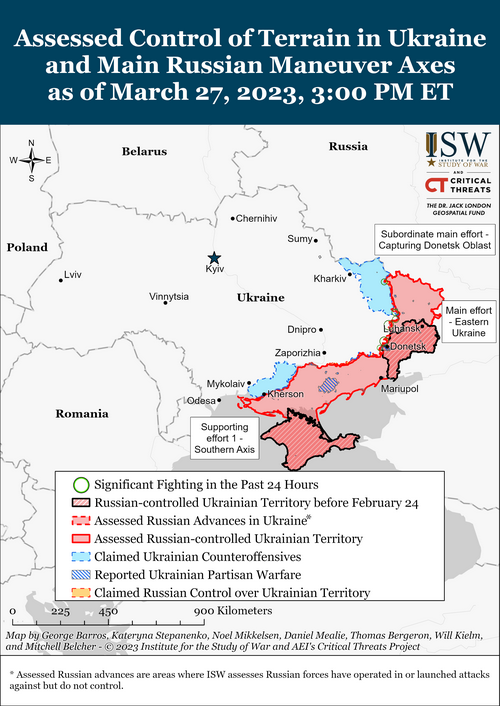
From The Institute For The Study of War:
Russian Offensive Campaign Assessment, March 27, 2023
Grace Mappes, Karolina Hird, Layne Philipson, and Frederick W. Kagan
March 27, 7:15pm ET
Click here to see ISW’s interactive map of the Russian invasion of Ukraine. This map is updated daily alongside the static maps present in this report.
Click here to access ISW’s archive of interactive time-lapse maps of the Russian invasion of Ukraine. These maps complement the static control-of-terrain maps that ISW produces daily by showing a dynamic frontline. ISW will update this time-lapse map archive monthly.
Rumors about the dismissal of Russian Eastern Group of Forces (Eastern Military District) Commander Colonel General Rustam Muradov on March 27 generated a muted and cynical response in the Russian information space. The milbloggers claimed that Russian military authorities dismissed Muradov from his position as Eastern Group of Forces commander, but ISW cannot currently verify these claims.[1] Muradov took command of the Russian Eastern Military District (EMD) on October 6, 2022, and has overseen a series of disastrous offensive operations led by EMD elements in western Donetsk Oblast over the past five months.[2] One milblogger claimed that Muradov is on “vacation,” which the milblogger noted is tantamount to resignation. Others claimed that Muradov’s removal is a positive step but stated that Muradov’s replacement is more important than his removal.[3] Some milbloggers noted that Muradov was responsible for significant Russian military failures in western Donetsk Oblast, including the high casualties suffered in the assault against Pavlivka in October-November 2022 and the prolonged and failed effort to take Vuhledar.[4] Independent Russian investigative outlet Vazhnye Istorii (iStories), citing sources close to the Russian General Staff, reported that the Russian General Staff accused Muradov of being inept due to battlefield failures and significant losses in western Donetsk Oblast, including the near obliteration of the Tatarstan ”Alga” volunteer battalion.[5] One prominent milblogger claimed that military authorities are also considering dismissing Western Military District Commander Colonel General Yevgeny Nikiforov, whose forces operate along the Kupyansk-Svatove-Kreminna line in eastern Ukraine.[6]
ISW cannot confirm the rumors of either Muradov’s or Nikiforov’s dismissals, but it is noteworthy that Russian milbloggers are discussing potential dismissals of commanders associated with areas of operation in which Russian forces have been largely unable to secure substantial gains or have suffered major losses. Russian milbloggers do not appear to be hypothesizing about the removal of either the Central Military District (CMD) Commander Lieutenant General Andrey Mordvichev or Southern Military District Commander (SMD) Colonel General Sergey Kuzovlev.[7] Neither the CMD nor the SMD are heavily committed in critical areas of the front, and Mordvichev and Kuzovlev have therefore likely avoided becoming targets of Russian command skepticism because they are not currently responsible for significant failures. The muted information space response to the reported firings is additionally indicative of broader disillusionment with Russian military command, which milbloggers have argued for months needs systemic overhauls. Many milbloggers have consistently praised former Commander of Russian Armed Forces in Ukraine Army General Sergey Surovikin despite the fall of west (right) bank Kherson Oblast under his command, however. One milblogger claimed on March 27 that Surovikin may be responsible for defending against a future Ukrainian counteroffensive and claimed that Surovikin’s military strategy is better than that of Russian Chief of the General Staff and current Commander of Russian Armed Forces in Ukraine Army General Valery Gerasimov.[8] Russian authorities and some milbloggers have fixated on identifying and punishing individual commanders for the failures of their troops, rather than interrogating and resolving endemic issues in Russian command and control, force structure, and deployment patterns.
Russian milbloggers also had a muted response to Russian President Vladimir Putin’s March 25 announcement that Russia will deploy tactical nukes to Belarus, suggesting that Putin’s messaging is aimed at Western rather than domestic Russian audiences. Many milbloggers and news aggregators simply amplified various points from Putin’s March 25 interview that artificially inflate the capabilities of the Russian military and defense industrial base (DIB) to sustain a prolonged war effort, as well as the nuclear weapons deployment announcement itself.[9] One milblogger correctly noted that deploying tactical nuclear weapons to Belarus does not improve Russia’s military situation in Ukraine, claiming that Russian forces need to instead prepare for a future Ukrainian counteroffensive, and criticized continued Russian military command and organization issues.[10] Another milblogger recognized that Putin targeted his nuclear weapons deployment announcement at the West and praised the prospect of being the ”nightmare” of the US.[11]
Russian military leadership likely committed limited higher quality Wagner Group elements to the offensive on Avdiivka, potentially to reinforce recent limited tactical successes in the area. Ukrainian Tavriisk Defense Forces Spokesperson Colonel Oleksiy Dmytrashkivyskyi stated on March 25 that Ukrainian intelligence forecasts that Wagner may appear in the Avdiivka direction.[12] A Russian VK user posted an obituary on March 26 announcing the death of Wagner Group fighter Yevgeny Malgotin in Avdiivka on March 20.[13] The obituary claims that Malgotin had prior military experience and fought with the 2nd Russian Volunteer Detachment of the Army of Republika Sprska (commonly referred to as the Bosnian Serb Army) in 1992.[14] Malgotin appears to have been a seasoned fighter, and likely represents the higher caliber of fighter that comprises Wagner’s special operations forces. While Wagner has heavily committed a majority convict-based force to operations near Bakhmut, there is likely a contingent of higher-quality operators at various locations in Ukraine. Russian military leadership may have decided to deploy certain Wagner elements to the Avdiivka area in recent weeks to support exhausted and lower-quality Donetsk People’s Republic (DNR) elements in their efforts to take the settlement. If such Wagner fighters have been fighting near Avdiivka, their involvement may help explain the limited tactical gains made in the area over the past week.
Key Takeaways
- Rumors about the dismissal of Russian Eastern Group of Forces (Eastern Military District) Commander Colonel General Rustam Muradov on March 27 generated a muted and cynical response in the Russian information space.
- Russian milbloggers also had a muted response to Russian President Vladimir Putin’s March 25 announcement to deploy tactical nukes to Belarus, underscoring that Putin’s messaging is aimed at Western rather than domestic Russian audiences.
- Russian military leadership likely committed limited higher quality Wagner Group elements to the offensive on Avdiivka, potentially to reinforce recent limited tactical successes in the area.
- Russian forces made marginal gains around Svatove and Russian forces continue ground attacks along the Kupyansk-Svatove-Kreminna line.
- Russian forces continued ground attacks in and around Bakhmut and made gains within Bakhmut.
- Russian forces continued ground attacks along the Avdiivka-Donetsk City line.
- Russia appears to be increasingly deploying elements of conventional formations in a piecemeal fashion along the entire frontline, including in southern Ukraine.
- Russian authorities continue forming new volunteer battalions subordinate to irregular formations.
- Ukrainian partisans conducted an improvised explosive device (IED) attack against an occupation law enforcement officer in Mariupol, Donetsk Oblast.
Go here to read the rest.
From Strategy Page:
March 27, 2023: The Russian military has suffered, and continues to suffer, heavy losses in Ukraine but is still planning on how to rebuild and expand. Planners ran into a major problem upon discovering that, somehow, wartime losses and emigration had greatly reduced the number of men able to serve in the military. Another problem is the cost of this rebuilding. Russia hasn’t got the cash to pay for recruiting, equipping and training the new troops. The Russian plan calls for a force containing 600,000 volunteer (contract career) soldiers and several hundred thousand conscripts.
This latest and greatest new plan ignores past experience with contract soldiers. These men were willing to serve in a peacetime force that would defend the motherland. Invading a neighbor and running into very hostile and lethal locals was unexpected and unacceptable. Many of the contract soldiers who survived the initial weeks of the invasion quit the military, with many justifying this on the ground that their contracts had been violated. This was technically illegal but there were so many departing contract soldiers that the government just let them go. The government planners seem to have forgotten this but many of the military-age men they plan to recruit remember and are not interested. The government response to this is chiefly more attempts to deceive potential recruits into signing up.
The number of military age men coming of age is falling rapidly because of a low birth rate. There are also long-used methods to avoid conscription or otherwise being forced into the military. These techniques were developed two centuries ago when the Russian monarchy first introduced conscription. Families would try to hide their military age men, simply leave the country, or bribe conscription officials. The proportions of each varied over time – leaving the country was not possible during most of the communist period, while bribery rose in the 1990’s and really took off after the first Chechen war (1994). The government got new soldiers any way they could and life went on. 21st Century Russian recruiters have tried to adapt but the young men and their families are not cooperating.
Long before the Ukraine invasion disaster, Russia was struggling with the task of rebuilding the military after the collapse of the Soviet Union in late 1991. Russia needed soldiers and they became increasingly hard to obtain since the 1980s and that got worse after the 1991 collapse of the Soviet Union. Having tried just about everything else, Russia sought Russian-speaking foreigners from former Soviet republics that had become independent. Foreign recruits had to meet the psychological and physical standards, and especially if they had needed skills, good jobs are available. Not many Russian-speaking foreigners were interested.
This inability to attract new recruits, even with conscription, put the government in an embarrassing situation because promises were made on this issue and not kept. Not once but multiple times. Some of the solutions make the problem worse. For example, in 2012 the government assured the public that conscription would end by 2020 and be replaced with better paid and trained volunteers (contract soldiers). That did not happen because of a shortage of volunteers and money to pay them. To make matters worse the number of eligible conscripts continues (as expected) to shrink. This also puts at risk plans to also create a large reserve force.
The decline in available conscripts could be seen in the official number of conscripts expected for the semi-annual draft. Russian conscription still operates like the original 19th century version when it was easier to take the conscripts twice a year. The late 2017 draft expected to obtain 134,000 conscripts, compared to 152,000 in late 2016. Only 147,000 were available for the early 2017 draft and the decline continued into the 2020s. It was obvious that conscription could not be eliminated until the mid-2020s at the earliest and even that was seen as too optimistic because the military, under pressure to “meet the quota”, takes a larger number of young men who are unfit for service and leaves it to the units that receive these men to sort that out. That can be made to work in peacetime but if there is any combat it quickly leads to disaster. All industrialized nations (including China) now suffer from the problem of too many potential recruits being overweight, out of shape or illegal drug users.
In 2015 the conscript problem became a major domestic scandal because the government violated the law by sending conscripts into eastern Ukraine, where there was some combat. At first the government insisted that the law allowed conscripts to go if they were volunteers and signed a consent form. But families complained that a growing number of conscripts were sent in who had not volunteered and that they were sent to a combat zone that the government insisted contained no Russian troops. Some commanders were found to be using deception to get conscripts to volunteer and sign a document attesting to that, so they could be sent into Donbas (eastern Ukraine), which is not a declared war. Apparently some conscripts, caught up in the nationalist “NATO is conspiring against us” propaganda the government has been pumping out with increasing frequency and intensity, really did sign the document willingly. They were also encouraged by the much higher pay offered for those serving in a combat zone. But as often happens in the military, some volunteers were acting under duress or were deceived when told signing the contract was a formality to justify the extra money for some “special training exercises inside Russia”. Some of these volunteers later figured out where they really were and deserted inside Ukraine and shared details of their experiences with Ukrainians and others outside Russia.
This sort of thing was officially denied and denounced by the Russian government via the government controlled mass media. But the Internet is another thing and there were a growing number of Russians who called out their government for lying about what is going on in Ukraine and for forcing conscripts into combat zones. Some of those conscripts were sent back to their families in sealed coffins with the explanation that it was because of a training accident. Other soldiers who served with some of the dead soldiers, especially those who were also conscripts, provided more accurate and embarrassing, to the Russian government, versions of what went on.
Meanwhile, despite resistance from Russian traditionalists in and outside the military, Russia moved ahead after 2012 to establish a Western style military reserve system, composed of troops who are fully trained to begin with, who would regularly refresh that training, and be capable of being quickly mobilized and operating as effectively as active duty troops. This was a big departure from over a century of using less well trained reservists. The new system was supposed to be operational by 2016 and look similar to the reserve system currently used in the United States and other Western nations. The Russian plan did not work out as expected.
Rebuilding their reserve system was an attempt to revive the Russian “secret army” that long drove foreign intelligence analysts nuts because it was difficult to ascertain just how good these reserve troops were. During the Cold War it was known that the first Soviet secret army, composed of former conscripts (reservists with no training after discharge), was not as good as the Soviet leadership believed but good enough to halt, just barely, the 1941 German invasion. After the Cold War ended in 1991, and a lot of secrets were briefly available from the wreckage of the Soviet Union, it was discovered that the Cold War era secret army was more of a shambles than the pre-1941 one. In the 21st century the Russians are determined to do it right. The only problem now is the falling price of oil. Sales of oil are a major part of the national economy and the falling oil price plus Ukraine-related financial sanctions means there was less money for military programs. The reserve program was a victim of this.
The old Russian cadre/conscript/reserve system looked impressive on paper but was a mess when actually used. Traditionalists in the Russian military still believe the old system is better than trying to import Western ideas. Yet the recent experience with the traditional reserve system says otherwise. For example, at the end of the Cold War, Russia had over 150 combat divisions in its army. But only a third of these were at full strength in peacetime, the rest were reserve divisions. The Russians planned to mobilize over two million men to fill out their reserve divisions in wartime. In peacetime the reserve divisions and their equipment were maintained by a skeleton crew of active duty soldiers.
In theory, this mass reserve system could work and its use against German invaders in 1941 was the best example of that. But it rarely worked well for Russia. In 1914 the Germans demonstrated to their disbelieving opponents that reserves could be as effective in wartime as regulars. The Germans did this by requiring their reserves to train regularly, much like the current American system. Russia could not afford this, although attempts were made to do some training. Most Russian reservists were assigned to a unit they had never seen and never would see unless they were called up. Despite the disastrous performance of their reserves in 1914 and 1941, when Russia called up reservists for their invasion of Afghanistan in 1979 they were forced to quickly withdraw them and bring in regulars. The reservists just weren’t effective.
Before 1991, Russia maintained an additional fifty divisions on paper, to be raised in wartime from reserves and obsolete equipment held in storage. These units, with troops in their thirties and forties using equipment as old as themselves, were known to be no match for an equal number of active divisions. But such “mobilization” divisions can make a difference, if you believe that quantity has a quality all its own. Now that Russia has sold, scrapped, worn out, lost in combat, or mislaid over 100,000 Cold War era armored vehicles and other equipment, bringing back the old reserve system is not only difficult, but probably more expensive than adopting a Western model. In fact, given the cost of modern equipment and the economic problems, as in not enough cash for any government endeavors, by 2000 reviving the old reserve system was impossible.
The pre-1991 Russian system kept track of every veteran until the age of fifty. That was their reserve manpower, and about all they did was keep track of current mail addresses. Many nations still use the same general concept for their reserves. Unable to afford the expense of regular reserve training, the usual source of men with current experience are those discharged in the last few years. Russia has been using conscription since the 19th century and during the Cold War there was a constant supply of recently discharged men for the reserves. That reduced Russia’s reserve to a million men times the number of years you want to go back- say two to five million men. This was a major flaw in the Russian system, as it has been found that soldiers lose most of their military skills within a month of leaving active service. It takes several months to get these skills back. If troops are sent into combat before they have been retrained, their units will do very poorly against a better trained opponent. This was demonstrated in Ukraine during 2022 and 2023.
The Russian system, based on the one developed in 19th century Germany, was suitable for a nation lacking great wealth. It was cheap, because it had to be. During the Cold War a Russian reservist could not be called up for more than ninety days a year unless a national emergency was declared. This was not done out of any regard for the reservist but in recognition of the labor shortage and economic disruptions that would be created. Most reservists were never called up.
An example of the problems inherent in this system could be seen in the Russian mobilization against Poland in 1980. In areas adjacent to Poland Russia had 57 divisions. At least 40 would be needed to guarantee a quick conquest of an increasingly uncooperative Poland. Of the 57 available divisions, only 28 were fully manned and 24 of those were active units already assigned to East Germany and Czechoslovakia. These were for dealing with a NATO invasion or local rebellion in those two countries. Because of possible unrest in Eastern Europe, or interference from NATO countries, the divisions in East Germany and Czechoslovakia were left alone. This forced the use of 36 reserve divisions and bringing most of them in from other areas. Over half a million men would have to be called up. This would have a noticeable effect on the local economy, as over 50 million man days would be lost. In addition, there would be the expense of maintaining the troops and the loss of civilian trucks taken by the army for activated reserve divisions. This strain on the local economy was one of the critical, but not mentioned, factors causing Russia to demobilize and not attempt to pacify Poland by invading. Local officials were also not cooperating because they were not going to be reimbursed by the central government for what the local governments spend on this. Russia made it appear that they were being diplomatic but they were faced with causing enormous economic disruption in Russia areas adjacent to Poland, and that could have led to unrest in Russia itself.
Economic disruption is not the only problem Russian-style mobilization armies face. These armies rely heavily on conscripts, to the extent that 75 percent of their manpower were conscripts serving for two or three years. Most of the noncommissioned officers were conscripts of dubious quality. Russian officers are all volunteers and graduates of military academies or civilian universities. These officers also perform many of the supervisory tasks normally assigned to NCOs in Western armed forces. Supervision, management and leadership of Soviet troops was inadequate in peacetime and became even more inept when millions of reservists were mobilized. The mobilized army was about 85 percent conscript, with the rate going over 90 percent in a third of the divisions. If history is any guide, this third of the Russian Army was probably less than half as effective as the top third.
The solution to these quality problems is training. Most Western armies train their reserves, or attempt to. Training is critical because an effective soldier is very much a technician. The effective maintenance and use of weapons and military equipment is possible only with constant practice. Reserves that do not regularly practice require one or more months to regain their skills. Personnel with prior military service are easier to whip into shape for combat because of their familiarity with military routine. Because of their prior service, reserve troops have demonstrated an ability to function in a military environment. However, one should not place too much reliance on prior military experience. Unless these troops maintain good physical conditioning and some knowledge of their military skill, they are not a great deal better than raw civilian recruits.
Go here to read the rest.
The Russians inherited from the Soviets a military system that could not work without huge economic disruptions, the price to be paid if the huge Soviet armies of yore were raised. Putin, for all his desire to resurrect the Soviet Union, has made no attempt to engage in grand scale conscription and raise, train and equip the three to five million troops necessary to conquer Ukraine. Thus we have a Potemkin war engaged in by Russia pretending that it is still a global superpower. If it were not so bloody, this failed nostalgia tour would be pathetic.

