
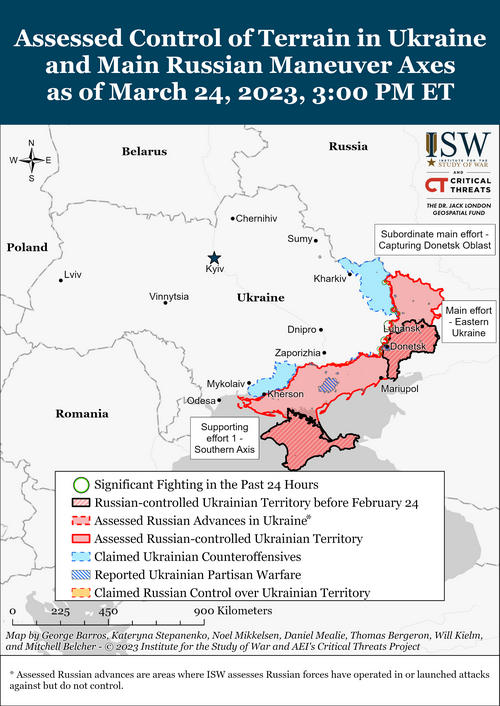
From The Institute For The Study of War:
Russian Offensive Campaign Assessment, March 24, 2023
Karolina Hird, Grace Mappes, Angela Howard, Nicole Wolkov, George Barros, and Frederick W. Kagan
March 24, 4:30pm ET
Click here to see ISW’s interactive map of the Russian invasion of Ukraine. This map is updated daily alongside the static maps present in this report.
Click here to access ISW’s archive of interactive time-lapse maps of the Russian invasion of Ukraine. These maps complement the static control-of-terrain maps that ISW produces daily by showing a dynamic frontline. ISW will update this time-lapse map archive monthly.
Prominent voices in the Russian information space are increasingly setting information conditions to prepare for a potential Ukrainian counteroffensive. Russian Security Council Deputy Head Dmitry Medvedev emphasized on March 24 that the Russian General Staff is aware that Kyiv is preparing for offensive operations and that the Russian General Staff is considering its own decisions and responses to prepare for a Ukrainian offensive.[1] A prominent Russian milblogger claimed that Ukrainian actors are disseminating disinformation about plans for a Ukrainian attack towards Belgorod Oblast, in order to draw Russian troops to border areas and allow Ukrainian troops to launch attacks on other sectors of the front, partially echoing Wagner Group financier Yevgeny Prigozhin’s prior warnings about a Ukrainian push on Belgorod Oblast.[2] Another Russian milblogger warned that Ukrainian forces will likely try to launch a counteroffensive before the Russian defense industrial base (DIB) gains the capacity to increase production and bolster Russian defensive potential.[3] Wagner Group financier Yevgeny Prigozhin similarly claimed on March 23 that he knows of plans for an extensive Ukrainian counteroffensive, as ISW previously reported.[4] The wider Russian spring offensive appears to be culminating, and the Russian information space appears to be responding to the slow-down of Russian operations and potential for Ukraine to regain the initiative with substantial anxiety.[5] Russian military command will need to commit a significant number of forces to the frontline to either prevent culmination or launch renewed offensive operations, and it is unlikely that such forces exist at sufficient scale to do either.
Crimean occupation head Sergey Aksyonov has reportedly formed a Wagner Group-affiliated private military company (PMC) in occupied Crimea. Independent Russian investigative outlet Vazhnye Istorii (iStories) reported on March 23 that Aksyonov has publicly sided with Wagner Group financier Yevgeny Prigozhin against the Russian Ministry of Defense (MoD) and created PMC “Convoy” under the leadership of Prigozhin associate Konstantin Pikalov, who has led Wagner operations in Africa.[6] PMC ”Convoy” is reportedly a BARS (combat reserve) unit, meaning that ”Convoy” servicemembers sign two contracts—one with ”Convoy” itself and one with the Russian MoD.[7] iStories reported that ”Convoy” initially consisted of 300 people and has been deployed to occupied Kherson Oblast.[8] The iStories report is particularly noteworthy against the backdrop of Wagner’s and Prigozhin’s continually declining influence in Russia and loss of access to convict recruits. Prigozhin and Prigozhin-affiliated elements may be trying to diffuse Wagner’s remaining power by creating separate PMCs and other parallel military formations in addition to launching new recruitment efforts through traditional channels.[9] Aksyonov additionally appears to have affiliated himself and the Crimea occupation administration with Prigozhin, which may have important implications for the role of forces from occupied Crimea in subsequent phases of the war.
Some prominent Russian milbloggers criticized the Russian military command for continuing to impale Russian forces on Vuhledar with ineffective human-wave style frontal assaults. The milbloggers claimed that current Russian tactics against Vuhledar, which include an initial frontal assault followed by assaults against fortified Ukrainian flanks, result in high Russian combat losses resulting in no gains due to challenging terrain, lack of combat power, and failure to surprise Ukrainian forces.[10] The milbloggers called on Russian forces to cut Ukrainian ground lines of communication (GLOCs) into Vuhledar both with strikes against rear GLOCs and by encircling the settlement for a multi-vector attack, but implied that Russian forces are unable to implement these suggestions due to munitions shortages and the failure to take many settlements surrounding Vuhledar.[11] Russian forces are unable to sustain any significant rate of advance anywhere on the front line using these human-wave style attacks, and the Vuhledar area once held informational significance to Russian milbloggers during the offensive for Pavlivka in in late October and early November 2022.[12] The Russian 155th Naval Infantry Brigade has been destroyed and reconstituted as many as eight times since the start of the war in large part due losses sustained during the prolonged effort against Vuhledar.[13] The re-emergence of vitriolic criticism about Russian failures near Vuhledar likely reflects the information space’s ongoing frustration with the Russian military command amid deep-seated fear about a prospective future Ukrainian counteroffensive. It is possible that Russian forces are undertaking a renewed and inconsistent push to take Vuhledar in the style of limited and localized ground attacks, though it is also possible that the sources claiming as such are engaging in circular reporting or re-reporting old events.[14]
Russian President Vladimir Putin held a meeting with the Russian Security Council likely as part of his effort to portray himself as a present and effective wartime leader. The meeting centered around Russia’s effort to develop its electronics industry, though the Kremlin readout provides little detail about the meeting itself.[15] Russia has been seeking ways to mitigate the effect of Western sanctions on the Russian defense industrial base (DIB), which relies on electronics to produce advanced materiel and weaponry.[16] Belarusian President Alexander Lukashenko has notably claimed that Belarus can produce weapons for Russia given Belarus’s access to electronics, and Russia and Belarus recently signed an agreement on furthering their respective electronics industries.[17] This meeting likely aimed to portray Putin as holding the Russian Security Council responsible for mobilizing the DIB to meet wartime demands while not providing evidence of any progress towards this goal.
Key Takeaways
- Prominent voices in the Russian information space are increasingly setting information conditions to prepare for a potential Ukrainian counteroffensive.
- Crimean occupation head Sergey Aksyonov has reportedly formed a Wagner Group-affiliated private military company (PMC) in occupied Crimea.
- Some prominent Russian milbloggers criticized the Russian military command for continuing to impale Russian forces on Vuhledar with ineffective human-wave style frontal assaults.
- Russian President Vladimir Putin held a meeting with the Russian Security Council likely as part of his effort to portray himself as a present and effective wartime leader.
- Russian forces conducted limited attacks along the Kupyansk-Svatove-Kreminna line.
- Russian forces have made gains in and around Bakhmut and conducted ground attacks in the Avdiivka-Donetsk City area.
- The Ukrainian General Staff corrected its March 23 statement that Russian forces withdrew from Nova Kakhovka, occupied Kherson Oblast.
- Russian occupation authorities announced the creation of a pro-Russian militaristic youth movement aimed at brainwashing children.
- The Russian government is adopting new measures to revitalize and eliminate corruption, lethargy, and resistance in Russia’s defense industrial base (DIB).
- The United Kingdom Ministry of Defense (UK MoD) reported on March 24 that at least 1,000 Russian personnel training at the 230th Combined Arms Obuz-Lesnovsky Training Ground in Brest, Belarus, redeployed to Russia.
Go here to read the rest. Both sides are now waiting for the Ukrainian offensive to begin and the historical orchestra is warming up in the background.


Putin is claiming that he is putting nukes in Belarus.
Most of the Belarusian people despise their government and Russian influence.