Donald R. McClarey
Cradle Catholic. Active in the pro-life movement since 1973. Father of three, one in Heaven, and happily married for 43 years. Small town lawyer and amateur historian. Former president of the board of directors of the local crisis pregnancy center for a decade.
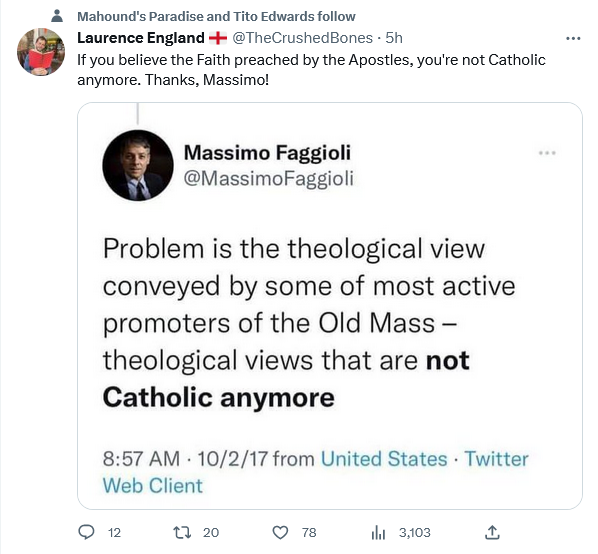



Not Catholic anymore? He means “not in fashion anymore”. But he throws in the word “theology” to sound sharp. Why, if our faith was that interchangeable it would not have lasted a single year past the crucifixion of Our Lord. People like Massimo have nothing better to do than to pick on the traditionalists. And I think it’s jealousy which drives people like him. My theory is that he probably doesn’t have the same reverence, loyalty and discipline as a traditionalist, and he really can’t be bothered to try and attain these virtues. So, he drags everyone down to the level of mediocrity where he is most comfortable.
Agreed Ezabelle.
The Church of Nice can’t stomach the true Faith bc of it’s nonconformity to bless sinfulness, sinful behavior.
To bless same sex couples within the Church via so-called marriage is removing God from His Church.
A common practice among many Christian denominations.
Massimo probably makes a good gravy for the pasta. His theological views should be tossed out the window.
Philip- yep, and he would rather toss the pasta out and drink the pasta water and call it a might good meal.
Just like Rachel Levine isn’t a man anymore?
The original Mass – that is to say, the Last Supper – was given in Aramaic, not Latin, not even Koine Greek. Likely Aramaic was the language used to celebrate the Mass for decades among the early Jewish Christians (though they didn’t call it Mass).
Then as more Gentiles became Christian, the New Testament books got written in Koine Greek (the lingua Franca of the eastern part of the Roman Empire), and the Mass was soon celebrated in that language by the undivided Church, and is even still celebrated that way up to the present day by many Eastern Orthodox Churches (they call it Divine Liturgy). Their Divine Liturgy in Koine Greek is as valid as the West’s Latin Mass (excommunications were mutually lifted in the early 1960s).
Eventually, because the Western part of the Empire was Latin-speaking, the Mass came to be celebrated in Vulgate (Common, not ignoble) Latin. The change in the West was NOT made because Latin is a more holy language (it’s not) but because it was the language which the people in the West could understand (sort of like us using English nowadays). The East continued for the most part to use Greek, and Jewish and Syrian Christians likely still continued to use Aramaic for a time.
Now all these things said, Pope Francis’ banning the Latin Mass of the West is 100% wrong. As a person who understands Latin, I enjoy attending Latin Mass (as I am able). But far more importantly, it’s just plain stupid to throw out centuries if not millennia of history, and to deprive many people who truly benefit spiritually from the Mass in Latin. But a reverently conducted Novus Ordo with Eucharistic Prayer 1 and the priest facing Ad Orientem is just valid and just as holy as a Mass in any other language, including Latin, Koine Greek and Aramaic. Now yes, there is much to be said for the rites and ceremonies unique to the Latin Mass. It is like heaven on earth. But if you can’t get heaven on earth in the primary language that you speak, then you surely won’t get it from an ancient language that you don’t speak.
Sidenote: if I had my way, everyone would be compelled learn Latin and Greek in high school (which my Dad made me learn), and the Mass would be given in only Latin, Greek and Aramaic (and Old Church Slavonic for our Russian friends). But God has wisely seen fit to ensure that I shall never be in charge of anything, including the decor and setup of the rooms in my house, and the nuclear course assignments I must teach at Neutrons ‘R Us. 😉 .
Thanks LCQ for a rational discourse on language in the liturgy.
Great history, LQC, and I fully agree with your points. I rarely can attend a TLM here in the Dallas diocese because the past several bishops, whole not actively trying to kill it, have relegated it to a single parish on the extreme western boundary of the diocese, which is in the middle of some of the worst traffic congestion in this whole area. That makes it an hour’s drive each way even on weekends. When we are enjoying the cooler summers of NW Illinois, it’s at least sixty miles one way to find a TLM. My bride is not willing to make those treks, so we stick with our local NO parish in both locations. Nevertheless, I would attend TLM exclusively if I had the chance, and not because of the Latin, which is a red herring in my opinion. Yes, it sounds beautiful, especially with a well-trained Schola chanting propers. But the point for me is the content. What do the Mass texts actually say? I’ve made this point here at TAC before, but a comparion of the text of the 1962 Missale Romanum with that of the current Missal quickly shows that the principal feature of the Novus Ordo, aside from what language is used, is the elimination of so many prayers and gestures that the “new” celebration seems like reading the Cliff Notes instead of the “real thing.” The Latin Mass Society of UK (lms.org.uk) used to have a handy side by side comparison on their site, which I can’t seem to find today. But you can do the exercise yourself. In the end, while those who seek to validate the gutting of the text insist that “all or nearly all of the prayers are still there”, even a cursory comparison shows this to be a wild exaggeration. Depending on how one counts prayers, the NO contains anywhere from 17% to 48%, in whole or in part, of the prayers in the 1962 Missal. This article spells out the differences in intricate detail. https://www.newliturgicalmovement.org/2021/07/mythbusting-how-much-of-1962-missal-is.html#.Y_tiMBBMGhA
So, taking the 48% figure, even the most generous estimate shows us that the Church has, since imposition of the Novus Ordo Missal, simply eliminated over half of the prayers of the Mass. If we believe in the necessity and efficacy of prayer, my simple question is: How can this possibly be a good thing? Add to this, of course, the systematic elimination of traditional devotions and observations that has accompanied the post-conciliar revolution, and you have a severely dumbed-down faith, which inevitably leads to millions upon millions of dumbed-down Catholics. Example: a few years ago I was asked to lead a group prayer at the annual “thanks to our teachers” luncheon for our parish pre-school, of which I am a Board member, as our pastor had been called away. I decided we would say the Angelus, just because I personally love to say it. Not a single one of the teachers, including several who are in their sixties, and all of whom are regular Mass-goers, even knew what the prayer was, never mind being able to recite the responses other than the Hail Marys. That was quite a surprise, to say the least. Again, the point of supporting the TLM and traditional devotions is not about the Latin. It’s about the liturgy itself and the power of prayer. If more people knew what has been taken from them, the number who oppose the Vatican’s attempts to kill the TLM entirely would, I believe, be much higher than it is. Complacency is a cancer on the Church in this context.
Mr. Maggioli has no idea what he is talking about. V2 was SUPPOSED to be pastoral in nature, not doctrinal. No pontiff or council has the God given authority to change what has been handed down from Christ through the Apostles and any such man or group should be anathema.
V2 needs a serious reexamination and a syllabus of errors. As for the Novus Ordo, a far superior liturgy is used by the Ordinariate, which as I understand is close to an English trsnslation of the Tridentine Mass.
The Latin Mass is an excellent bulwark against the greatest heresy of our age and perhaps of all time; that of Modernism, which was definitively condemned by Pope St. Pius X. It was the mass of countless saints, though with slight modifications over the centuries. And it remains of inestimable value in that people worldwide, wherever they are, can worship in a common language, certain in the knowledge that as they pray, those prayers will have the same essence in meaning for others, no matter what their native languages may be.
Nothing whatsoever against the N.O., which is the mass I most regularly attend, but, I think the Latin Mass helps connect the faithful of today with the communion of saints, and with all who have worshipped before us. We are after all not just the Church Militant, but the Church Suffering and the Church Triumphant. We need to maintain our spiritual ties with those of the Church, in all three of its manifestations. The Latin Mass is an excellent way of doing exactly that.
He inadvertently typed out the silent part.
The Russian Divine Liturgy still is in Old Church Slavonic. The laity rebelled at the idea of putting it in the vernacular in the early 20th Century.
PF, your point about the Ordinariate liturgy is well taken. And also from the book of Common Prayer, written by Elizabethans, whose command of the English language has not been surpassed.
Here’s where some Ordinariate (Anglican Usage) parishes are located:What territory does the Ordinariate of the Chair of Saint Peter encompass?
Based in Houston, Texas, the Ordinariate includes communities throughout the United States and Canada. Our Lady of Walsingham in Houston is the Cathedral for the Ordinariate of the Chair of Saint Peter. Other large communities include Our Lady of the Atonement, San Antonio, TX; Holy Martyrs, Murietta, CA, Christ the King, Towson, MD; Church of the Incarnation, Orlando, FL; St. Mary the Virgin, Arlington, TX, and St. Thomas More, Scranton, PA. Ordinariate groups and clergy are located in areas such as Maryland, Texas, California, New York and South Carolina; Oshawa, Victoria, Ottawa and Calgary.
Based in Houston, Texas, the Ordinariate of the Chair of Saint Peter has more than 40 Roman Catholic parishes and communities across the U.S. and Canada.
and for an example, the liturgy at its best, go here (a YouTube search “Anglican usage” will show many others):
https://www.youtube.com/watch?v=sBdAhl9u62k&t=63s
Thank you for the positive feedback, Folks.
I have been to Mass at both Anglican Ordinariate and Orthodox Anglican (not affiliated with Canterbury or ECUSA) parishes. Absolutely beautiful. Everything in Elizabethan English. Ad Orientem. Altar rails. Incense and bells. The whole nine yards. The way things are supposed to be.
Our friend Massimo needs to read what St. Paul taught us: “Jesus Christ is the same today as He was yesterday, and as He will be forevemore.”.
“Old theological views are not Catholic anymore”. I wonder, did St. Paul give him a private locution to take back his 60 ish. AD statement?
When reading through the prophets it is not hard to come to the conclusion that our society is the type of thing that they were condemning.
I’m sure there were people in Israel and Judah saying “the problem with those that oppose the asherah poles is that they subscribe to theological views which are not Hebrew anymore.”
I no longer attend a Novus Ordo Mass if I can possibly avoid it. Not because it’s always going to be terrible, but because I never know when a third-rate vaudeville act is going to break out.
Never seen a vaudeville act. Just hymns which sound like repurposed Hallmark channel scores, piano music, a platoon of Eucharistic ministers (none wearing a tie), and the celebrant forever facing the congregation. Also, the lextrix in the most tasteless shoes.
Speaking of Elizabethan English: The KJV of the Bible still refers to God as a thing, a “that” and a “which”. Then WHO are sovereign persons if God is a “which”?. Even the Lord, Jesus Christ is a sovereign person. The Holy Trinity is three sovereign Persons. God is the Supreme Sovereign Being WHO is.
Referring to God as a thing, a “that” or a “which” comes from denying the Real Presence.
Re: The reasons for Latin’s pride of place in the Latin Rite liturgy— whether one is speaking of either Novus Ordo or Vetus Ordo— can be found in Veterum Sapientia.
That Apostolic Constitution was given by St. Pope John XXIII in 1962. He considered it so important he signed it on the high altar of St. Peter’s during Mass on the Feast of St. Peter’s Chair. Sadly, within a few months Pope John died and the Vatican II Council he had called swept all before it.
Give VS a read— it’s admirably concise (just seven pages) and to the point. Interestingly, it has never been abrogated —it’s just been ignored.
I think it’s debatable that the Last Supper was celebrated in Aramaic; there is as much reason to think it was celebrated in Hebrew, which would not have been the vernacular of the day. Apparently evidence from the Essenes shows that Hebrew was in use as a lingua sacra (according to Jeremias, The Eucharistic Words of Jesus), and some textual peculiarities suggest a Hebrew origin, although to be fair there is a single (maybe more have been more recently discovered) manuscript that strongly suggests an Aramaic origin, which may indicate parallel traditions. I don’t think it’s necessarily a slam dunk either way.
The earliest Christian Greek liturgical texts are also not purely Koine Greek, but rather have distinctive hieratic leanings already predicated on the heavy infusion of the LXX into the linguistic content of the language employed, rendering it is some respects an artificial idiom, akin to the distinction between the idiom employed in the ancient Homeric epics (which utilized an idiom never spoken) and classical or Koine Greek. The distinction between literary and vernacular language in the ancient, largely illiterate world was additionally more pronounced. Thus, while the Greek used in the liturgy would be “understandable” in some respect, it would also be at the very least “exotic” in many respects, especially to those not brought up in a milieu suffused with the LXX. The shift from Greek Christian literature being more heavily Hellenistic and less “Judaistic” doesn’t occur until the period of or after the Apologists, suggesting (among other reasons as well) that the vernacular wasn’t the only reason for the early utilization of Greek. (See Christine Mohrmann’s Liturgical Latin: Its Origins and Character.)
The Church of Rome had Latin as a common language since at least the middle of the second century, but the liturgical Latin that emerged in the 4th century was neither Classical nor Vulgar, but rather a heavily stylized hieratic idiom. This was keeping to a large extent with the traditional Roman religious ethos which valued a sacral language; Quintilian quips about how “the hymns of the Salii are barely understood by their own priests; and yet their religion prohibits the hymns from being changed.” This combined with many other factors led to a late development of Latin into a liturgical language that was not simply a vernacular. (ibid.)
I think it’s also important to avoid the modern positivist tendency to reduce language to its communicative aspect. Since hieratic language is practically a universal phenomenon, the expressive character of language is just as important. Ancient liturgies especially do not have language as an accidental accoutrement, but rather have that language form an indispensable part of its superstructure. The difference between the various ancient liturgies isn’t simply a difference in translation, but the various rites and essential characteristics flow to a large extent from the language employed. As an example, in the Roman rite the chants are wholly infused with Latin and constructed on its grammatical and phonetic structure. With some ingenuity some of the chants can be force-fit into the vernacular to more or less (usually less) success, but only by losing much of the organic unity which characterizes them as Gregorian chant. This is no doubt why Paul VI recognized that by abandoning Latin chant would by and large be lost.
It would also be one thing if the liturgical reform was simply rendering the Roman rite into the vernacular. Rather, only about 17% of the orations were not modified or completely rewritten, to say nothing of making the canon (one of the most unique characteristics of the Roman rite) optional, destroying the Divine Office, moving away from a yearly lectionary, remaking the calendar, rewriting the rites of the sacraments, etc.
If language is not merely communicative but also expressive (as every era of humanity has intuitively known prior to the modern era), then at the very least the data of the past half century would at least I think allow one to question if the prioritization of the communicative mode of language has been successful.