
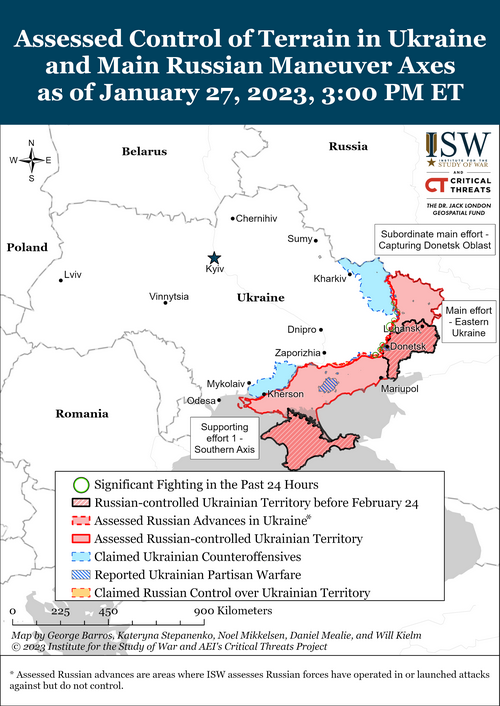
From The Institute For The Study of War:
George Barros, Kateryna Stepanenko, Riley Bailey, Grace Mappes, Angela Howard, and Frederick W. Kagan
January 28, 6 pm ET
Click here to see ISW’s interactive map of the Russian invasion of Ukraine. This map is updated daily alongside the static maps present in this report.
Conventional Russian forces are likely replacing exhausted Wagner Group forces to maintain the offensive in Bakhmut after the Wagner Group’s offensive in Bakhmut culminated with the capture of Soledar around January 12. The Wagner Group’s assault on Bakhmut has likely culminated with its surge on Soledar. Wagner Group forces in Bakhmut have not made significant gains since capturing Soledar around January 12. Conventional Russian units are now participating in fighting in Bakhmut to reinvigorate the Russian offensive there. Combat footage posted on January 20 indicates Russian Airborne Forces (VDV) are operating around Bakhmut as the footage shows a Russian BMD-4M – niche mechanized equipment exclusively used by the VDV.[1] A Russian source reported that Wagner and VDV elements conducted joint operations in Bakhmut on December 27.[2] The Russian Ministry of Defense has been increasingly reporting that Russian VDV are operating in the Bakhmut area since early January 2023, indicating conventional Russian forces are augmenting if not replacing likely culminated Wagner forces in the area.[3] Wagner Group forces – particularly convicts – have taken heavy causalities in Bakhmut since the fall of 2022. One anonymous US official reportedly stated on January 5 that the Wagner Group’s forces have sustained more than 4,100 deaths and 10,000 wounded, including over 1,000 killed between late November and early December near Bakhmut.[4]
Ukrainian officials have maintained that the Russian offensive on Bakhmut has not culminated.[5] ISW has previously assessed that the Russian offensive on Bakhmut was culminating.[6] We continue to assess that the Wagner offensive has culminated, but now assess that the Russians are committing conventional units to continue the fight. The larger Russian effort against Bakhmut has likely thus not culminated.
Russian forces are attempting to prevent Ukraine from regaining the initiative possibly ahead of a planned decisive Russian offensive in Donbas. Chief of the Russian General Staff Valery Gerasimov stated on December 22 that Russian forces are focusing most of their efforts on seizing Donetsk Oblast, which likely entails Russian forces capturing key positions in western Luhansk Oblast and northeastern Donetsk Oblast to reach the oblasts’ administrative borders.[7] Russian forces have resumed ground attacks in the Vuhledar area (which they unsuccessfully attempted to reach in late October 2022) and are conducting small-scale assaults in Zaporizhia Oblast and around Donetsk City. Russian forces are conducting a large-scale offensive operation on the Bakhmut frontline as their current main effort and a defensive operation, for now, on the Svatove-Kreminna line.[8]
The localized attacks on Vuhledar and settlements in Donetsk and Zaporizhia oblasts are likely intended to disperse Ukrainian troops and set conditions for a decisive Russian offensive in western Luhansk Oblast, as ISW had previously assessed.[9] Russian forces may be attempting to disperse the Ukrainian grouping of forces on the Svatove-Kreminna line to enable a Russian recapture of Lyman, Donetsk Oblast. Russian forces could seek to use Lyman as a launching point for a decisive offensive to secure Donbas by conducting an offensive from Lyman in tandem with a drive on Bakhmut or from Bakhmut toward Slovyansk if the Russians succeed in capturing Bakhmut. The Russians may imagine that they can drive from their current positions directly to the Donetsk Oblast border along several independent lines of advance, although it is unlikely that they would not recognize the extreme improbability of success in such an attempt. The Russians more likely intend to pursue several phases of offensive operations culminating with securing the borders of Donetsk and Luhansk oblasts. These phases would likely require anywhere from six to 12 months of Russian campaigning, if they are possible at all, extrapolating from past Russian operational patterns and assuming higher levels of Russian combat power and capability than ISW has observed since the start of the war.
Russian forces likely lack the combat power necessary to sustain more than one major offensive operation while fixing Ukrainian forces in western Donetsk and eastern Zaporizhia oblasts. There is no open-source evidence to suggest that Russian forces have regenerated sufficient combat power from their losses in the early phases of the war to enable Russian forces to conduct simultaneous large-scale mechanized offensives in the next several months. The Russian military has not demonstrated the capability to conduct simultaneous combined arms offensive operations since early 2022. Russia’s most recent gains around Bakhmut relied on months of human wave attacks to secure territorial gains around Bakhmut by brute force at tremendous human costs. Russia’s earlier capture of Severodonetsk and Lysychansk in summer 2022 also did not utilize combined arms but instead relied on large-scale rolling artillery barrages to methodically destroy Ukrainian positions. Russian forces are experiencing growing artillery ammunition shortages that would prevent them from repeating these tactics.[10] It is unlikely, moreover, that the conventional Russian military will be willing to take the kinds of horrific losses the human wave tactic has inflicted on Wagner’s convicts. The Russians’ ability to execute large-scale rapid offensives on multiple axes this winter and spring is thus very questionable.
The conventional Russian military still must undergo significant reconstitution before regaining the ability to conduct effective maneuver warfare. The Russian Ministry of Defense’s (MoD) plans to significantly increase the size of Russia’s military with 12 new maneuver divisions will take at least until 2026, if this effort succeeds at all.[11] Western intelligence and defense officials have not issued any indications that Russia’s effective mechanized warfare combat power has recently increased, and ISW has not observed any indicators along those lines.
The Russian military leadership may once again be planning an offensive operation based on erroneous assumptions about the Russian military’s capabilities, however. Russia’s military failures in Kyiv, Kharkiv, and Kherson oblasts have demonstrated time and again that Russian military leadership overestimates the Russian military‘s own capabilities. The degraded Eastern Military District naval infantry elements that are currently attacking Vuhledar will likely culminate even if they succeed in capturing the settlement.[12] The Ukrainian loss of Vuhledar, if it occurs, would not likely portend an immediate Russian breakthrough on multiple lines of advance in Donetsk or in the theater in general, therefore. Ukraine‘s spring rain season (which normally occurs around April) will degrade the terrain’s suitability for maneuver warfare. If Russian forces attempt simultaneous mechanized offensives in the next two months they would likely disrupt Ukrainian efforts to conduct a counteroffensive in the short term, but such a Russian offensive would likely prematurely culminate during the spring rain season (if not before) before achieving operationally significant effects. Russian forces’ culmination would then generate favorable conditions for Ukrainian forces to exploit in their own late spring or summer 2023 counteroffensive. Ukraine would additionally be seeing growing benefits from the incorporation of Western tank deliveries that have only just been pledged.
The Russians are thus very unlikely to achieve operationally decisive successes in their current and likely upcoming offensive operations, although they are likely to make tactically and possibly even operationally significant gains. Ukraine will very likely find itself in a good position from which to conduct successful counteroffensive operations following the culmination of Russian offensives before or during the spring rainy season—always assuming that the Ukrainians do not preempt or disrupt the Russian offensives with a counter-offensive of their own.
The Russian military’s decreasing reliance on Wagner forces around Bakhmut is likely reducing Wagner Group financier Yevgeny Prigozhin’s influence. ISW assessed on January 22 that the Kremlin likely turned to Prigozhin’s irregular forces to get through a rough period following the culmination of Russian conventional forces’ offensive in Luhansk Oblast over the summer of 2022, which misled Prigozhin into overestimating his importance in the Russian military and political spheres.[13] The Kremlin, however, will not need to appease Prigozhin if Russian conventional forces continue to take responsibility for the Bakhmut frontline. ISW has reported that the Kremlin likely has already been slowly terminating his privileges.[14] Gerasimov and the Russian Ministry of Defense (MoD) have also embarked upon new efforts to professionalize the army, an effort that, if successful, would marginalize parallel military formations such as the Wagner Group.
Prigozhin is likely sensing and is overcompensating for his declining influence and has therefore begun to attack the nationalist veteran faction. The veteran faction has been demanding that the Russian military command fix flaws within its conventional campaign instead of focusing on ineffective and unconventional solutions since at least May 2022.[15] Prigozhin continued on January 28 to berate Igor Girkin – a prominent Russian nationalist voice and a former Russian officer who has connections with the Russian veteran community – with vulgar insults and accusations that he is responsible for Russian forces’ loss of Slovyansk in 2014.[16] Prigozhin accused Girkin, Russian State Duma Parliamentarian and Committee on Defense member Lieutenant General (Ret.) Viktor Sobolev, and Leader of the Russian Liberal Democratic Party Leonid Slutsky of living in a past in which Russia relied on conventional forces.[17] Sobolev previously supported the Russian MoD effort to professionalize the military by enforcing grooming standards, and Slutsky avidly advocated for the Kremlin to declare mobilization to rectify the dire situation on the frontlines in early fall 2022.[18] Prigozhin went after these three individuals likely in an effort to undermine their credibility and advocacy for reforms and improvements within the military that further marginalize his undisciplined and brutal parallel military forces.
Prigozhin is also facing bribery accusations, which may further diminish his reputation regardless of their validity. Prigozhin responded to a media inquiry on January 27 regarding speculations that he receives bribes from convicts who do not then serve on the front lines but still receive a pardon for their “service.”[19] The allegations claimed that Prigozhin had recruited and soon released convicted Lipetsk Oblast Parliamentarian Andrey Yaitskiy (who some commentators speculated was physically unfit for military service), which granted him a pardon in exchange for a bribe.[20] Prigozhin attempted to deflect the accusations by claiming that Wagner discharged Yaitskiy with honors following his heavy injuries sustained on the frontlines and included purported testimony from Yaitskiy’s alleged commanders who portrayed him as a hero.[21] ISW cannot independently verify these bribery accusations against Prigozhin, however, their emergence is notable given that corruption and bribery is endemic in Russia and a hated cultural vice among Russians.
Key Takeaways
- Conventional Russian forces are likely replacing exhausted Wagner Group forces to maintain the offensive in Bakhmut after the Wagner Group’s offensive in Bakhmut culminated with the capture of Soledar around January 12.
- Russian forces are attempting to prevent Ukraine from regaining the initiative possibly ahead of a planned decisive Russian offensive in Donbas.
- Russian forces likely lack the combat power necessary to sustain more than one major offensive operation while fixing Ukrainian forces in western Donetsk and eastern Zaporizhia oblasts.
- The Russian military leadership may once again be planning an offensive operation based on erroneous assumptions about the Russian military’s capabilities
- The Russian military’s decreasing reliance on Wagner forces around Bakhmut is likely reducing Wagner Group financier Yevgeny Prigozhin’s influence.
- Russian forces reportedly continued limited counterattacks to regain lost positions along the Svatove-Kreminna line.
- Ukrainian forces continued to strike Russian rear areas in Luhansk Oblast.
- Russian forces continued offensive operations in the Bakhmut and Avdiivka-Donetsk City areas. Russian forces continued a localized offensive near Vuhledar in western Donetsk Oblast.
- Russian sources did not report any Russian ground attacks in Zaporizhia Oblast for the second consecutive day on January 28.
- Some Russian citizens continue limited efforts to sabotage Russian force generation efforts.
- Russian occupation officials continue to set conditions for the long-term forced deportation of Ukrainian children to Russia.
Go here to read the rest.
From Strategy Page:
January 28, 2023: When it comes to the Ukraine War, Belarus is definitely a Frenemy (friend and enemy) of southern neighbor Ukraine and a hostage to eastern neighbor Russia. Belarus only has about a fifth of Ukraine’s population and a less vibrant and aggressive form of nationalism. Technically Belarus is an ally of Russia in its war in Ukraine, yet most Belarusians are pro-Ukraine. Some have actively helped Ukraine from inside Belarus while a few have crossed the border and joined the Ukrainian Foreign Legion.
The ruler of Belarus since 1994 is Alexander Lukashenko, a veteran communist official in the Soviet Union until 1991. Lukashenko was active in the three-year process to create a new constitution and hold elections. Lukashenko won the first presidential election, which was his only legitimate victory. After that he rigged the elections in one way or another to remain in power. He developed close ties with Russia and Vladimir Putin but refused to back Russian demands that he allow closer links with Russia that would eventually make Belarus part of Russia. This resistance was tolerated because Lukashenko was otherwise an ally of Russia and used Russian assistance to block efforts in Belarus to reduce Russian influence. This helped Lukashenko remain in power but also enabled Russia to stage part of the 2022 invasion from Belarus. Belarussian railway workers sabotaged the rail lines into Ukraine and that played a role in the defeat of Russia’s northern offensive into Ukraine and attempt to seize the Ukrainian capital Kyiv. Eventually some of the railway workers responsible were identified, prosecuted and sent to prison. Most Belarussians considered these railway workers heroes. Popular attitudes like this made Lukashenko even more dependent on Russian protection. This included stationing Russian troops in Belarus and Lukashenko allowing Russian troops to be trained in Belarus.
Despite all this Lukashenko refused to send his troops to join Russian forces inside Ukraine. The main obstacle to that happening is that Russia wants to annex Belarus as well as Ukraine. Before 2022, Belarus was seen as the next former Soviet territory to be annexed by Russia. The response of Ukrainians to Russian invasion has changed attitudes towards annexation of Belarus. This is despite the fact that the longtime (since 1994) Belarus president-for-life Alexander Lukashenko has ruled Belarus as a loyal ally of Russia. That has not helped the Belarussian economy or improved the lives of Belarus voters. A new post-Soviet Union generation of voters noticed how life was better in democracies, especially other former victims of Russian rule like neighboring Poland, Lithuania, Latvia, Estonia, and Ukraine. They blame Lukashenko for the poverty and mismanaged economy in Belarus, as well as an incompetent response to covid19.
Since 2020 Lukashenko has faced growing popular protest against government incompetence and decades of rigged elections, corrupt rule, and inability to do much of anything effectively. Since the late 1990s Lukashenko has won reelection with 80-90 percent of the vote in visibly fraudulent elections. Lukashenko is a Soviet era official, who runs Belarus using the Soviet Union as a model. Belarus is a police state, where elections, and everything else, are manipulated to keep the same politicians in power. It’s a tricky business but so far Lukashenko has kept his security forces loyal and up to strength. He bribes or bullies key officials to keep the country running. Lukashenko has maintained good relations with Russia, getting him cheap fuel supplies and other aid. Belarus is small (9.5 million people) compared to neighbors Russia (146 million) and Ukraine (42 million) and Russia wants to absorb Belarus and Ukraine to rebuild the centuries old Russian empire that the czars created and the communists lost. Lukashenko, like most Belarussians, opposes annexation by Russia. So far Russia is not actively seeking to annex Belarus or send in security forces to help suppress what has turned into a rebellion against Lukashenko.
Lukashenko is becoming more of a liability for Russia but is currently still a “favored ally.” Russia would like to be rid of Lukashenko but there is no one in Belarus with his skills, experience and pro-Russia attitude. Russia has created a major problem for itself in Belarus. Not as bad as the mess in Ukraine, but still another setback in the Russian effort to rebuild the Soviet-era Russian empire. Lukashenko noted what happened to pro-Russia Ukrainian politicians after the Russians invaded and most Ukrainians joined or supported the fight against Russian domination and any pro-Russia Ukrainians. Lukashenko openly admitted his surprise at how the Ukrainian invasion had slowed down and the ability of the Ukrainians to organize a counteroffensive. While Ukraine might defeat Russia and clear them out of Ukraine, Russia will still be there and still a threat to Belarussian independence. At the same time Lukashenko needs economic assistance and some Russian troops to keep himself in power. This is a dangerous game but one Lukashenko has been playing successfully for over twenty years.
Go here to read the rest. January is ending and no sign of a winter offensive on either side. The major offensives likely will not start until spring this year.


Belarus and Western Ukraine were part of the Polish Lithuanian Commonwealth. The Belarusian and Polish people have a similar culture and ties that go back centuries. Belarus was ancient Lithuania.
Most Belarusians hate Lukashenko with a passion. Should that thug attack Ukraine, Belarus itself will get invaded. It may be the tipping point to cause his removal. Loukshrnko isn’t nice to anyone, but his treatment of ethnic Poles stuck in Belarus is more than annoying to the Polish government, which is arming itself to the teeth.