
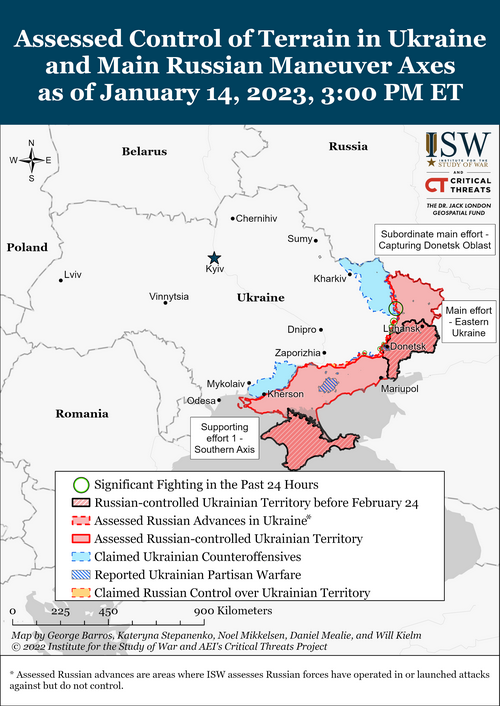
From The Institute For The Study of War:
Kateryna Stepanenko, Riley Bailey, Angela Howard, and Mason Clark
January 14, 7:30 pm ET
Click here to see ISW’s interactive map of the Russian invasion of Ukraine. This map is updated daily alongside the static maps present in this report.
Russian forces launched two waves of missile strikes targeting Ukrainian critical infrastructure on January 14. Ukrainian officials reported that Russian forces conducted 50 missile and three airstrikes against Kyiv, Kharkiv, Odesa, Kryvyi Rih, Dnipro, Vinnytsya, and unspecified settlements in western Ukraine.[1] Russian missile strikes on Dnipro City damaged an apartment building, killing at least 5 people and wounding over 60.[2] The Ukrainian General Staff reported that Russian forces struck Ukrainian cities and settlements in two waves: first employing S-300 and S-400 systems in Belarus against ground targets in Kyiv and Kyiv Oblast in the morning and later launching 28 cruise missile strikes using Kh-101/Kh-555, Kh-22, sea-based Kalibr, and Kh-59 guided air missiles.[3] The Ukrainian General Staff added that Ukrainian forces shot down 18 cruise missiles and three guided air missiles.
Ukrainian Air Force Spokesperson Yuriy Ignat stated that Russian forces used missiles fired with a sharp ballistic trajectory, possibly modified S-300 and S-400 missiles or Iskander-M systems, to strike Kyiv, noting that Ukrainian forces cannot currently shoot these missiles down when fired from short-range.[4] Ignat explained that S-300 and S-400 missiles launched from Belarus can hit Kyiv in less than two minutes. Ignat stated that Ukraine can only effectively prevent these strikes by destroying Russian S-300 complexes with Ukrainian long-range systems. Ignat added that Russian forces have previously used these modified systems to target Ukrainian infrastructure in Kharkiv and Mykolaiv oblasts.
The Kremlin continues to falsely claim that Ukraine poses an existential threat to Russia to reject Ukrainian offers of a peace summit and retain Putin’s original maximalist goals. Russian Permanent Representative to the United Nations Security Council Vassily Nebenzya responded to Ukrainian proposals for a peace summit on January 13 with a series of false claims framing Ukraine as an aggressor that was, ludicrously, “about to attack Moscow.”[5] Nebenzya stated that Russia’s war in Ukraine will only end “when the threat to Russia no longer comes from the territory of Ukraine” and when “the discrimination [against] the Russian-speaking population” in Ukraine ends.[6] Kremlin claims of discrimination against Russian speakers in Ukraine are a longstanding information operation seeking to justify Russia’s invasion of Ukraine.[7] Nebenzya reiterated the Kremlin’s narrative that Ukraine’s refusal to recognize Russia’s illegal annexation of occupied Ukrainian territories and relationships with the West threaten Russia and claimed that Ukrainian ties with the West (rather than Russia’s invasion and occupation of Ukraine) undermined Ukraine’s sovereignty and cultural identity.[8] Nebenzya claimed Ukraine is not interested in negotiations and is no more than a NATO paramilitary company—both longstanding claims that the Kremlin intends to delegitimize Ukraine as an independent actor and shift the responsibility for negotiations onto Western officials, who the Kremlin likely believes Russia can pressure into preemptive concessions.[9] Nebenzya asserted that if the Kremlin cannot achieve its maximalist goals through negotiations, it will achieve them through military means.[10] Nebenzya’s speech again demonstrates that the Kremlin has not abandoned its maximalist goals in Ukraine, false justifications for its unprovoked war of aggression, and will seek to coerce the West to negotiate over Ukraine’s head.[11]
The Kremlin continues to use long-standing false narratives that the Ukrainian government is oppressing religious liberties as moral justification for its refusal to negotiate with Ukraine, likely in the hopes of turning international public opinion against Ukraine. Nebenzya claimed in his address that the “Zelensky regime” is an “authoritarian dictatorship” that desires “to destroy the canonical church in Ukraine—the Ukrainian Orthodox Church.”[12] Nebenzya likely deliberately misrepresented the Ukrainian Orthodox Church Moscow Patriarchate (UOC MP)—a Kremlin-affiliated institution—as the official Ukrainian Orthodox Church, which is a separate entity from the UOC MP. Nebenzya argued that such an “authoritarian dictatorship” represents a major obstacle to peace talks and requested a special meeting of the United Nations Security Council to discuss alleged state persecution of the “Ukrainian Orthodox Church.”[13] Ukrainian officials are not persecuting religious liberty or the Ukrainian Orthodox Church, however. Russian officials are intentionally misrepresenting Ukrainian efforts to prosecute Kremlin-linked elements of the UOC MP as persecution of the Ukrainian Orthodox Church. The Ukrainian Orthodox Church is an independent entity that continues to operate in Ukraine, while the UOC MP is a non-independent subordinate branch of the Kremlin-controlled Russian Orthodox Church, which has fiscally and rhetorically supported Russia’s war in Ukraine.[14]
Wagner financier Yevgeny Prigozhin continued to leverage the Wagner Group’s role in capturing Soledar to elevate his political stature and indirectly criticize the conventional Russian military. Prigozhin published footage on January 14, which he claimed was filmed in Soledar, promoting Wagner’s claimed role in capturing the town.[15] Prigozhin introduced the Wagner Group commander who oversaw the capture of the settlement and extolled Wagner’s capabilities compared to the conventional Russian military.[16] Prigozhin stated the Wagner Group succeeded due to its wealth of experience, its independence, its effective military equipment, and its superior management system.[17] Prigozhin claimed the Wagner Group’s management system incentivizes commanders and subordinates to work closely together on the ground and allows the complaints of regular fighters to be heard.[18] Prigozhin likely highlighted these elements, true or not, to distinguish the Wagner Group from the conventional Russian military and likely advertise for further recruitment and denigrate conventional Russian forces, lobbying for an increased role for Wagner Group—and himself—in the war in Ukraine.
Key Takeaways
- Russian forces launched two waves of missile strikes targeting Ukrainian critical infrastructure on January 14.
- The Kremlin continues to falsely claim Ukraine poses an existential threat to Russia to reject Ukrainian offers of a peace summit and retain Putin’s original maximalist goals.
- The Kremlin continues to use long-standing false narratives that the Ukrainian government is oppressing religious liberties as moral justification for its refusal to negotiate with Ukraine and likely in the hopes of turning international public opinion against Ukraine.
- Wagner financier Yevgeny Prigozhin continued to leverage the Wagner Group’s role in capturing Soledar to elevate his political stature and indirectly criticize the conventional Russian military.
- Russian forces continued limited counterattacks along the Svatove-Kreminna line.
- Russian forces continued offensive operations around Soledar as well as in the Bakhmut and Avdiivka areas. Ukrainian forces are highly unlikely to still hold positions within the settlement of Soledar itself.
- Russian forces continued defensive operations and reinforced frontlines positions on the east (left) bank of the Dnipro River in Kherson Oblast.
- Western officials are increasingly joining Ukrainian authorities in warning that Russia is preparing for an imminent second wave of mobilization.
- Russian occupation officials in Kherson continued measures to forcibly relocate residents to Russia.
- Ukrainian partisan attacks continue to disrupt Russian rear security efforts.
Go here to read the rest. The latest big development is that the Ukrainians are getting Western tanks. The Russians have suffered severe losses in armor, and the Ukrainians have plenty of tanks of Russian manufacture. However these are knockoffs of Soviet tank designs with mostly 20th century technology, with slap dash 21st century add-ons. The best Russian tank is the t-90, which entered service in 1992, with the latest variant being the t-90M. Without Western tanks the Ukrainians have nullified the Russian advantage in armor. With Western tanks, the Ukrainians can speed up their big offensives.


I have a friend who is absolutely insistent that Putin’s goal is not genocide of the Ukrainians as a people & a nation. He says that Putin’s goal is not genocide of the Ukrainians. I told him that the statements Outin has made about genocide have been public so there is no question about Putin’s goal. He says that I am only getting that idea from the MSM. I told him I don’t get my info from the MSM. He is convinced the only way that Ukraine has a chance to survive is to call a truce & make a deal giving up land to the Russians. I told him the only chance Ukraine has to survive is to fight for its very existence. He is just sure that the Ukrainians are going to be over run by the Russians in the next t 3 months. Where is this guy getting his info?
There are plenty of people on the internet who swallow all the propaganda that Putin wishes to produce. I have to admit that there is also a lot of Ukrainian propaganda out there. I stay away from both and try to report the facts as best as I can discern them.