
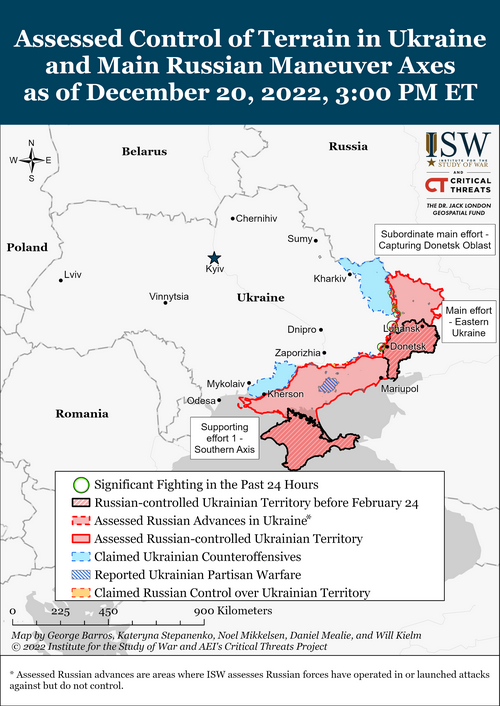
From The Institute For The Study of War:
Russian Offensive Campaign Assessment, December 20
Kateryna Stepanenko, Riley Bailey, George Barros, Madison Williams, and Frederick W. Kagan
December 20, 8 pm ET
Click here to see ISW’s interactive map of the Russian invasion of Ukraine. This map is updated daily alongside the static maps present in this report.
Intensifying Russian pressure on Belarus is degrading Belarusian President Alexander Lukashenko’s maneuver room to avoid making concessions to the Kremlin. Russian President Vladimir Putin’s long game to reestablish suzerainty over Belarus is making progress separate and apart from Putin’s efforts to get Belarus more actively involved in his invasion of Ukraine. Lukashenko confirmed that Russia “gave” Belarus an unspecified number of S-400 air defense systems during his meeting with Putin in Minsk on December 19, confirming ISW’s 2021 forecast that Russian-made S-400 systems would begin operating in Belarus.[1] Lukashenko had previously rejected S-400 systems operating in Belarus in 2020.[2] Lukashenko is likely delaying acceding to Putin’s larger demands – such as committing Belarusian forces to join the invasion against Ukraine – by making smaller concessions that he has stonewalled for years.
Russian military personnel will likely operate the Belarus-based S-400 systems. Russian personnel may operate the S-400 systems from the so-called joint Russian-Belarusian Air Force and Air Defense Forces training center in Grodno, Belarus – a permanent Russian military presence in Belarus that the Kremlin established in the spring of 2021.[3]
ISW continues to observe indicators consistent with the most dangerous course of action (MDCOA) of a renewed Russian invasion of northern Ukraine from Belarus.[4] Ukrainian military officials continue to warn about a growing Russian threat from Belarus. Ukrainian Joint Forces Commander Serhiy Nayev stated on December 20 that Russian elements in Belarus have military potential “currently sufficient” to create an unspecified threat to Ukraine and that these elements can conduct unspecified “tactical actions.”[5] Nayev’s statement marks an inflection in Ukrainian officials’ characterization of the growing Russian forces in Belarus; previous Ukrainian descriptions of Russian forces in Belarus did not ascribe to them tactically significant capacities.[6] Independent Belarusian sources continue to report growing Russian mechanized forces in Belarus.[7] About 30 Russian T-80 tanks were reportedly deployed to Belarus around December 20.[8]
These indicators support the MDCOA forecast, but that course of action remains unlikely at this time. A Russian invasion of northern Ukraine from Belarus is not very likely imminent. Nayev reiterated that Ukraine’s defense is prepared to defend northern Ukraine.[9] The Ukrainian General Staff reiterated that it has not observed Russian forces forming strike groups in Belarus as of December 20.[10] ISW will continue to monitor the situation.
Ukrainian President Volodymyr Zelensky’s frontline visit to Bakhmut on the 300th day of war is undermining an ongoing Kremlin information operation intended to present Russian President Vladimir Putin as an involved war leader. Zelensky made a surprise visit to Ukrainian troops serving on the intense Bakhmut front on December 20 and presented awards.[11] In contrast, Putin held a senior-level award ceremony where he celebrated Russian occupation and Kremlin officials such as proxy leaders from occupied Donetsk, Luhansk, Kherson, and Zaporizhia oblasts, Russian propagandist and RT Editor-in-Chief Margarita Simonyan, and Russian milblogger Semyon Pegov among other state officials.[12] ISW has previously assessed that Putin has intensified his efforts to extricate himself and the Russian Ministry of Defense (MoD) from persistent criticism by making public appearances relating to various undertakings aimed at improving the Russian war effort. This award ceremony further indicates Putin‘s fixation with presenting himself as an involved wartime leader.[13] Putin likely seeks to deflect blame for Russian military failures in Ukraine by maintaining a façade that paints Putin in a positive light but absolves him of responsibility for the war.
Putin’s decision to award members of his circle who have not even been directly involved in fighting in contrast with Zelensky’s visit near the front lines in Bakhmut sparked some criticism among Russian nationalist voices. A former Russian militant commander and critical voice in the Russian information space, Igor Girkin, noted that Putin is awarding “his heroes in the Kremlin” but not Russian and proxy servicemen who are engaged in combat on the frontlines.[14] Other milbloggers speculated that the Kremlin made a secretive political decision for a Russian ceasefire, allowing Zelensky to walk around Bakhmut.[15] Another milblogger reiterated that Putin had not visited the occupied territories and stated that Russian forces would not be able to effectively conduct a precision strike in time against Zelensky.[16]Zelensky’s visit to Bakhmut upstaged Putin’s efforts to establish himself as a wartime commander-in-chief and turned Putin’s own information operation into an embarrassment even within parts of the pro-war Russian information space.
Wagner financier Yevgeniy Prigozhin further undermined Putin, possibly inadvertently, within the Russian information space by attempting to boost his standing against the backdrop of Zelensky’s visit to Bakhmut. Prigozhin published a series of videos claiming he arrived at the frontlines near Bakhmut to speak to Zelensky regarding the control of territories in the area.[17] Prigozhin’s “offers” to negotiate with Zelensky are neither serious nor authoritative, since he does not hold any official position in Russia. Prigozhin, however, continues to pose as a prominent political and military figure in Russia. Such farcical comments are likely a response to Zelensky‘s repeated offers to negotiate directly with Putin after Russia withdraws its forces from Ukraine. Prigozhin’s appearance on the frontline further weakens Putin’s presentation of himself as a wartime leader, since Putin has not even visited Russian-occupied territories, let alone gone anywhere near the front lines. Social media users additionally exposed that Russian Defense Minister Sergey Shoigu did not actually visit the frontlines on December 17 – as he claimed – by geolocating the videos the Russian MoD posted of Shoigu‘s trip in Armyansk, Crimea.[18] While Prigozhin did not directly criticize Putin for his inability to directly address Zelensky or arrive on the frontlines, his and Zelensky’s visits to the frontlines threaten to make Putin’s posing as a wartime commander in chief humiliating rather than effective.
The Kremlin’s efforts to improve the reputation of the Russian MoD may have prompted Prigozhin to double down on his efforts to legalize Wagner in Russia. Russian state media outlet RT – likely affiliated with Wagner – published a 10-minute report on Wagner describing Prigozhin’s establishment of the paramilitary organization as an attempt to support “Russian interests” and defend the “Russian world.”[19] Such a portrayal suggests that Prigozhin is trying to rid Wagner of the mercenary stigma and instead re-introduce the group as a legitimate military formation in Russia that supports Russian national interests. RT also introduced prominent Kremlin officials like the Chairman of the Fair Russia – For Truth Party Sergey Mirnonov who criticized the Russian government for not seizing the initiative to recognize Wagner troops’ ”heroism” in Ukraine or granting Wagner official status under Russian law. Private military companies such as Wagner are notably illegal in Russia. The RT report also supported a long-standing ISW assessment that Prigozhin is strategically growing his influence on the Russian internet, noting that the newly-opened Wagner Center in St. Petersburg is a working space for “patriotic” media outlets and bloggers to resist the information war against Russia. Prigozhin will likely continue his efforts to establish himself and his Wagner Group in Russia by promoting himself on Telegram and Wagner-affiliated media, which may further diminish the Kremlin’s attempts to minimize criticism of its defense leadership.
The Kremlin will likely continue efforts to portray Putin and the Russian Ministry of Defense (MoD) as effective leaders of the war in Ukraine when Putin holds the Russian MoD board meeting on December 21. The Kremlin press service announced on December 20 that Putin will hold an expanded version of the Russian MoD board meeting on December 21, which will reportedly include a summary of the activities of the Russian Armed Forces in 2022 and a setting of tasks for the Russian military in 2023.[20] The Kremlin press service announced that Russian Defense Minister Shoigu will deliver the main report on the progress of the “special military operation” in Ukraine at the meeting.[21] The Kremlin press service stated that the commanders of military districts and services of the Russian Armed Forces, the heads of central military authorities, and representatives of federal executive bodies will attend the expanded meeting.[22] The Kremlin press service also stated that 15,000 Russian military officials will attend the meeting via video conference.[23] Putin is likely holding a larger-than-usual Russian MoD board meeting to present the Russian military as an organized and formidable fighting force and to demonstrate that his control over that force remains unquestioned despite its pronounced military failures in its invasion of Ukraine. Shoigu will likely deliver a main report on the war in Ukraine that minimizes the Russian MoD’s responsibility for failures at the front and offers an optimistic forecast for what Russian forces will be able to achieve operationally in Ukraine in 2023. The Kremlin will likely publicize aspects of the event to augment the Kremlin’s continuing efforts to present Putin and the Russian MoD as competent managers of the war in Ukraine and to shield Putin and the Russian MoD from the criticism of the ultra-nationalist pro-war community.[24] The event shows that Putin is taking increasing pains to surround himself with military uniforms, possibly hoping to evoke recollections of Joseph Stalin engaging with the Soviet STAVKA during World War II and to separate himself from the famous pictures of Putin separated by a very long table from Shoigu and Chief of the General Staff General Valery Gerasimov.
Key Takeaways
- Russian pressure against Belarus is degrading Belarusian President Alexander Lukashenko’s maneuver room to avoid making concessions to the Kremlin.
- ISW continues to observe indicators consistent with the least likely but most dangerous course of action (MDCOA) of a renewed Russian invasion of northern Ukraine from Belarus.
- Ukrainian President Volodymyr Zelensky’s visit to Bakhmut undermines an ongoing Kremlin information operation to present Russian President Vladimir Putin as an involved war leader.
- Wagner financier Yevgeniy Prigozhin undercut Putin’s efforts to portray himself as a wartime leader within the Russian information space, possibly inadvertently.
- The Kremlin’s efforts to improve the reputation of the Russian MoD may have prompted Prigozhin to increase his efforts to legalize Wagner Group in Russia.
- The Kremlin will likely continue efforts to portray Russian President Vladimir Putin and the Russian Ministry of Defense (MoD) as effective leaders when Putin holds an expanded annual Russian MoD board meeting on December 21.
- Russian forces conducted limited counterattacks along the Svatove-Kreminna line.
- Russian forces continued offensive operations in the Bakhmut and Avdiivka areas.
- Russian forces are expanding defensive fortifications on the left (east) bank of the Dnipro River in Kherson Oblast.
- A Kremlin official deflected questioning surrounding a Moscow Oblast military recruitment officer’s December 17 claim that Russian authorities will extend the service period for conscript soldiers.
- Russian President Vladimir Putin demanded that Russian security services intensify their efforts to counter pro-Ukrainian partisan activity.
Go here to read the rest.
From Strategy Page:
December 20, 2022: A few months after the Russians invaded Ukraine, they realized the Ukrainians always seemed to know what was going on in Russian occupied territory. It was the Ukrainian internet and the Diia app most Ukrainians had on their phones to keep and maintain their ID, driver’s license and similar items. As soon as the Russians invaded, Ukrainians used their cellphones and the Diia app to report sightings 0f Russian forces. Ukraine quickly added additional capabilities to Diaa that enables users to just point (at Russian activity) and click to automatically report the sighting to Ukrainian intelligence, along with an image and the location of the user and time when the report was made. What made all this work reliably was the willingness of satellite communications entrepreneur Elon Musk to turn on his new Starlink commercial satellite network for Ukraine and let them use it free-of-charge for the duration of the war.
The Ukrainians had other communication options. Much of the land-line phone lines were kept operational even though these lines were more difficult to defend. Another separate communications system was operated by the Ukrainian railway system. Each of the nearly 1,600 railway stations and facilities was connected by a land-line system that runs adjacent to the tracks. This is used by railway staff to control traffic and report any problems. Railway staff also have their encrypted apps and this played a major role in keeping the railways operational and able to carry personnel (military and civilian) as well as cargo.
It was Starlink that kept the Internet operational everywhere in Ukraine and, in combination with Diia, gave Ukrainian commanders a better picture of where Russian forces were than the Russians themselves had. For that reason Ukrainians in Russian occupied territory were soon being searched for Diia equipped cell phones. Russia threatened to treat any Ukrainian with Diia on their cell phone as being spies. In wartime, civilians are always an excellent source of information on what is going on in their area. The problem has always been communications and getting that information to those who could use it. Diia and Starlink changed that, as well as how the war was reported. Ukraine was more welcoming for journalists who wanted to visit the troops. Ukrainian and foreign journalists did, as did UN and Red Cross observers who were investigating any war crimes or atrocities. The Russians were often guilty of both and Ukrainian witnesses provided lots of images and videos of who did what, when and where. Reporting from Russian occupied Ukrainian territory or Russia itself was much more difficult. You needed permission and failure to abide by a growing list of things you could not broadcast or publish was illegal.
On the battlefield Russian forces invadingUkraine are at a disadvantage for many reasons, including inadequate or absent military radios and access to the Internet. While Western military radios have been using frequency hopping and software-defined operation for over three decades, Russian forces were way behind. Obsolete Russian military radios were a visible problem during the 2008 invasion of Georgia so their government ordered modern military radios be developed and issued to Russian troops as soon as possible. This didn’t begin to happen until 2017. By 2022 there were not enough of the new Azart radios available for all the Russian troops going into Ukraine. There were many units still using the old radios that the Americans, and most Western forces, replaced decades ago.
Azart was an effort to duplicate the U.S. Army SINCGARS series of radios introduced in the 1980s to provide a solution to jamming of radio transmissions on the battlefield, as well as the risk of the enemy understanding these messages. Russian jamming of tactical radios was a threat throughout the Cold War and SINCGARS was the first successful solution because it used effective frequency hopping (rapidly changing frequencies according to a pre-arranged pattern) when sending and receiving messages. The three radios in the SINCGARS family had a range of 8-35 kilometers. Unfortunately, these are FM (line of sight) radios that lose a lot of their range in hilly or urban terrain. Operators have also found that the range is halved when the frequency hopping was used. When a user finds the signal fading, they will switch to single frequency mode to keep the connection. This allows the enemy to jam the signal, and to listen in. The Russian military radios, especially the new ones, proved unreliable and often unavailable. In Afghanistan NATO forces could use satellite radios as well as FM tactical radios using airborne repeater aircraft.
Russia has none of this for its troops in Ukraine while Ukrainian forces had free access to the high-speed Starlink system. Within a week of the Russians invading, Starlink delivered the first truckloads of user kits (a small satellite dish and a “modem” to allow any PC user to connect. Since then thousands of user kits have been donated or purchased by Ukraine. Starlink engineers detected and defeated Russian efforts to disrupt its operation. This neutralized Russian efforts to destroy Ukrainian access to the Internet. Starlink advised Ukrainian users how to use Starlink to avoid the Russians detecting a user and their location for an air or missile attack. During March Starlink added several new features, like the ability to be used in a moving vehicle, using power from a battery or the vehicle electrical system. This enabled Ukrainian forces to use Starlink in combat.
Azart proved less capable than expected under combat conditions because there were not enough of them and these radios were unable to remain in contact with higher headquarters. In combat Russian support forces are supposed to erect temporary repeater towers or employ vehicles carrying mobile towers so that Azart users on the front line could stay in touch with other units and the chain of command that went all the way back to the Stavka (Great Staff) in Moscow that controlled all military operations. The repeater towers did not work because armed Ukrainians found and destroyed them. Some Russian commanders still had their cell-phones as well as Ukrainian sim cards that enabled use on the Ukraine cell phone system, which the Ukrainians kept operational. Most Russian troops were ordered to leave their cell phones behind because the Ukrainians could track cell phone users and, in the case of Russian troops, use that information for an airstrike or ambush.
Some veteran Russian officers and troops, especially those who had served in Syria, obtained Chinese walkie-talkies similar to those often used by Islamic terrorists and irregular forces worldwide. In Syria the Russians eventually banned soldiers from using modern (4G) cellphones that could be used to post photos and videos to social media. In addition, some major bases in Syrian had jammers going 24/7 to prevent any use of 4G phones, especially by local Islamic terrorists who were constantly trying to kill Russians, often with the help of cell phones that could provide a target beacon for swarms of quad-copters armed with explosives. Many Russian troops and civilian contractors carried their 4G phones anyway and when outside the range of the jammers powered them up and sent accumulated emails and photos home and to social media.
The problems Russia had with cell phones in Syria were also taking place in eastern Ukraine (Donbas) where Russian forces invaded in 2014, a year before Russian troops showed up in Syria. The communications problems in Donbas were worse because the Ukrainians quickly mobilized and halted the effort to take two Ukrainian provinces. The Russian advance halted and was stalled until 2022.
In Syria the Russians tried to exploit the enemy use of cell phones but found that more difficult than expected. At the same time Russian troops with cell phones became a major intelligence problem, and that continued in Russian occupied areas of Ukraine as well. For example, in late 2017 the Russian-run “government” in eastern Ukraine (Donbas) sentenced a local man to ten years in jail for distributing a cell phone photo via twitter that showed Russian Army vehicles and other equipment in the rebel-controlled half of Donbas. Russia denies they have troops there but it has been an open secret because of cell phones, Internet access and most Ukrainians in Russian occupied Donbas wanting the Russians gone. Sending one man to prison and publicizing it was supposed to make the population less ready to do this sort of thing. That didn’t work.
Russia used Ukraine as a test site for new Cyber War tactics and techniques. In late 2016 Ukraine accused Russia of employing hackers to insert trackers into cell phones used by Ukrainian military personnel fighting in Donbas. Ukraine has also found evidence of the same or similar hackers, usually civilian groups working as contractors for the Russian government, going after numerous government and commercial networks in Ukraine. Some of these hackers were also identified as going after targets in the United States. The hacking of cell phones used by military personnel is believed to be the cause of several accurate and fatal attacks on Ukrainian troops in Donbas. The hackers made it possible to track the location of the phone owners and accurately fire shells or rockets at them.
These capabilities had already attracted the attention of the U.S., which was supplying Ukraine with military equipment and technical assistance. American and NATO electronic warfare experts paid close attention to what the Russians were up to in Donbas and the cell phone hack was not unexpected. When it did arrive, it was scrutinized and dissected. That led to countermeasures that were ignored by the Russians and used by Ukrainian forces fighting the 2022 invasion.
Their poor communications capability significantly degraded Russian combat capabilities and made Russian troops much more vulnerable. For example, the Russians have to be careful using air strikes or artillery fire near their own troops because there is no way for ground forces to communicate with aircraft or distant units providing the shell, rocket or ballistic missile fire to report they or the target had moved. This is one of the reasons for the Russians shifting most of their artillery fire to cities, because these targets don’t move, like the Ukrainian soldiers and irregulars do.
At the same time the Ukrainian forces have reliable, and often encrypted, communications. This was because the Ukrainians kept their cell phone system operational by quietly making changes to it that made it more difficult for Russian hackers or military forces to shut the system down. Where there was cell service Ukrainians could use encrypted apps to communicate while Russian forces used their pre-Azart military radios or Chinese walkie-talkies, where communication is all in the clear. Nearly all Ukrainians can speak Russian as well as Ukrainian and have methods or equipment to detect and locate Russian troops communicating without encryption. Azart has modern encryption but using it reduces the range of the radios by up to 50 percent. Because of that Russian troops rarely use the encryption. The Ukrainians knew all about Azart because soon after Russian troops began receiving them in 2017, many also showed up on the black market, where anyone could buy one. The Ukrainians did so and, along with NATO, discovered what Azat could do and what its weaknesses were. Ukrainian and NATO tech experts concluded that, with proper countermeasures, the Azart radios would become a major liability for Russian commanders and it was. Some Russian troops got Ukrainian sim cards for their cell phones so they could call home and the Ukrainians exploited this by harvesting those messages and postings to social media to monitor Russian morale and operations, and sometimes use location information for attacks.
Russian commanders, unable to communicate, must stay on the roads and are often stalled because they have not received new orders, cannot report that they are under attack or that a unit has suffered heavy losses and requires assistance, especially evacuation of the wounded. Local civilians are no help because they move away when Russian troops are near but are very helpful to any Ukrainian forces who ask for information. This is one reason Russian troops were told, soon after the invasion began, to loot at will to obtain supplies. This enraged Ukrainian civilians even more, so they made cellphone images of Russian troops looting and abusing civilians which quickly spread worldwide, including to Russia, where civilians had been told that Ukrainians welcomed their Russian liberators.
Go here to read the rest. At the battle of Tannenberg in 1914 the outnumbered Germans destroyed two invading Russian armies. It was noted after the battle that the invading Russians had broadcast in the clear over radio and made no effort to code their messages before sending them out. More than a century later, the Russians are still allowing their abuse of modern technology to hamper their battlefield communications. The Russian army is not a military force but a museum piece.

