
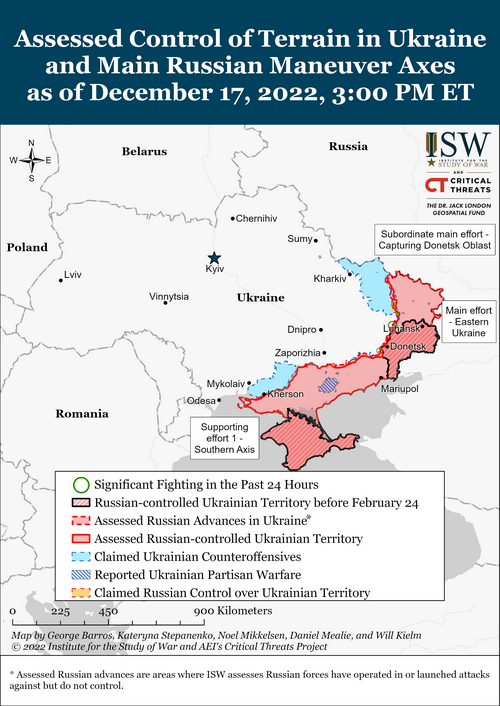
From The Institute For The Study of War:
Russian Offensive Campaign Assessment, December 17
Riley Bailey, Karolina Hird, Grace Mappes, George Barros, Angela Howard, and Frederick W. Kagan
December 17, 5:30 pm ET
Click here to see ISW’s interactive map of the Russian invasion of Ukraine. This map is updated daily alongside the static maps present in this report.
The Kremlin is likely attempting to depict Russian President Vladimir Putin as a competent wartime leader and to rehabilitate the image of the Russian Ministry of Defense (MoD) by publicizing Putin’s meeting with the joint headquarters of the Russian Armed Forces. The Kremlin announced on December 17 that Putin worked at the joint headquarters of the services of the Russian Armed Forces throughout the day, heard reports on the progress of the “Special Military Operation” in Ukraine, and held a meeting with the joint headquarters and a separate meeting with commanders.[1] The Russian MoD and media published footage of the meeting with the joint headquarters that showed that Chief of the General Staff of the Russian Armed Forces Army General Valery Gerasimov, Russian Defense Minister Army General Sergei Shoigu, and the Commander of the Joint Group of Forces in Ukraine Army General Sergei Surovikin were in attendance.[2] Images and video of the event provided by the Russian MoD preclude the identification of other notable officers (such as military district or army commanders) present, however. The Kremlin likely publicized the meeting to present Putin as being thoroughly engaged with the planning and execution of the war in Ukraine following recent prominent criticism of his role in leading the war effort by figures in the ultra-nationalist pro-war community.[3] One prominent milblogger even questioned whether “Putin finally showed public interest in the special military operation” at their suggestion to do so.[4]
The Kremlin also likely publicized Putin’s meeting with the joint headquarters to rehabilitate the image of the Russian MoD in response to the pro-war community’s routine criticism of the Russian MoD. The Kremlin likely consciously publicized Gerasimov’s, Shoigu’s, and Surovikin’s attendance at the meeting with Putin to present the Russian MoD as an organized, unified, and effective war-fighting institution and to shield the top commanders of the Russian Armed Forces from further criticism. The Russian MoD has taken great care in the past months to affirm Gerasimov’s continued role as Chief of the General Staff for a similar reason- in the absence of tangible Russian victories against Ukraine, Russian military leadership seeks to present a picture of a functional and seamless chain of military command.[5] The Kremlin is likely attempting to rehabilitate the image of the Russian MoD to counterbalance the growing influence of pro-war ultra-nationalist figures, primarily that of Chechen Republic head Ramzan Kadyrov and Wagner Group Financier Yevgeny Prigozhin, and their parallel military structures. The Kremlin will likely continue to attempt to shield the Russian MoD from criticism while still facilitating the growing influence of these ultra-nationalist pro-war figures. This effort is unsustainable and will likely continue to generate conflict between the Russian MoD and the ultra-nationalist pro-war community.
The Kremlin likely aims to portray Putin as a leader in touch with the Russian people by publicizing Putin’s participation in meaningless events like the grand opening of a turkey farm. Independent Russian news outlet The Moscow Times reported that the Kremlin has instructed leaders of certain state-owned corporations and regional governors to prepare a “positive agenda” of news and events in which Putin can participate.[6] The Moscow Times noted that Putin’s calendar already includes small events, such as the grand opening of a turkey breeding center, commemorating the anniversaries of state corporations, and reopening a repaired highway.[7] The Moscow Times cited Kremlin officials who said that the social well-being of the Russian people is declining while war fatigue is growing and that Putin needs to be seen as a “herald of good news.”[8] Such efforts likely aim to remind the Russian people that Putin is not just a military leader in wartime but also a civilian leader with close ties to the people. However, amplifying pithy events while canceling opportunities for the public to meaningfully engage with Putin on the state of the war and the country will not likely meaningfully improve Putin’s image, and, as ISW previously assessed, may undermine Putin’s populist appeal.[9] Russian pro-war nationalists have recently criticized the Russian MoD for similar performative messaging that ignores Russia‘s wartime realities by branding the MoD with the epithet “Russian Ministry of Camouflage Selfies,” as ISW has previously reported.[10]
A New York Times (NYT) investigation of Russian military documents supports ISW’s longstanding assessments about how flawed Russian planning assumptions and campaign design decisions plagued Russia’s invasion of Ukraine from its onset. ISW has long assessed that faulty Russian planning assumptions, campaign design decisions, and Russian violations of Russia’s own military doctrine undermined Russian operations. The NYT acquired and published logbooks, timetables, orders, and other documents of elements of the 76th Airborne Division and 1st Guards Tank Army related to the early days of the war on December 16.[11] The documents demonstrate that Russian military planners expected Russian units to be able to capture significant Ukrainian territory with little to no Ukrainian military opposition. The documents indicate that elements of the 76th Airborne Division and Eastern Military District were ordered to depart Belarus and reach Kyiv within 18 hours against little resistance; Russian planners placed OMON riot police and SOBR Russian National Guard (Rosgvardia) special police elements (essentially a Russian SWAT equivalent) within the first column of a maneuver element of the 104th Air Assault Regiment of the 76th Airborne Division.[12] Riot police are not suitable lead elements for a large maneuver force in a conventional force-on-force war because they are not trained to conduct combined arms or mechanized warfare. The decision to place riot police in the lead column is a violation of Russian (or any normal) doctrine and indicates that Russian planners did not expect significant organized Ukrainian resistance. A separate set of orders indicates that Russian planners expected unsupported elements of the Russian 26th Tank Regiment (of the 47th Tank Division, 1st Guards Tank Army) to conduct a mostly uninhibited, 24-hour dash from Ukraine’s border with Russia to a point across the Dnipro River, about 400 kilometers away.[13] Ukrainian forces destroyed elements of the 26th Tank Regiment in Kharkiv Oblast, hundreds of kilometers short of its intended destination on March 17.[14]
The NYT investigation also supports ISW’s assessments that Russian strategic commanders have been micromanaging operational commanders’ decisions on tactical matters and that Russian morale is very low. The investigation supported existing reporting that Russian soldiers in Belarus did not know they were going to attack Ukraine until February 23—the day before the invasion—and that some soldiers did not know about the invasion until one hour before the invasion began.[15] A retired Russian general told the NYT that the lack of a unified Russian theater command meant there was “no unified planning of actions and command [and control].”[16] A Ukrainian pilot told the NYT he was amazed that Russian forces did not conduct a proper air and missile campaign at the beginning of the war to target Ukrainian airfields—as Russian doctrine prescribes. The NYT reported a Russian tank commander deliberately destroyed a Rosgvardia checkpoint in Zaporizhia Oblast over an argument and that many Russian soldiers sabotaged their own vehicles to avoid combat.[17] The NYT’s findings support ISW’s assessments and body of research on why the Russian military has been experiencing significant failures since the beginning of the invasion.
Ongoing Russian offensive operations around Bakhmut are further driving a wedge between forces of the Donetsk People’s Republic (DNR) and Yevgeny Prigozhin’s Wagner Group troops. DNR Head Denis Pushilin claimed on December 17 that both DNR and Wagner units are closing the “pincers” on Ukrainian troops in Bakhmut.[18] Several milbloggers responded to Pushilin’s claim and categorically denied that DNR troops have anything to do with fighting in Bakhmut, emphasizing that offensive efforts in this area are exclusively led by the Wagner Group.[19] The disparities between Pushilin’s claims, which represent the official DNR line, and statements made by Prigozhin and other prominent voices in the Russian information space suggest that there is a continued and growing divide between the DNR and the Wagner Group. During battles for settlements south of Bakhmut in October, Prigozhin denied any involvement by DNR or conventional Russian troops in the capture of Ivanhrad.[20] Prigozhin has also previously been remarkably clear-eyed about the slow and grinding pace of Wagner advances in the Bakhmut area, which directly contrasts with exaggerated claims made by Pushilin and other Russian sources.[21] Wagner’s role in operations around Bakhmut will likely continue to contribute to divides between various factions in the Russian military and discredit DNR authorities and the forces that they command.
The US Central Intelligence Agency (CIA) assesses that the Kremlin is not serious about negotiations with Ukraine, agreeing with a longstanding ISW assessment. CIA Director William Burns told PBS NewsHour on December 16, “Most conflicts end in negotiations, but that requires a seriousness on the part of the Russians in this instance that I don’t think we see… it’s not our assessment that the Russians are serious at this point about a real negotiation.”[22] ISW has consistently assessed that Russian President Vladimir Putin is not interested in negotiating seriously with Ukraine and retains maximalist objectives for the war.[23]
Putin has consistently weaponized invocations of the negotiation process to isolate Ukraine from partner support. Putin has routinely framed Ukraine as refusing concessions and likely seeks to use any ceasefire and negotiation window to allow Russian troops time to reconstitute and relaunch operations, thus depriving Ukraine of the initiative. A ceasefire agreement that occurs soon enough to allow Russian forces to rest and refit this winter is extremely unlikely. Russia and Ukraine are currently opposed to one another on the terms of any such agreement, and it is highly unlikely that Russian and Ukrainian officials will agree to a ceasefire, let alone implement one, for some months. Russian forces will likely not have the opportunity to pause Ukrainian winter counter-offensives and reset before spring.
Key Takeaways
- The Kremlin is likely attempting to increase perceptions of Putin’s competence and of that of the Russian Ministry of Defense by publicizing Putin’s meeting with the joint headquarters of the Russian Armed Forces and Putin’s appearances at non-military events.
- A New York Times investigation of Russian military documents from early in the war supports ISW’s longstanding assessments about how flawed Russian planning assumptions and campaign design decisions plagued Russia’s invasion of Ukraine from its onset.
- Ongoing Russian offensive operations around Bakhmut are further driving a wedge between forces of the Donetsk People’s Republic and Yevgeny Prigozhin’s Wagner Group troops.
- The US Central Intelligence Agency assesses that the Kremlin is not serious about negotiations with Ukraine, agreeing with a longstanding ISW assessment.
- Ukrainian forces conducted counterattacks near Svatove and Kreminna and continue to strike Russian rear areas.
- Russian forces continued offensive operations near Bakhmut and Avdiivka-Donetsk City.
- Ukrainian officials warned that Russian forces may be attempting to draw Ukrainian forces into a trap on the east (left) bank of the Dnipro River.
- Russia may be conducting an information operation falsely connecting ongoing negotiations on the demilitarization of the Zaporizhzhia Nuclear Power Plant to a prospective future Ukrainian counteroffensive in Zaporizhia Oblast.
- Several Russian sources denounced a military commissar’s claim that Russian authorities will extend the service period for conscript soldiers. An extension of the legal mandatory service period would not be necessary to keep current conscripts in the field, however, as all former conscripts are reservists, and all reservists are already eligible for mobilization.
Go here to read the rest. We may not have a winter pause, but there does seem to be a pause in major operations.

