
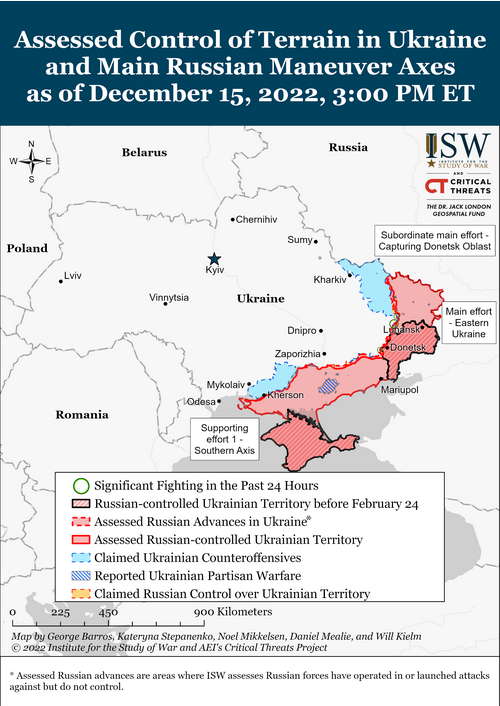
From The Institute For The Study of War:
Kateryna Stepanenko, George Barros, Riley Bailey, Katherine Lawlor, Layne Phillipson, and Frederick W. Kagan
December 16, 6:00 pm ET
Click here to see ISW’s interactive map of the Russian invasion of Ukraine. This map is updated daily alongside the static maps present in this report.
Russian forces conducted their ninth large-scale missile campaign against critical Ukrainian energy infrastructure on December 16 and carried out one of the largest missile attacks on Kyiv to date. Ukrainian Commander-in-Chief General Valery Zaluzhny stated that Ukrainian air defenses shot down 60 of 76 Russian missiles, of which 72 were cruise missiles of the Kh-101, Kalibr, and Kh-22 types, and four guided missiles of the Kh-59 and Kh-31P types.[1] The Kyiv City Military Administration reported that Ukrainian forces destroyed 37 of 40 missiles targeting Kyiv.[2] Ukrainian officials also reported that Russian missiles struck nine energy infrastructure facilities and some residential buildings in Zhytomyr, Kyiv, Kharkiv, Dnipropetrovsk, and Zaporizhia oblasts.[3] Ukrainian military officials noted that Russian forces launched most of their missiles from the Black and Caspian seas and the Engels airfield in Saratov Oblast.[4] Russian forces are likely intensifying their strikes on Kyiv to stir up societal discontent in the capital, but these missile attacks are unlikely to break Ukrainian will.
Russian strikes continue to pose a significant threat to Ukrainian civilians but are not improving the ability of Russian forces to conduct offensive operations in Ukraine. Ukraine’s state electricity transmission system operator Ukrenergo stated that restoration of electricity may be delayed by the December 16 strikes and announced a state of emergency aimed at electricity market suppliers.[5] Ukrenergo added that Ukraine’s United Energy System had to cut more than 50% of energy consumption as a result of the strikes.[6]
Russian National Security Council Deputy Chairman Dmitry Medvedev made inflammatory but irrelevant comments in support of ongoing information operations that aim to weaken Western support for Ukraine. Medvedev published on December 16 a list of what he described as legitimate military targets, which included “the armed forces of other countries that have officially entered the war” in Ukraine.[7] Medvedev rhetorically questioned whether Western military aid to Ukraine means that NATO members have entered the war against Russia.[8] Medvedev did not explicitly state that the armed forces of NATO members are legitimate military targets nor that he was stating an official Russian position on legitimate targets in the war in Ukraine.[9] Medvedev likely made the comments in coordination with the large-scale Russian missile strikes in an attempt to weaken Western support for Ukraine by stoking fears of escalation between the West and Russia. Medvedev has previously made purposefully inflammatory comments in support of other information operations with the same aims.[10] Medvedev’s past and current inflammatory rhetoric continues to be out of touch with actual Kremlin positions regarding the war in Ukraine. Russian forces have and will likely continue to target Western military equipment that Ukrainian forces have deployed in Ukraine, of course, but there is nothing surprising or remarkable in that fact.
Russian President Vladimir Putin will likely pressure Belarusian President Alexander Lukashenko for Russian-Belarusian integration concessions at an upcoming December 19 meeting in Minsk—Putin’s first meeting with Lukashenko in Minsk since 2019.[11] Lukashenko and Putin reportedly will discuss Russian-Belarusian integration issues, unspecified military-political issues, and implementing Union State programs.[12] The Union State is a supranational agreement from 1997 with the stated goal of the federal integration of Russia and Belarus under a joint structure. The Kremlin seeks to use the Union State to establish Russian suzerainty (control) over Belarus.[13]
Lukashenko is already setting information conditions to deflect Russian integration demands as he has done for decades.[14] Lukashenko stressed that “nobody but us is ruling Belarus,” and that Belarus is ready to build relations with Russia but that their ties “should always proceed from the premise that we are a sovereign and independent state.”[15] It is unclear whether Putin will be successful in extracting his desired concessions from Lukashenko. Lukashenko has so far largely resisted intensified Russian integration demands and has refused to commit Belarusian forces to join Russia’s invasion of Ukraine.
Putin’s visit to Minsk could indicate that Putin is trying to set conditions for the newly assessed most dangerous course of action (MDCOA) that ISW reported on December 15: a renewed offensive against Ukraine—possibly against northern Ukraine or Kyiv—in winter 2023.[16] Russian Defense Minister Sergei Shoigu and Belarusian Defense Minister Viktor Khrenin signed an unspecified document to further strengthen bilateral security ties—likely in the context of the Russian-Belarusian Union State—and increase Russian pressure on Belarus to further support the Russian invasion of Ukraine, in Minsk on December 3.[17] ISW’s December 15 MDCOA warning forecast about a potential Russian offensive against northern Ukraine in winter 2023 remains a worst-case scenario within the forecast cone. ISW currently assesses a Russian invasion of Ukraine from Belarus as low, but possible. Belarusian forces remain extremely unlikely to invade Ukraine without a Russian strike force. It is far from clear that Lukashenko would commit Belarusian forces to fight in Ukraine even alongside Russian troops. There are still no indicators that Russian forces are forming a strike force in Belarus.[18]
Putin and Lukashenko’s meeting will—at a minimum—advance a separate Russian information operation that seeks to break Ukrainian will and Western willingness to support Ukraine, however. This meeting will reinforce the Russian information operation designed to convince Ukrainians and Westerners that Russia may attack Ukraine from Belarus. Russia’s continued strikes against Kyiv, constant troop deployments to Belarus, and continued bellicose rhetoric are part of (and mutually reinforce) this information operation. The Kremlin is unlikely to break the Ukrainian will to fight. The Kremlin likely seeks to convince the West to accept a false fait accompli that Ukraine cannot materially alter the current front lines and that the war is effectively stalemated. ISW assesses that such a conclusion is inaccurate and that Ukraine stands a good chance of regaining considerable critical terrain in the coming months.
Russian President Vladimir Putin reportedly ignored warnings about worst-case economic scenario assessments from senior Kremlin financial advisors prior to launching his full-scale invasion of Ukraine in February 2022. Unnamed sources told the Financial Times (FT) that the head of the Russian Central Bank, Elvira Nabiullina, and the head of Sberbank, German Gref, briefed a 39-page assessment to Putin outlining the long-term damage to the Russian economy if Russia recognized the independence of proxy republics in Donetsk and Luhansk oblasts a month prior to the full-scale invasion.[19] FT sources noted that both Nabiullina and Gref spoke to Putin of their own initiative but were not brave enough to tell Putin that Russia risked a geopolitical disaster when he interrupted the brief to ask how Russia can prevent a worst-case scenario. Nabiullina and Gref specifically warned Putin that Western sanctions would set the Russian economy back by decades and negatively impact the Russian quality of life. Both Nabiullina and Gref reportedly were shocked when Putin launched the invasion on February 24 and indirectly expressed some discontent to their inner circles, despite implementing provisions to mitigate some negative impacts of sanctions during the first weeks of the war.
The report, if true, indicates that Putin had received some prognosis of the war’s risks and costs but decided to ignore them in favor of his maximalist goal of seizing Ukraine. It is unclear if Putin received and subsequently ignored similar reports from the Russian Ministry of Defense (MoD) or the Ministry of Foreign Affairs (MFA), but his engagement with Nabiullina and Gref shows that he had some awareness of the potential long-term risks of the war. Nabiullina’s and Gref’s reported hesitance to dissuade Putin also demonstrates the unbalanced power dynamic that may have prompted some Russian officials to play along with Putin’s bad decisions rather than remonstrating with him.
Russia is continuing to endure some economic challenges as a direct result of Putin’s war in Ukraine. FT reported that Nabiullina was able to protect the Russian economy from the worst-case scenario by undertaking provisions such as regulation of the exchange control during the first day of the war, but some war costs are likely catching up to the Kremlin. Russia’s Central Bank announced on December 16 that mobilization had sparked increasing manpower shortages across several industries in Russia.[20] The Central Bank report added that Russia has limited possibilities to expand its production as a result of shortages in the state labor market and noted that “unemployment hit a historic low.” The costs of Putin’s war, including the human and labor cost of his force generation efforts, will continue to have a long-term effect on Russia’s economy, as ISW has previously assessed.[21]
Key Takeaways
- Russian forces conducted another set of large-scale missile strikes throughout Ukraine and one of the largest missile attacks against Kyiv to date.
- Russian strikes continue to pose a significant threat to Ukrainian civilians despite generating no improvement in the Russian ability to conduct offensive operations.
- Dmitry Medvedev made inflammatory but irrelevant comments in support of ongoing information operations that aim to weaken Western support for Ukraine.
- Russian President Vladimir Putin will likely pressure Belarusian President Alexander Lukashenko to support the Russian war in Ukraine further at a December 19 meeting in Minsk.
- Lukashenko is already setting information conditions to deflect Russian integration demands.
- Putin’s upcoming visit to Minsk could indicate that he is setting conditions for a new offensive from Belarusian territory.
- Putin and Lukashenko’s meeting will likely advance a separate Russian information operation that seeks to break Ukrainian will and Western willingness to support Ukraine.
- Russian President Vladimir Putin reportedly ignored worst-case scenario assessments of potential damage to the Russian economy prior to launching his full-scale invasion of Ukraine.
- Russia is continuing to face economic challenges as a direct result of the war in Ukraine.
- Russian forces conducted counterattacks in the Svatove and Kreminna areas.
- Russian forces continued offensive operations in the Bakhmut and Avdiivka-Donetsk City areas.
- Russian forces continued to undertake defensive measures on the left (east) bank of the Dnipro River.
- Russian officials will likely struggle to recruit additional contract servicemembers despite ongoing efforts to do so.
- Russian occupation authorities continued seizing civilian infrastructure to treat wounded Russian servicemen and aid Russian forces operating in occupied territories.
Go here to read the rest.
From Strategy Page:
December 16, 2022: For the first time in a decade, Vladimir Putin is not holding his annual news conference where he reports on Russian accomplishments over the past year. This year Putin does not believe he can turn the disastrous war in Ukraine and the debilitating foreign economic sanctions into anything positive to report on during the annual news conference. Putin was getting more criticism from Russians, including many Internet-based commentators who supported the war but reported accurately what was going on in Ukraine and the sorry state of the Russian military effort. Opinion polls showed that support for Putin was shrinking faster than support for the war. Putin decided to declare violence against the war effort inside Russia was domestic terrorism and recalled Russian personnel who were dealing with the remaining Islamic terrorists in the Caucasus and told them to go after Russians who were violently opposing the war effort.
With the regular Russian forces in a shambles, Putin found that the only military organization he could depend on was the Wagner Group. This military contractor organization was authorized by Vladimir Putin in 2014 with trusted associate (and self-made millionaire) Yevgeny Prigozhinin in charge. Prigozhin assigned his corporate security chief, Dmitry Utkin to run the operation. Utkin is a former special operations officer who used the call sign “Wagner” while in the army. Prigozhin and Utkin report directly to Putin and Wagner Group often carries out special tasks for Putin. Until 2022 Wagner only operated outside Russia and was only in Ukraine briefly between 2014 and 2017 to oversee organizing Russian-backed separatists. This often involved killing particularly difficult local military leaders. Between 2015 and 2022 Wagner operated overseas as military security contractors for pro-Russian foreigners with enough money to pay. This included Syria, Libya, Sudan, Central African Republic, Madagascar, Venezuela, Mozambique and Mali. In Africa Wagner made a lot of money and got involved in the illegal minerals and diamonds trade. Africa has been very lucrative for Wagner and Putin. By late 2021 Wagner had about 8,000 personnel, who were largely former Russian soldiers, many of them from airborne and special operations units. The Wagner supervisors (officers and NCOs) were also veterans and all were paid very well and on time. Then came the Ukraine invasion and when it was clear that the Russian army could not handle the Ukrainians, Putin called on the Wagner Group to help out. By the end of 2022 Wagner had recruited about 30,000 men for the war in Ukraine. Recruiting was difficult because the pay was not as lucrative as overseas and casualties were higher, much higher. Ever resourceful, Putin allowed Wagner to recruit from prisons and offer inmates freedom after serving six months in Ukraine for Wagner. These men were paid and equipped but few were veterans and training was brief, often just two weeks. These Wagner forces were sometimes called “penal battalions”, something that was used by Russia during World War II for very dangerous missions. As with the original penal battalions, discipline was harsh and those who tried to desert were executed, often in a brutal fashion. In one case the deserter was beaten to death with sledgehammers. These Wagner troops were more reliable than the new recruits the Russian army was conscripting but the Wagner men soon discovered that the promised high pay was not being delivered and a growing number were getting killed before the end of the six-month contract. Inside Russia the idea that these felons would be free once their contract was completed was very unpopular. The government announced that none of these Wagner men would be allowed back in Russia but would serve in overseas Wagner operations. That was also untrue. Ukrainians began capturing some of the penal battalion men and considered them POWs (prisoners of war), where they were safer than in Russia or working for Wagner. These POWs were willing to give detailed accounts of their experience with Wagner. The overseas Wagner operations remained fully staffed. In early 2022 some overseas Wagner personnel were brought back to organize and lead the Wagner expansion in Ukraine. These men were trusted Wagner veterans who were Russian patriots but also quickly saw that the Russian war effort in Ukraine was a mess. In the end, Putin was only able to get limited help from Wagner because even Wagner vets saw that the Ukraine operation was going badly. Currently, the primary task for Wagner is attacking Bakhmut City in Donbas. Wagner has been taking heavy losses here with little to show for it. The Ukrainian forces are the defenders and content to inflict large casualties on the Wagner forces. Ukrainian intelligence believes that Russia is trying to train and equip a new force of capable and well-armed troops in Belarus and then launch another offensive south from Belarus to nearby Kyiv, the Ukrainian capital. The Ukrainians seem to have good information on Russia’s plans and this prediction makes sense because many Belarussians are pro-Ukraine. While revealing Russian plans regularly, Ukraine is very secretive about its own operations and manages to keep those secrets secret. Commercial satellite photos do show Ukrainian forces assembling for what appears to be another offensive to seize all of Kherson province and cut off Crimea from vital supply lines from Russia. That could coincide with the Russian offensive out of Belarus, which the Ukrainians appear to be ready for.
Russia is still trying to adapt to the unexpected situation in Ukraine. A year ago, Putin described Ukraine as an artificial nation that rightfully belonged to Russia and should be reunited with Russia. He said the people living in Ukraine had no true sense of being a separate nation and were unwilling to defend their deplorable state. This became the justification for the February 2022 invasion of Ukraine. Within weeks it was becoming obvious the people defeating the Russian invaders thought of themselves as Ukrainians and were willing to fight, and defeat any invaders. It took a few months for the Russians to realize that not only were the Ukrainians better armed, organized and led, but the initial Russian defeats were also due to serious effects in the Russian military.
The problem was that Russian tactics, training and leadership had not changed much since the Cold War despite multiple reform efforts after 1991. For example, NATO used “mission orders” in combat. Senior commanders gave mission objectives to subordinate commanders and expected them to work out solutions to whatever obstacles they encountered. Russia was still using the same Soviet-era centralized command and control. This worked in World War II when the Russians were significantly superior to the Germans in numbers of troops, weapons and ammunition. Those victories came at a very high cost in personnel and weapons. Russia attributed this to the fact that “quantity has a quality of its own”. This is true to a certain extent but in the last two years of World War II Russia had a growing number of combat-proven officers and NCOs (non-commissioned officers). Such was not the case during the Cold War and by the 1960s Russian generals were complaining that their troops were less capable because Russian training was unable to regenerate this wartime experience. NCOs were once more eliminated after World War II and the number of officers expanded to make up for the loss of NCOs.
Western forces developed more realistic training and personnel methods and, in the 1980s and early 1990s, demonstrated that their approach was effective. Western nations were also more effective at testing and improving their weapons. This was also demonstrated in 2022. Ukraine adopted the Western approach not just to spite the Russians, but because their NATO neighbors (Poland, the Baltic States and Romania) had already made the switch and agreed that NATO practices and standards were superior to Russia’s. NATO’s methods were also more expensive and some new NATO members were still using conscription. The British went all-volunteer in the 1950s and the United States did so in the 1970s. After 1991 most NATO nations ended conscription. Even with conscription, Western nations developed better training methods than the Russians ever did. It helped that the West still maintained a large and experienced force of NCOs. Russia tried to do that but had limited success because there were so many other problems with military service in Russia. Without a lot of NCOs, Russia had no way of quickly replacing heavy officer losses by promoting able NCOs to officer rank.
The Ukrainian quickly adopted Western tactical, organizational and training methods and this gave Ukrainian forces a substantial edge in defeating the 2022 invasion. Now the better trained, led and equipped Ukrainian forces are continuing their offensives to clear all of Ukraine of Russian forces. These have been underway since late August and the Russians have not found a way to stop them.
Ukraine also made many innovations, which included establishing an International Legion for defending Ukraine. So far about 20,000 foreigners have enlisted, most of them veterans of their own governments’ armed forces, and some were special operations veterans. There are international and national prohibitions against unofficially participating in another country’s war, though this has been pretty much constant for five thousand years. This doesn’t stop the most determined volunteers, many of them willing to fight and not just provide support as trainers and advisors.
The foreign advisors include support for the Ukrainian Special Operations Command, which is now the fifth branch of the Ukrainian military. The Ukrainians recognized an opportunity and recruited several hundred foreign special operations veterans to serve in a branch of Ukrainian Special Operations. Russia also obtained some foreign fighters, most of them foreign mercenaries already working for the Russians in foreign wars. Ukraine attracted far more foreigners who traveled to Ukraine at their own expense and worked for nothing. The volunteers were housed, fed and otherwise supported but were not, in the classical sense, mercenaries.
Some of the International Legion volunteers had been active members of foreign militaries and served in Ukraine between 2014 and 2021. These volunteers were particularly valuable because they had been part of the NATO effort to turn Ukrainian forces into a NATO compatible force. This is a process that continued after the invasion and is one reason NATO nations so quickly, massively and continuously supplied Ukraine with weapons, supplies and other essentials after the invasion. Nine months into the war that aid amounts over $100 billion, with most of it already in Ukraine or on the way. In 2021 the Ukrainian defense budget was about $600 million. In 2022 it is nearly three billion dollars because of foreign assistance.
The Russian national budget increased by $80 billion (to $480 billion) since 2021, its defense budget has nearly doubled, going from $57 billion to $83 billion, and the budget for the national police and other internal security forces has gone from $47 billion to $77 billion. Some of this is spent in Russian-occupied Ukraine, especially Donbas and Crimea. These two areas were illegally annexed and have growing problems with local security, not all caused by Ukrainians. For 2023 Russia plans to spend $132 billion. This defense spending growth was made possible by borrowed money. These loans had to be made at very high interest rates because the domestic and international financial industries agree that Russia is currently a bad credit risk from massive international sanctions and its military defeats in Ukraine.
Military reform has never come easily to Russia and usually occurred when a particularly strong and harsh ruler was in charge. In modern times Russia has undergone four periods of major military reform. The first was in the early 18th century, under Czar Peter the Great. The next was under Field Marshall Milyutin in the late 19th century. In the 1930s over a dozen daring reformers made the military ready for modern warfare. Most of the latter were executed by a paranoid dictator, Josef Stalin, just before World War II. For over 60 years there was not much real reform, until 2008, when Defense Minister Serdyukov sought to make the Russian military similar to what the West had long possessed. This meant fewer officers and conscripts, more NCOs and volunteers, plus new equipment, weapons, training methods, and tactics. Serdyukov made a lot of enemies in the military with his reform efforts and was replaced in 2012. One of Serdyukov’s most unpopular moves was to shrink the size of the officer corps. Despite the fact that most of the officers being let go were not really needed, this elicited a lot of protests from active duty and retired officers.
Despite the complaints, the mass officer firings continued. Shrinking the officer corps saved money but did not improve the quality of officers much because most of the good officers had left after the Soviet Union collapsed in 1991 and the Russian military’s budget was slashed by 80 percent.
Building an NCO corps of long-serving soldiers was difficult because the 1930s reforms eliminated them as a potential source of revolutionaries. Officers, all members of the Communist Party, were considered more politically reliable than NCOs. Another big problem was the collapse of the Soviet-era military industries. With orders from the Russian military disappearing in the 1990s, many of these firms disappeared or switched to civilian products. Those that survived did so because of export orders. The defense industries also lost their best people, who left for better paying jobs overseas or in new non-defense firms in Russia.
Then there’s corruption, which expanded in the military in the 1990s when the size of the force shrank over 70 percent. Officers and troops sold off a lot of unneeded military equipment and officers stole money they had control over. This caused all sorts of problems, from lack of equipment, maintenance and barracks to shortages of food or fuel to stay warm during the severe Russian winter. These food shortages caused hunger and even some starvation deaths among lower-ranking troops. After 2000 military prosecutors have been busy sending some corrupt officers to jail, but that did not even begin to eliminate such misconduct. Low troop morale remained a problem. It was not surprising that the government gave priority to keeping nuclear weapons, and the missiles that deliver them, in good shape. As for the rest of the armed forces, change kept coming very slowly but persistently. The ancient Russian army traditions are gradually being peeled away and the Russian army is slowly evolving into a 21st century force. The new Defense Minister Shoigu didn’t halt the reforms, he just made them more palatable for the traditionalists and made it clear that the big changes were here to stay. Shoigu was a loyal and often effective associate of Vladimir Putin. Unfortunately, Shoigu slowly became more compliant than effective and was a major supporter of Putin’s claim that Ukraine was really part of Russia and most Ukrainians secretly agreed with that. When that proved to be false during the first weeks of the 2022 invasion, Shoigu got behind the fantasy that Russians were actually fighting NATO troops in Ukraine and that this explained the failures of the new BTGs (Battalion Task Groups) and the Russian military in general. Preaching fantasies like this united Ukrainians and NATO nations and caused them to increase efforts to get the Russians out of Ukraine and Putin out of a job.
Go here to read the rest. The Russians fling missiles at Kiev and other Ukrainian targets primarily because their ground forces lack the quality and quantity to prevail against the Ukrainian ground forces. Unless that changes, Russia in 2023 will receive its worst foreign defeat since the Russo-Japanese War, which led to the year of revolts of 1905.

