
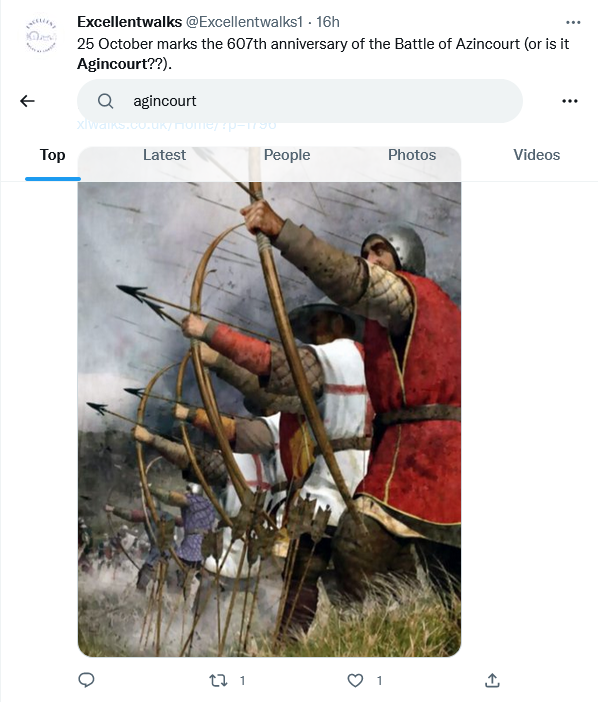
At the last moment Henry sought to avoid so desperate a battle. Heralds passed to and fro. He offered to yield Harfleur and all his prisoners in return for an open road to Calais. The French prince replied that he must renounce the crown of France. On this he resolved to dare the last extremity. The whole English army, even the King himself, dismounted and sent their horses to the rear; and shortly after eleven o’clock on St Crispin’s Day, October 25, he gave the order, “In the name of Almighty God and of Saint George, Avaunt Ban-ner in the best time of the year, and Saint George this day be thine help.” The archers kissed the soil in reconciliation to God, and, crying loudly, “Hurrah! Hurrah! Saint George and Merrie England!” advanced to within three hundred yards of the heavy masses in their front. They planted their stakes and loosed their arrows.
The French were once again unduly crowded upon the field. They stood in three dense lines, and neither their cross-bowmen nor their battery of cannon could fire effectively. Under the arrow storm they in their turn moved forward down the slope, plodding heavily through a ploughed field already trampled into a quagmire. Still at thirty deep they felt sure of breaking the line. But once again the long-bow destroyed all before it. Horse and foot alike went down; a long heap of armoured dead and wounded lay upon the ground, over which the reinforcements struggled bravely, but in vain. In this grand moment the archers slung their bows, and, sword in hand, fell upon the reeling squadrons and disordered masses. Then the Duke of Alencon rolled forward with the whole second line, and a stubborn hand-to-hand struggle ensued, in which the French prince struck down with his own sword Humphrey of Gloucester. The King rushed to his brother’s rescue, and was smitten to the ground by a tremendous stroke; but in spite of the odds Alengon was killed, and the French second line was beaten hand to hand by the English chivalry and yeomen. It recoiled like the first, leaving large numbers of unwounded and still larger numbers of wounded prisoners in the assailants’ hands.
Sir Winston Churchill, from The Birth of Britain
October 25, 1415 was an amazing day for the English. The English longbow had long proved in the Hundred Years War to be a devastating weapon in the hands of skilled archers, but rarely had the English faced such long odds as they did at Agincourt. Approximately 6,000 English, exhausted and worn from their march, faced approximately 30,000 French. About five out of six of the English were archers with the remainder men-at-arms, knights and nobility. The French had about 10,000 men-at-arms, knights and nobility, and 20,000 archers, crossbowmen and miscellaneous infantry.
The English established their battle line between the woods of Agincourt and Tramecourt, which offered excellent protection to both of their flanks. The English archers made up the front line with stakes set in the ground before them to impale charging horses. Archers were also placed in the woods to provide flanking fire against advancing French. The men at arms and knights and nobility, were divided into three forces behind the archers. They fought on foot.
The terrain between the woods that the French would have to cross in their attack of the English consisted of newly ploughed, and very muddy, fields. Having walked through muddy fields on several occasions in rural Illinois, I can attest that simply getting from point A to point B in such terrain can be exhausting, let alone fighting at the end of the tramp through the morass.
For three hours there was no fighting, the French waiting for reinforcements. King Henry tiring of this had his army advance to put pressure on the French to attack. Alarmed by this offensive movement by the English, the French finally attacked.
The French advanced in three battles, or lines, one behind the other. The mounted French, only about 1200 men, were in the first line. All the other French fought afoot.
The charge of the mounted French was a complete disaster and set the tone for the entire battle. Due to the woods, the English archers could not be outflanked, and their blizzard of arrows wreaked havoc with the horses of the French as they made their frontal charge. The French cavalry fell back on the advancing dismounted French men-at-arms. These advanced against heavy fire from the longbowmen, who fired into the French men-at-arms until they ran out of arrows, and then joined in the melee with the English men-at-arms. The French initially succeeded in forcing back the English line. However, their success was short-lived. Exhaustion set in among the French after their trek through the muddy fields, and the English longbowmen, wearing no armor and therefore much more agile than their adversaries in the mud, attacked with surprising success, aiming their blows at unarmored portions of the bodies of the French men-at-arms. The fighting lasted about three hours before the French withdrew in defeat. The stunned English slowly realized that they had won one of the most incredible against the odds victory in military history.
Chorus: Thus far, with rough and all-unable pen,
Our bending author hath pursued the story,
In little room confining mighty men,
Mangling by starts the full course of their glory.
Small time, but in that small most greatly lived
This star of England: Fortune made his sword;
By which the world’s best garden be achieved,
And of it left his son imperial lord.
Henry the Sixth, in infant bands crown’d King
Of France and England, did this king succeed;
Whose state so many had the managing,
That they lost France and made his England bleed:
Which oft our stage hath shown; and, for their sake,
In your fair minds let this acceptance take.
Exit
Shakespeare, Henry V


Kenneth Brannagh knocked that speech out of the ballpark. Always inspiring. As a high school student I never understood the big deal about Shakespeare but maybe my teachers didn’t either. The older I get, the better I understand Shakespeare.
Thank you, Don.
I don’t think Cathy Shakespeare clicks with most people if it is read. It was meant to be heard, and until it is heard the magic eludes most people. As the Germans say, you cannot understand Shakespeare until you have heard him in the original German!
A great victory for the English but gained them nothing in the long term. Despite their ability to roam as they wished in France, their downfall began a little more than a decade later with the unlikely rise of a peasant girl from Domremy who began the lengthy process of expelling the English from France.
The critical factors were the early death of Henry V and the long regency of his infant son, Henry VI.
There’s a smugness in Branaugh that I can’t get past. It worked for Gilderoy Lockhart. I also thought he was fine in Swing Kids (a very underrated movie). But in general I don’t like him.
I don’t think Cathy Shakespeare clicks with most people if it is read. It was meant to be heard, and until it is heard the magic eludes most people. As the Germans say, you cannot understand Shakespeare until you have heard him in the original German!
If you say so. The last Shakespeare play I attended was put on by late adolescents at a theatre camp. It was incomprehensible and I was bored silly. (Also annoyed, because the theatre camp was run by COVID Karens, so I had to give proof of the ineffective vaccine I’d had 15 months before ‘ere I could enter the theatre and I was admonished multiple times to don my ineffective mask).
I prefer reading Shakespeare.
There’s a smugness in Branaugh that I can’t get past.
It’s all in your head.
[…] at The American Catholic, Don McCleary does his usual quality unpacking of the more famous anniversary associated with today. The Battle of Agincourt is known for many reasons, not the least being its […]
[…] : FIVEFOLD OUR […]
[…] at The American Catholic, Don McCleary does his usual quality unpacking of the more famous anniversary associated with today. The Battle of Agincourt is known for many reasons, not the least being its immortalization in […]
“The last Shakespeare play I attended was put on by late adolescents at a theatre camp.”
I recall being quite (un)impressed with Leo DiCaprio’s version of Romeo and Juliet. …Well, Cathy DID comment about trouble when teachers don’t “get” Shakespeare either.