Water Dogs

https://twitter.com/____B_S____/status/1582855934468009984

Refreshment for the soul.

0 0 votes
Article Rating
7 Comments
Oldest
Newest Most Voted
Inline Feedbacks
View all comments
Frank
Frank
Thursday, October 20, AD 2022 7:31am

This made my day. ❤️😊

Ezabelle
Ezabelle
Thursday, October 20, AD 2022 9:32am

Very cute.

CAM
CAM
Thursday, October 20, AD 2022 9:46am

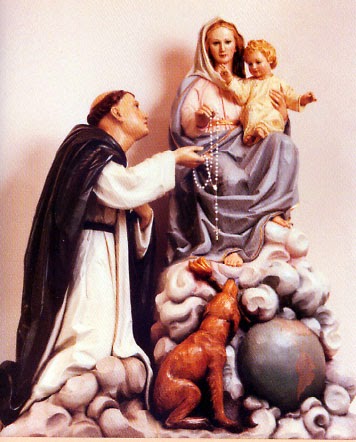
Thanks for the smile. Are they Golden Retrievers? Wondering about the statue – St. Dominic?

John L Flaherty
John L Flaherty
Thursday, October 20, AD 2022 10:01am

Awwwwww…….so cute.

Quotermeister
Quotermeister
Thursday, October 20, AD 2022 11:31am

“The world is full of devouring wolves, and you, unfaithful dog, know not how to bark.”
_

These are the words that have come down to us concerning the chastisement of one Blessed Alan de la Roche. Living during the 15th century, Alan was a Dominican priest from Bretagne, Douai, near the English Channel. According to tradition, the Virgin Mary appeared to him, having previously been responsible for his conversion from a dissolute life, and charged the priest with the task of reviving the practice of praying the holy Rosary.
_

Reluctant, whether disbelieving in the visions or fearful in some way, and perhaps on account of some excessive attachment to his studies and the works that had previously occupied him, Alan did not, at first, begin preaching.
_

As a consequence, the Holy Mother returned to him, and with her the exalted spirit of the founder of his order, St. Dominic himself, to urge his spiritual son to take up that righteous commission that heaven had entrusted to him. And with these, the Lord—Christ himself—was seen by Alan, and from humanity’s saviour, he heard the words: “The world is full of devouring wolves, and you, unfaithful dog, know not how to bark.”
_

Understandably, the Blessed Dominican now began to strive in the path set out before him. Indeed, dog he was. By way of Latin word play, the Dominicans are called “Domini canes,” the Lord’s dogs, hounds of heaven.
_

When the Dominican’s founder’s mother, Blessed Juana de Aza, was pregnant with the future saint, she dreamt that she would give birth to a dog, and that it would carry a torch in its mouth, with which it would inflame the world. The missionary meaning of this dream would come to be known during the labours of St. Domingo de Guzmán (1170-1221) and the members of the order he founded.
_

The torch as lampstand, burning with sacred oil, and its place in the hound’s mouth, as though fire and light were a bark, like a trumpet call, reminds us of the function of trumpets in the Bible, announcing and calling forth to battle, as they were used in the Israelites’ war on Jericho and against the forces of the Dragon in the Apocalypse. Torches are sometimes accompanied by trumpets(Judges 7:16-20) and appear in connection to weapons of war (Proverbs 26:18), keeping faith (Matthew 25), and the divine presence (Apocalypse 4:5). We also find a scriptural connection with canines when Samson used torches attached to foxes to wage war on the Philistines (Judges 15:3), a conflict analogous to Dominican spiritual warfare.

Biblically, the wolf is a beastly devourer, one poised to consume sheep who stray from the fold of the blessed flock. This is the sense in which the presence of wolves throughout the world was invoked in the words heard by Blessed Alan from the mouth of his Redeemer.
_

The dog, however, is a sheep in that flock. Not a wolf in sheep’s clothing, but a sheep turned wolf, domestic wolf. Endowed with the predatory energies of that feral hunter, he places these at the service of the righteous assembly. Like St. Dominic, his lot is to warn, to bark, against heresy, to preach concerning the errors of the spiritual sickness of his era.
_

Dominic himself was locked in combat against the Albigensian, or Cathar, creed: a dualistic system that seems to have posited the existence of two competing divinities, one of which, the creator of the material cosmos, had malevolently forged this world as an abode of abject slavery in which to entrap souls. The only hope for the latter is therefore to utterly reject and thereby escape this realm. A doctrine such as the resurrection of the body would therefore be quite anathemic to Catharism. Like the neo-Platonists and early Christians, Dominic’s generation was called to refute Gnosticism by expounding on materiality’s ultimate participation in higher metaphysical principles.
_

This would be the first “bark” of the heavenly hounds.
_

It would not always be directed against wolves outside the shepherd’s pastures, however. The sheep are sent among the wolves, therefore the wolves are among the sheep—and so must the dogs be.

From “The Metaphysics of Dogs From Tobit, to Dominic, to Dante: Part I” by Carlos Perona Calvete — (07.09.22)

https://europeanconservative.com/articles/essay/the-metaphysics-of-dogs-from-tobit-to-dominic-to-dante-part-i/

CAM
CAM
Thursday, October 20, AD 2022 11:54am

QUOTERMEISTER, thank you for the very thoughtful explanations and link. Passing to our local priest who has a yellow lab.

Scroll to Top