
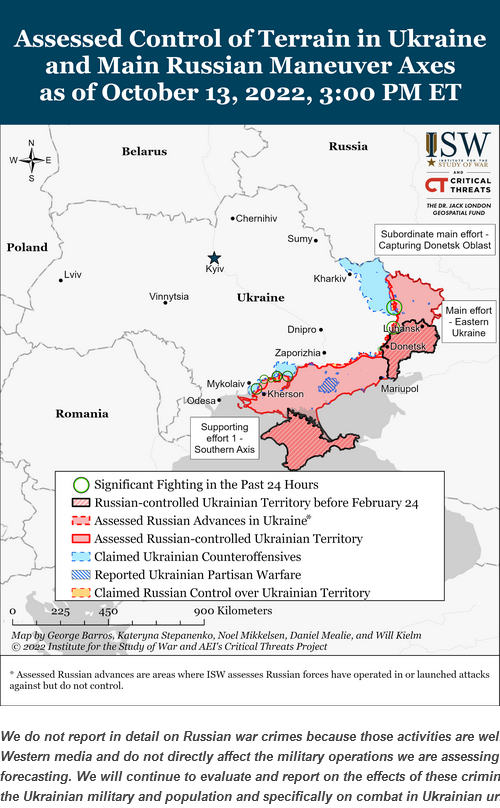
From The Institute For The Study of War:
Russian Offensive Campaign Assessment, October 13
Karolina Hird, Kateryna Stepanenko, Katherine Lawlor, and Frederick W. Kagan
October 13, 9:15 pm ET
Click here to see ISW’s interactive map of the Russian invasion of Ukraine. This map is updated daily alongside the static maps present in this report.
Public reports of the first deaths of ill-prepared mobilized Russian troops in Ukraine have sparked renewed criticism of the Russian military command. Russian media reported that five mobilized men from Chelyabinsk have already died in combat in Ukraine just three weeks after President Vladimir Putin’s declaration of partial mobilization on September 21.[1] The report led many pro-war milbloggers to claim that the number of dead and wounded among mobilized servicemen is likely higher than this due to lack of promised training, equipment, unit cohesion, and commanders, as well as repeated instances of wrongful mobilization.
Russian milbloggers claimed that Commander of the 58th Combined Arms Army of the Southern Military District (SMD), Mikhail Zusko, ordered the immediate deployment without any pre-combat training of newly mobilized servicemen of the 15th Regiment of the 27th Motor Rifle Brigade from Moscow City and Moscow Oblast to the collapsing frontline around Svatove around October 2nd and 3rd.[2] Ukrainian outlets had previously reported that the Kremlin has arrested Zusko due to combat losses, and it is unclear why an SMD commander would issue orders pertaining to a unit within the Western Military District (WMD).[3] Milbloggers noted that relatives found half of the 15th Regiment personnel wounded in a Belgorod Oblast hospital after the unit got caught in heavy artillery fire when attempting to reach the Svatove frontline. Milbloggers noted that the regiment had no orders, military command supervision, signal, or supplies, and that the other half of its personnel is still at the Svatove frontline. Another milblogger noted witnessing the coffins of mobilized men arrive in Chelaybinsk, Moscow, and Yekaterenburg, and claimed that many mobilized men are surrendering to Ukrainian forces.[4] One Russian milblogger complained on October 13 that newly mobilized men are being deployed in a haphazard way that will lead to 10,000 deaths and 40,000 injuries among them by February 2023.[5]
Russian mobilization structures are continuing to face bureaucratic challenges, which may further undermine the combat effectiveness of mobilized personnel. Milbloggers claimed that the Russian Ministry of Defense (MoD) did not set proper conditions to integrate and monitor the deployment of mobilized men at the frontlines.[6] Russian military units reportedly disperse mobilized men among different units without keeping proper records of their deployed locations on the frontlines, causing families to complain to military leadership. Russian military officials are also continuing to assign men with previous military experience to units that do not match their expertise. One milblogger even warned that Russian MoD’s inability to properly update families of the whereabouts of their relatives will lead mothers and wives to form human rights groups that “will break Russia from within.”[7]
ISW cannot independently verify milblogger claims, but the community has been proactive in highlighting the Kremlin’s mobilization since the day of its declaration in hopes of improving the prospects of the Russian war in Ukraine.[8] ISW has also previously reported on a video of mobilized men from Moscow Oblast in Svatove who complained about their lack of equipment and deployment to the frontlines without proper training, which corroborates some milblogger reports.[9] The persistence of such complaints supports ISW’s assessment that the mobilization campaign will not produce enough combat-ready Russian personnel to affect the course of the war in the short term. The Kremlin’s rapid deployment of mobilized servicemen to the Kreminna-Svatove line may also indicate that Russian President Vladimir Putin is willing to throw away the lives of mobilized men in a desperate effort to preserve a collapsing frontline.
The Kremlin continues to struggle to message itself out of the reality of mobilization and military failures. The Kremlin continued its general pattern of temporarily appeasing the nationalist communities by conducting retaliatory missile strikes on Ukraine in an effort to deflect from persistent mobilization problems. Renewed milblogger critiques about mobilization again show how ephemeral the Kremlin’s successes are at deflecting attention from them. The nationalist community resumed its calls on the Kremlin to replace senior officials and commanders and declare war, which some had anticipated would be the Kremlin’s response to the Kerch Strait Bridge explosions, broken mobilization process, and loss of most of Kharkiv Oblast and Lyman.[10] The Kremlin remains trapped in a cycle of appeasing its pro-war constituencies but retaining Russian President Vladimir Putin’s vision of a limited war in Ukraine that is incompatible with their demands and expectations.
Russian forces continued to launch strikes on critical Ukrainian infrastructure on October 13. Ukraine’s Western Air Command noted that Russian forces launched Kalibr cruise missiles at infrastructure in western Ukraine, four of which Ukrainian troops destroyed.[11] The Ukrainian General Staff reported that Russian troops launched missile strikes on critical infrastructure and civilian objects in Kyiv, Dnipropetrovsk, and Mykolaiv Oblasts throughout the day on October 13.[12] Ukrainian military sources also reported that Russian troops continued drone attacks all over Ukraine, and that Ukrainian troops shot down four drones over Vinnytsia and Cherkassy on October 12.[13] Social media footage additionally shows explosions in Rivne, Ternopil, Lviv, Chernivitsi Oblasts following the activation of Ukrainian air defense systems.[14]
Russian forces are likely continuing to use Iranian Shahed-136 drones to support massive strike campaigns against critical Ukrainian infrastructure due to their low efficacy in active combat situations. Ukraine’s Southern Operational Command Spokesperson, Nataliya Humenyuk, claimed on October 13 that Russian forces are employing Shahed-136s primarily to strike buildings and infrastructure because the drones have limited efficacy against troop concentrations.[15] Humenyuk cited various sources who stated that Russia has received between 300 to several thousand Shahed-136s and is using them in areas as far away as 1,000km from the launch point, which is why Shahed-136 use has been densely concentrated around southern Ukraine.[16] Russian forces are also increasingly trying to launch the drones from the northern border area. Humenyuk’s statement, and the pattern of recent Shahed-136 strikes against infrastructure in Ukrainian rear areas, supports ISW’s previous assessment that Shahed-136s will not generate asymmetric effects for Russian forces because they are not being used to strike areas of critical military significance in a way that directly influences the frontline.[17]
Wagner Group financier Yevgeny Prigozhin is likely continuing efforts to distinguish himself and Wagner Group forces from more conventional Russian and proxy troops. Prigozhin emphasized in a comment to Russian outlet RIA FAN that Wagner Group forces singlehandedly took control of Ivanhrad, a settlement just south of Bakhmut, on October 13.[18] However, the Donetsk People’s Republic (DNR) Territorial Defense Force claimed that Luhansk People’s Republic (LNR) and DNR joint forces took control of Ivanhrad and the nearby settlement of Opytne, apparently contradicting Prigozhin’s statement that “not a single person from other units, except for employees of the Wagner Private Military Company” was in Ivanhrad at the time of its capture.[19] Prigozhin additionally rebutted the claim that Russian forces have taken Opytne and stated that fierce fighting is ongoing on its outskirts.[20] The disconnect between Prigozhin’s and the DNR Territorial Defense’s claims, as well as Prigozhin’s apparent desire to have Wagner Group fighters receive sole credit for the capture of Ivanhrad, is consistent with ISW’s previous observations that Prigozhin is jockeying for more prominence against the backdrop of his recent harsh critiques of the Russian Ministry of Defense (MoD) establishment.[21]
Increasingly degraded morale, discipline, and combat capabilities among Russian troops in combat zones in Ukraine may be leading to temporary suspensions in offensive operations in limited areas. The Ukrainian General Staff reported that, particularly in Donetsk Oblast, certain Russian units are receiving orders from commanders to temporarily halt offensive operations due to extremely low morale, psychological conditions, high rates of desertion, and non-execution of combat orders.[22] The General Staff statement is likely a reflection of the fact that Russian detachments are becoming increasingly degraded as they impale themselves on relatively small and insignificant settlements throughout Donetsk Oblast, especially around Bakhmut and the Donetsk City area. As these units become more degraded, they are likely reconstituted ad hoc with disparate combat elements, which leads to further demoralization and incoherence in the conduct of offensive operations. However, the apparent suspension of offensive operations in areas of Donetsk Oblast, nearly the only areas in Ukraine where Russian troops are engaged in offensive operations, will further complicate Russian efforts to take additional territory and likely further contribute to poor morale and overall attrition of combat capabilities.
Key Takeaways
- Public reports of the first deaths of ill-prepared mobilized Russian troops in Ukraine have sparked renewed criticism of the Russian military command.
- Russian forces continued to launch strikes on critical Ukrainian infrastructure on October 13.
- Increasingly degraded morale, discipline, and combat capabilities among Russian troops in combat zones in Ukraine may be leading to temporary suspensions in offensive operations in limited areas.
- Ukrainian forces made gains northwest of Svatove.
- Russian forces are continuing defensive operations in anticipation of potential Ukrainian attacks towards Kreminna.
- Ukrainian and Russian sources stated that Russian troops are attempting to recapture positions in northern and northwestern Kherson Oblast.
- Damage to the Kerch Strait Bridge continues to impede the movement of Russian supplies and personnel to southern Ukraine.
- Russian forces continued ground attacks in Donetsk Oblast and claimed to make marginal advances south of Bakhmut.
- Russian incompetence continues to take its toll on mobilized personnel before they ever reach the front lines, likely exacerbating already-low morale.
- Russian officials are likely increasingly limiting freedom of movement in Russia to preserve additional mobilizable populations and prevent them from fleeing the country.
- Russian occupation officials called for the evacuation of civilians from occupied Kherson Oblast.
Go here to read the rest.
From Strategy Page:
October 13, 2022: One of the surprising developments early in the Russian February invasion of Ukraine was the failure of the BTG (Battalion Task Group) system that Russia expanded since the 1980s because it had consistently proved successful in many small wars, including the rather large operation in Afghanistan during the 1980s. BTG began during World War II when it was found that forming temporary task forces containing tank and infantry units were more effective. The Germans did the same thing, calling them battle groups and the Americans adopted the practice after World War II. There was an important difference between the Western battle groups and the current BTGs. The Western battle groups were kept simple (mainly infantry and tank companies) with the addition of combat engineers or artillery as needed. American infantry officers got lots of realistic training using these battle groups. Western armies had many career NCOs to make sure the troops performed well.
Russia expanded their BTGs after 2000 and added more support units so that each BTG had most of the support capabilities usually found in a division. These support units were smaller in the BTG, often a dozen or so specialists riding in a few trucks. The BTG commander put an officer in charge of all these non-combat support troops and the dozens of trucks they traveled in. The combat element of a BTG always consisted of a few hundred infantry and ten or twenty tanks. But now there were small (platoon sized) detachments of specialists. The only ones that were always present were a dozen or so self-propelled 152mm guns and somewhat more 82mm and 120mm mortars. There was also a medical detachment. In the last decade a detachment of fire control troops was added to coordinate all that firepower with some UAVs to scout for targets. There was also a small number of self-propelled anti-aircraft weapons in addition to the portable anti-aircraft missiles carried by individual soldiers. There were several other specialist units that could be added as needed. Total strength of a BTG varied depending on how it was assembled. Personnel strength could vary from 600 to 800 personnel.
These new BTGs became the standard for Russian divisions, which now consisted of two or three brigades. Each of these usually had just two BTGs. The division had fewer support units because most of these troops were now assigned to BTGs or brigades. By 2021 there were 170 BTGs. The combat elements (one tank company, two or three infantry companies and one or two batteries of artillery) contained contract (volunteer) troops while most of the rest of the BTG depended on conscripts. The conscripts had several shortcomings. They could not be used in a combat zone, their term of service was only one year and they were not as well trained as the contract troops (or trained at all). By law conscripts were not allowed in a combat zone unless it was wartime and they were defending Russia.
This massive adoption of BTGs was a mistake that became obvious when nearly half the available BTGs were sent into Ukraine in early 2022. Many newly formed BTGs were sent to the Ukrainian border in late 2021 to threaten Ukraine and if that did not work, to invade.
The flaw in the BTGs was not obvious until they encountered well-armed and motivated opponents. That happened soon after they crossed the border into Ukraine. The leadership in these BTGs could not handle the complex composition of BTGs. Senior Russian leaders knew this from the performance of BTG leaders during military exercises. This was not a surprise as the quality of officers had declined in the last decade and there were still not enough experienced NCOs.
The lack of competent leadership meant the troops in the BTGs were poorly used during combat and increasingly abandoned their vehicles and fled if they encountered Ukrainian troops, who concentrated on hitting the very vulnerable tanks and light armored vehicles (like BMPs or wheeled armored infantry carriers) as the BTG leaders failed to carry out effective reconnaissance or get the infantry out of their armored vehicles and protect their tanks from Ukrainian infantry armed with modern Western anti-tank weapons. Worse, the Ukrainians concentrated on attacking the BTG trucks carrying supplies and maintenance personnel. The trucks were the last to enter Ukraine because there were a lot of conscripts driving the trucks and these conscripts were not told they were driving into Ukraine. Instead, many were told they were on another training exercise. Most of these vehicles were destroyed or abandoned by the Ukrainian airstrikes, artillery fire and ground troops using whatever weapons they had. In one case a retired Ukrainian soldier was given a single-shot RPG (Rocket Propelled Grenade Launcher) by some passing Ukrainian troops. The elderly veteran used that one RPG to destroy a Russian truck by waiting for the fuel trucks, hitting one of them. The fiery explosion ignited other trucks including some carrying fuel. Soon the truck column was in flames and the surviving drivers were walking back to the border. The attacks on the trucks meant that the combat units could not refuel and had to stop before they reached their objectives. The Ukrainians now had stationary Russian armored vehicles to attack. The few competent or determined BTG officers were soon killed as they tried to get their troops to put up an effective fight. These young officers had no experience and many had little or no training for combat (such as a weather officer dragooned as an armored reconnaissance officer). Senior Russian officers (colonels and generals) who did have experience were under tremendous pressure from their military and political commanders to get the problem fixed. Many went to the front line BTGs to show the junior officers how it was done, often by example. Many of these senior officers were killed or wounded. This further weakened the leadership of the brigades and divisions that went into Ukraine dependent on their BTGs.
The BTGs and leadership problems were known to many senior civilian and uniformed military leaders. There had been continuous reform efforts since the Soviet Union dissolved in 1991. The Russian Defense Ministry introduced some unexpected changes in 2013. For the first time the “Command Center ” for the military was physically separate (in a new building complex) from the Stavka, the General Staff which long handled planning and administration of the military. This was part of a trend towards installing more Western style civilian control over the military high command. At the same time there was an effort to placate military traditionalists. A new Defense Minister reversed the conversion of the two elite divisions stationed in Moscow; the Kantemyrovskaya tank division and the Tamanskaya motor-rifle division, to the new brigade/BTG structure. The ministry also ordered the return of ideological training for troops and increased the use of informants and opinion surveys to monitor morale and loyalty in the military. This included a return of the Soviet era “Zampolit” (political officer). In Soviet times every unit commander had a deputy (Zampolit) who represented the communist party and could veto any of the commanders’ decisions. The Zampolit was responsible for troop loyalty and political correctness. Sort of a communist chaplain. In 2010 the army reintroduced chaplains, something that the communists did away with in the 1920s. The new chaplains are, however, expected to report on the loyalty of the troops to church and state. Additional officers were added to handle ideological training and monitoring morale. Not exactly the return of the Zampolit but a return of most of the Zampolits’ duties.
This was not what a lot of senior officers expected when the reformist Defense Minister (Anatoly Serdyukov) took over in 2007 and was replaced by Sergei Shoigu in 2012. At first it was believed that Shoigu was going to reverse a decade of military reforms, but that did not happen. Some senior members of the Defense Ministry were openly advocating returning to the use of divisions, instead of Western style brigades, a system pioneered in the West. BTG (Battalion Task Groups) and a large reserve force, were something that was only talked about and rarely acted on. The reason for the demand to keep the divisions was the possibility of a large war in the east. The only major foe out there was China but China was not mentioned because China had become an economic and diplomatic asset for Russia. Nevertheless, China is and remains the major potential threat to Russia. The Chinese Army is three times larger and has 15 tank and mechanized infantry divisions it could place on the Russian border. China is also reorganizing its ground forces into one based on brigades rather than divisions. China believes that will be more effective than divisions and they may be right.
Officially Russia ceased to consider Chinese ground forces a threat, as Russian nuclear weapons are supposed to stop a Chinese ground assault. This is what kept the Russian brigade reorganization efforts alive, because brigades are more effective in dealing with insurrections and low-level unrest. Traditionalists in the Defense Ministry pointed out that nuclear war would destroy both nations and that the current situation allows China to quickly grab the Russian Far East (which China has long claimed) and then call for a peace conference. This is the sort of tactic China has used in the past and the Chinese are big fans of their imperial past. But the senior government leaders believed they could use diplomacy and new, faster moving conventional forces to prevent any Chinese use of “grab and declare peace” tactics.
For a while it seemed that Russian reformers were on the defensive. Since the end of the Cold War in 1991, there have been growing efforts to drag the army out of the 19th century. There has been resistance to change, especially when it involved ancient and often uniquely Russian practices. All these new ideas from the West were seen as, well, un-Russian. A year after reformist Defense Minister Serdyukov was replaced, most of his reforms continued and some, like making life more comfortable for the troops. were expanded. Soldiers now had showers in the barracks and lots of hot water. The food was getting better and buffet style dining, used for decades in the West, was introduced. New barracks were built and life in the military was much less like being in prison, which is what it resembled until the reforms began.
For generations Russian conscripts were confined to their barracks when not on duty. This was unpleasant, as the barracks were often decrepit and uncomfortable. The barracks were upgraded over the last decade to include flush toilets, showers, central heating, washing machines, and many other amenities Western troops take for granted. In these old barracks troops were allowed to bathe once a week in a bathhouse that was often improvised for the occasion. In addition to showers in all barracks, along with wi-fi in some and new furnishings the new barracks had flush toilets and central heating. During the Cold War Russian troops stationed in East Germany lived in modern barracks, and that was one reason why duty in Germany was considered a choice assignment.
Military reform has never come easily to Russia and usually occurred when a particularly strong and harsh ruler was in charge. In modern times Russia has undergone four periods of major military reform. The first was in the early 18th century, under Czar Peter the Great. The next was under Field Marshall Milyutin in the late 19th century. In the 1930s over a dozen daring reformers made the military ready for modern warfare. However, most of these men were executed by a paranoid dictator, Josef Stalin, just before World War II. For over 60 years there was not much real reform, until 2008, when Defense Minister Serdyukov sought to make the Russian military similar to what the West had long possessed. This meant fewer officers and conscripts, more NCOs and volunteers, plus new equipment, weapons, training methods, and tactics. Serdyukov made a lot of enemies in the military with his reform efforts and was replaced in 2012. One of Serdyukov’s most unpopular moves was to shrink the size of the officer corps. Despite the fact that most of the officers being let go were not really needed, this elicited a lot of protests from active duty and retired officers.
Yet the mass officer firings continued anyway. Shrinking the officer corps proved bad for officer morale, as could be expected. Moreover, most of the good officers had left after the Soviet Union collapsed in 1991 and the Russian military saw its budget slashed by 80 percent. Building an NCO corps of long-serving soldiers was difficult because the 1930s reforms eliminated them as a potential source of revolutionaries. Officers, all members of the Communist Party, were considered more politically reliable than NCOs. Another big problem was the collapse of the Soviet era military industries. With orders from the Russian military disappearing in the 1990s, many of these firms disappeared or switched to civilian products. Those that survived did so with export orders. The defense industries lost their best people, who left for better paying jobs overseas or in new non-defense firms in Russia.
Go here to read the rest.
That the Russian military governor of Kherson is calling for the Kremlin to evacuate civilians from his province demonstrates just how dire the military situation is for the Russians in that area. Kherson is the gateway to the Crimea and if they lose it, the Crimea may not be far behind.

