
Lisa Murkowski’s gift to Alaska. Ranked voting: how to convert 40 percent into a winning majority, and to make the the supporters of the least popular candidate the king makers. This utter flim flam has the same relationship to democracy as tofu does to meat.


All politicians are public servants. Constituents have a right to demand Truth and Justice.
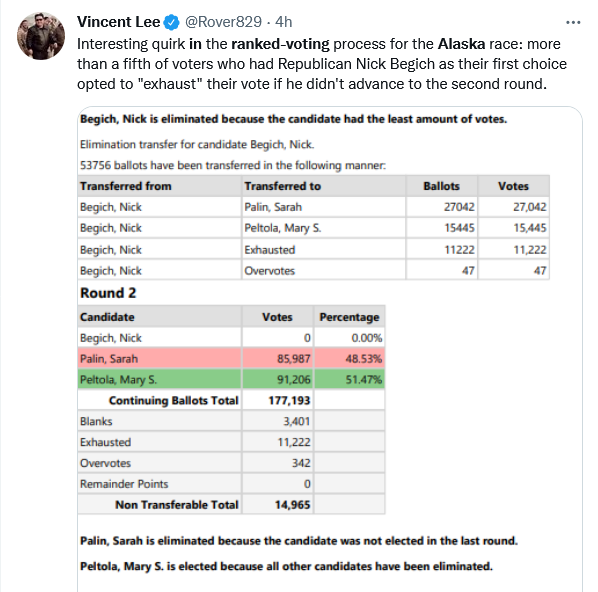
Peltola won a plurality in the first round, so would have won under the old system anyway. If the same number of people who voted for Begich voted for her or stayed home in a runoff, she still would have won. This isn’t a quirk of the voting system; it’s evidence of how unpopular Sarah Palin is.
Under the old system in Alaska Palin would have beaten Begich in a Republican primary and then creamed the Democrat in this election. Likely that a good many of Begich’s voters were confused as to ranked voting as over 11000 left their second choice blank. Maybe they intended to do so, but I am skeptical. We will find out in four months.
Ranked voting is the system that gave Minneapolis its worthless Mayor Frey — mayor during the BLM riots. He ‘won’ his seat with about 23% of the vote. Same story for all the leftist kooks on that City Council.
It’d be almost impossible for the people of Minneapolis to get rid of ranked voting at this point, but I understand the Minnesota state legislature has banned its adoption by any other municipalities. That— and the fact that RV is pushed by the left— should tell us it’s a bad, bad idea.
And this is how Murkowski wi win again. She couldn’t count on the write in scam so she pushe the RV as an behind the scenes
Precisely.
Ranked voting is the system that gave Minneapolis its worthless Mayor Frey — mayor during the BLM riots. He ‘won’ his seat with about 23% of the vote. Same story for all the leftist kooks on that City Council.
And this is how Murkowski wi win again. She couldn’t count on the write in scam so she pushe the RV as an behind the scenes
Write-in voting is not a scam. And ranked-choice is not why you have Mayor Frey or Lisa Murkowski. You have the because that’s who most voters prefer given the menu of choices. See Donald Horowitz on the alternate vote. It tends to generate winners who are somewhere around the median of a given spectrum due to vote pooling. It depends on what the spectrum is. Ranked choice has considerable utility when you have situations where you have more than two candidates competing for a single office as the secondary preferences of the trailing candidates are distributed among those higher on the rank-order.
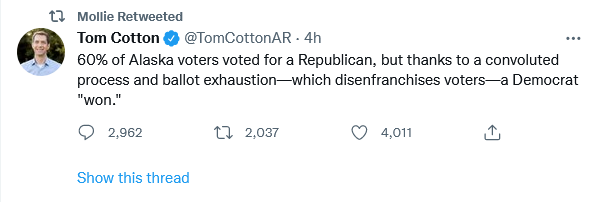
The process is not convoluted and disfranchises no one. Quite the contrary. No clue why Cotton is pushing this nonsense.
Should people be forced to use a system of voting that is so complicated it takes paragraphs of agate type to explain it? I think not. Just saying.
The process is not convoluted and disfranchises no one.
Completely disagree Art. It gives some voters two votes in one election. A great Equal Protection challenge to this garbage awaits.
Democrats in my home state of Massachusetts are pushing for “Ranked Voting”,
That’s all I need to know.
(Nov 3, 2020Massachusetts Question 2, the Ranked-Choice Voting Initiative was on the ballot in Massachusetts as an initiated state statute on November 3, 2020. It was defeated .)
Ranked voting makes sense for something like the Hugo awards, but I would not want it anywhere near public office.
Maybe – MAYBE as tie breaking system if numerous candidates for an office led to a close enough result that a run-off was necessary. Then, maybe a ranked choice would be useful result.
It gives some voters two votes in one election.
There is one ballot paper to fill out. Everyone gets the same number of ballots. One ballot. What a ranked-choice vote is, for every voter, is a vote with a contingent value.
Honestly, this sort of voting has been used for decades in Ireland and in Australia and there’s a body of academic literature on it.
“is a vote with a contingent value.”
Like I said Art, some voters get two votes, and the backers of loser candidates get to be kingmakers. From an Equal Protection analysis mandated by our Constitution, ranked choice voting stinks to high Heaven.
Should people be forced to use a system of voting that is so complicated it takes paragraphs of agate type to explain it?
The voting itself is not complicated at all. You just rank order your choices rather than checking a single box. If you make use of a Hare system tabulation, which you would if you were electing members of a conciliar body from a multi-member district, the tabulation procedure requires some explaining. (Again, has been used in Australia for generatios).
For an election with a single victor, the tabulation is straightforward. The point is to win a majority of the tally.
A, You rank the candidates according to first-preference votes, excluding from the tally blank and spoiled ballots.
B. If no candidate has a majority of the tally, you eliminate trailing candidates. The first time, you might eliminate the caboose candidate, eliminate any candidate who failed to score a threshhold of the tally (say 2%), or locate a candidate in the rank order ‘n’ whose 1st preference votes exceed the sum of first preference votes of all succeeding candidates.
C. You distribute the ballots of the eliminated candidates to whichever surviving candidate has the highest rank on a given ballot. Ballots on which no surviving candidate is marked are excluded from the tally.
D. In subsequent rounds, you exclude the caboose candidate and repeat step C.
E. When you arrive at a point when one candidate has a majority of the tally, you have a winner.
IMO, the important thing given our current problems is to have a drop dead date at which time no more mail in ballots will enter the stream. Ballots arriving later have to be sequestered, locked away, and returned to sender once the tabulation is complete. IMO, the optimal day would be the day before in-person voting. That gives inspectors time to validate the last batch of arrivals. The tabulation of the mail-in ballots can take place on the day in-person voting occurs, so that the first round of tabulation of mail-in ballots is complete at the time the polls close and then the tabulation of in-person votes can begin.
Like I said Art, some voters get two votes,
No, they don’t. The vote is transferred. It is still one vote. Any ballot cast might be transferred to another candidate contingent on the vote totals of a given round. If you can manufacture an equal protection case out of this, it’s only because judges are law school graduates and people go to law school because they are bad at math.
Maybe – MAYBE as tie breaking system if numerous candidates for an office led to a close enough result that a run-off was necessary. Then, maybe a ranked choice would be useful result.
That’s not the utility of the system. It’s utile in two cases. One is when you have a vigorous multi-party system, which they do in Alaska.
The other is when you have a dominant party as you do in New York. The system heretofore has had primary elections (using 1st past the post) and then pro-forma general elections which the opposition lose. The pro-forma general election is a waste of time. One option would be to have all candidate circulate designating petitions each in his preferred body of registrants (Democratic, Republican, and nonpartisan). All aspirants would appear on the ballot with the party preference listed in brackets. As for the ballot order, there would not be a single stereotype. There would be as many stereotypes as candidates who qualify for the ballot. What you do is make a drawing and place the slips drawn on a daisy wheel. You begin at one spot and move around counter clockwise, with the first candidate you choose being at the top of the ballot with the last you arrive at at the bottom. You create another stereotype by starting at another point. In this manner, each candidate has an equal chance of being the first candidate in the line up. You print up equal numbers of each stereotype. One precinct gets one stereotype, one gets another, one gets a third, and so forth. Each stereotype is distributed to an equal number of precincts. This is useful because you often have a critical mass of people who just rank people in the order they appear on the ballot. With variation in order from one precinct to another, these people cancel each other out.
Note, ranked-choice is sometimes called ‘instant-runoff’ voting. It’s a more refined version of conventional runoffs which select the top two from a first-past the post contest.
Where you have a roughly competitive situation the two step of primary and then general elections is optimal. Ranked-choice would be useful only when more than two candidates were nominated for the general election. Ranked choice could still be used for primaries on either side, as these often have more than two candidates competing.
I’m with Art. Anything outside most-votes-wins seems odd to the uninitiated, but there’s no argument against different methods as long as they’re publicly-known beforehand. The primary / general, the top-two runoff, they’re all a bit weird. I worry that people might cast their ballots wrong because they don’t understand ranked-choice, but there are a lot of aspects of voter ignorance that scare me more. And any time the experts say that they understand what the voters meant better than the voters do, I get even more worried. They cast their votes, and they’re responsible for them.
It’s not complicated at all … We’re an anarcho-syndicalist commune. We take it in turns to act as a sort of executive officer for the week. But all the decision of that officer have to be ratified at a special biweekly meeting, by a simple majority in the case of purely internal affairs, but by a two-thirds majority in the case of more …
but there’s no argument against different methods as long as they’re publicly-known beforehand.
Pinky in the state legislature cases of the Sixties the Supreme Court ruled unconstitutional all sorts of legislative representation systems, like on state senator per county for example, because they violated the principal of one man, one vote. If push came to shove, I doubt ranked choice voting, at least the variants I have seen, would survive a challenge in the US Supreme Court.
“No, they don’t. The vote is transferred. It is still one vote.”
No it is not. The fools who voted for fake conservative Begich got to vote again between the Democrat and Palin. That is two votes that the voters who cast first ballots for the Democrat or Palin enjoyed. No verbal legerdemain can get around that fact.
If you look at it that way, the Palin and Peltola voters voted twice too. The Begich voters had a second vote, too, but some of them wrote on their ballot that they didn’t want it.
Obviously, some voters only get one vote recognized while others two votes recognized.
Not sure how people can see that as a just and fair electoral system.
Maybe if those who have only their top pick recognized what that pick counted twice it could be considered fair and just.
You don’t have to vote in every contest. For example, some people only vote for the president. It’s sometimes called “undervoting”.
If you look at it that way, the Palin and Peltola voters voted twice too.
No they did not. Under the ranked voting scheme their second preferences were not counted. That is not a vote.
You don’t have to vote in every contest.
Apples and rock salt. By design under the Alaska ranked voting scheme some voters will have a second vote and some will not.
Correct me if I’m wrong, but isn’t the second vote only counted if there’s need of a runoff election? If so, it’s like having the runoff election at the same time as the regular election. The assumption would be that the person who voted for someone in the runoff election wouldn’t change their vote? Not two votes in an election, two votes in two elections which happened simultaneously?
I’m genuinely asking here, because I’m in the “This seems way overly complicated” camp.
I also see the co -incidence” of one voter casting two votes in one election. We should have one election day eith one election or choice of candidate.
Allowing a petson to be make two possible choices not only muddies theoutcome, it means the voterdoes not hsve to come to a clear choice . It is almost like situational modernism in the voting booth. Not good.
Each voter should make one choice (elect)) one candidate.
It’s always entertaining to watch how badly you’ll miss the point, Art. I really thought by this point in life you would have developed a theory of mind but oh well. Shine on you crazy diamond.
Let’s put it another way. Say there were X number of candidates. Maybe 6. After all the votes all come in and the total is revealed, all those people who cast votes for the bottom two candidates suddenly exclaim, “Hey wait! I don’t want to vote that person if they’re going to lose that badly. Let me change my vote!” Then those people all came in and cast new ballots for the top 4 remaining candidates. (For the purpose of this mental exercise, we’re assuming a magical world where cheating is impossible, nobody would be dishonest, etc etc.)
Now, would such a system really be “fair”? If you believe so, alright then, but this is Don’s fundamental point: that ranked choice voting would be no different from a system that calls in all the voters for losers and letting them vote again for one of the “winners.”
Now also if you want to point out that such a “come in and try again” system would be rife with corruption and cheating opportunities…
Yeah. That is a very good point.
All of the people who voted for all six candidates have the option of having their vote be counted for another candidate/s in later rounds. Every vote counted for Palin in round one got counted for Palin in round two, along with any of the votes that were cast for candidate X who didn’t rank high with the stipulation that, should their candidate not rank high enough, they’d be applied to Palin.
And – what are the cheating options? My vote won’t be counted for anyone I don’t want it counted for.
All of the people who voted for all six candidates have the option of having their vote be counted for another candidate/s in later rounds.
Untrue Pinky. The voters in the first round for the top two vote getters have no votes in the subsequent rounds.
Round One:
Peltola 75761
Palin 58945
Begich 53756
Begich is dropped. Of those who voted for Begich, 27042 chose Palin as their second option, and 15445 chose Peltola.
Round Two:
Peltola 75761 + 15445 = 91206
Palin 58945 + 27042 = 85987
Thank you Pinky for grasping that in round two the Begich supporters got to vote again.
As did the Palin 58945 and the Peltola 75761! In fact, the ranked voting nearly got Palin the win despite her being 16k votes behind in Round 1.
No they did not Pinky. They had no second round votes. Only their first round votes counted in the second round. The Begich second round votes were added to the first round totals of the first two candidates. Begich voters got a send vote that no one else got.
They didn’t have a second-round different vote. Is that what you mean? Because they had votes.
They had one vote cast in the first round Pinky. That is the only vote they had. In the second round the Begich voters had a second vote added to the vote totals of the first round of the first two candidates. The Begich voters, supporters of the third place candidate, got to decide the election.
You recognize that the 58945 people who voted for Palin in the first round had their votes count toward Palin in the second round, as was their wish. We can agree on that, right? If the dispute is that the Begich voters’ second choices were activated when he was dropped after the second round, I don’t see how that can be described as anything different than equal voting. If we’re both describing a situation in which 100% of the voters’ votes were counted in round one and in round two, then you’re just making that point that you don’t like the system, not that there’s some inequality in it.
At the risk of belaboring the point, do we have any reason to believe that a run-off would have turned out differently? Those Begich voters have said that they wanted to go 2:1 for Palin if he weren’t running. If the percentage had been higher, Palin would have won. She nearly did.
Of course there is an inequality Pinky. The Begich voters got to vote twice and no amount of weasel words will alter that fact. This is game playing against the voters. It was instituted so that Murkowski, who cannot win a Republican primary, could compete in a jungle primary where she can get Democrat votes. This is a complete grift and the casting of ballots should not be subject to this type of fraud. Under the old system Palin would have buried Begich in the Republican primary and gone on to whip the Democrat in the special election. One man, one vote, instead of this crap.
You’re speculating on the results of an election that didn’t happen. But there were results of an election that did happen: Palin and Peltola had a “run-off” in the second round, where she lost because the Begich voters only split 2:1 in her favor. 15k people said that they’d support Begich in the “primary” but Peltola in the “run-off”. Fifteen thousand “Begich but not Palin” votes, and Palin lost by five thousand.
Oh, wait, I don’t care anymore. It’s the long weekend!
You’re speculating on the results of an election that didn’t happen.
Yep, shorn of the flim flam of a new system that confused voters. Interesting that some 25% of the Begich voters did not put down a second choice. Intentionally or because they were confused and thought that not putting down a second choice could somehow help Begich or because they were simply confused as to indicating multiple choices for the same office? Who knows? I do know that election judges have told me that a fair number of voters often express confusion with ordinary ballots.
It’s the long weekend!
On that we can agree Pinky!
https://www.youtube.com/watch?v=VheNBlxEcH0
Ranked choice voting is always and only pushed by Democrats. There is probably a reason for that, and if anyone here says the reason is a desire for “fairness”, then I respectfully suggest you are hallucinating.
I don’t think the excuse for it is “fairness” … it’s more about efficiency. Mobilizing for a runoff election is expensive. Anticipating one by allowing for it during the general election isn’t a bad idea. The fact that spendaholic democrats push for it makes me suspicious, but no one here has plainly stated why it’s a bad idea. That alone is making me think that it might be a good idea.
but no one here has plainly stated why it’s a bad idea.