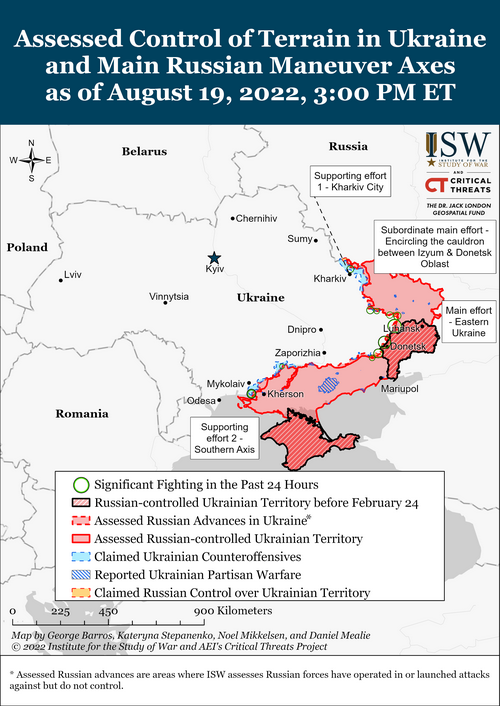
From The Institute For the Study of War:
Karolina Hird, Grace Mappes, Layne Philipson, George Barros, and Frederick W. Kagan
August 19, 7:30 pm ET
Click here to see ISW’s interactive map of the Russian invasion of Ukraine. This map is updated daily alongside the static maps present in this report.
Recent Ukrainian strikes on Russian military and transportation infrastructure in Crimea and Kherson Oblast are likely reducing Russian confidence in the security of Russian rear areas. Reports from August 18 about Ukrainian strikes are affecting the Russian information space despite the fact that these reports were likely overblown. Available open-source evidence indicates that Ukrainian forces did not conduct a successful kinetic attack against either the Stary Oskol Air Base in Belgorod or Belbek Air Base in Crimea on August 18. Geolocated footage shows that a fire started at a field just south of the Stary Oskol Airfield (rather than at the airfield itself), and satellite imagery shows Russian forces transporting ammunition and military equipment to a forest close to the field.[1] An unspecified Russian Zaporizhia Oblast occupation official reiterated that Russian air defenses near the Kerch Strait Bridge activated against a Ukrainian unmanned aerial vehicle (UAV) rather than an incoming strike.[2] There is no visual evidence of damage to either air base of as August 19. Geolocated footage shows no explosions or evidence of kinetic activity near the Belbek Air Base overnight on August 18-19, lending credence to claims that footage reportedly showing the explosion is recycled footage misattributed to the Belbek Air Base.[3] As ISW reported on August 18, Russian sources largely reported on and disseminated these false or exaggerated reports, indicating broader Russian panic.[4]
Russian authorities are visibly increasing security measures in Crimea, indicating growing worry among Russian authorities and civilians about the threat of Ukrainian strikes on rear areas previously believed to be secure. Russian authorities installed checkpoints to search Ukrainian cars and identify saboteurs in Sevastopol.[5] Certain Russian milbloggers made dramatic, pessimistic assessments that Ukrainian forces used strikes on the Kerch Strait Bridge and Belbek Air Base to conduct reconnaissance on Russian air and missile defense readiness and make assessments for new attacks, particularly the feasibility of a large strike.[6] Ukraine’s Center for Strategic Communications (UA StratCom) reported on August 19 that Russian forces are not in control of the situation in Crimea as evidenced by the blocking of the Kerch Strait Bridge and activation of air alarms in Sevastopol for the first time since the start of the invasion.[7] UA StratCom warned that Ukrainian forces have not yet struck the Kerch Strait Bridge with full capabilities and that prior Ukrainian strikes on the bridge demonstrate that the bridge is not as safe as the Russians previously believed.[8]
The situation at the Zaporizhzhia Nuclear Power Plant (ZNPP) remained largely unchanged on August 19, despite the Russian Ministry of Defense’s August 18 claims that Ukrainian forces would stage a provocation at the ZNPP on August 19. Russian sources claimed that Ukrainian forces shelled the ZNPP at night on August 18-19 but did not claim that Ukrainian forces launched a large-scale attack on the facility, contrary to Russian Ministry of Defense (MoD) statements on August 18.[9] Zaporizhia Oblast Head Oleksandr Starukh emphasized on August 19 that the situation at the ZNPP remains tense but under control.[10]
Ukraine’s Main Intelligence Directorate (GUR) reported that Russian authorities are likely preparing to hold show trials for Ukrainian soldiers in Mariupol around August 24, notably coinciding with Ukraine’s Independence Day.[11] The GUR warned that Russian authorities intend to hold a show trial of captured fighters from the Azovstal Steel Plant in the Mariupol Philharmonic Theatre and may use the theatre to stage a false-flag attack on August 24.[12] Mariupol Mayor Advisor Petro Andryushchenko confirmed that the Mariupol occupation administration canceled rehearsal schedules at the theatre in order to accommodate the show trials, which ISW previously reported on August 11.[13] As ISW previously reported, these show trials will likely be orchestrated in order to create the impression for Russian domestic audiences that Russian occupation authorities are taking necessary steps to secure occupied areas as well as attempt to demoralize Ukrainian troops.[14] Russian authorities are likely orienting the trials around Ukraine’s Independence Day in order to set further information conditions to exert law enforcement control of occupied areas.
Key Takeaways
- Recent Ukrainian strikes on Russian military and transport infrastructure in Crimea and Kherson Oblast are likely reducing Russian confidence in the security of Russian rear areas.
- The situation at the Zaporizhzhia Nuclear Power Plant (ZNPP) remained relatively unchanged on August 19 despite Russian claims that Ukrainian forces would stage a provocation at the plant.
- Russian authorities are likely preparing show trials of Ukrainian defenders of Azovstal on Ukraine’s Independence Day in order to further consolidate occupational control of occupied areas of Ukraine and set conditions to demoralize Ukrainian troops.
- Russian forces conducted limited ground attacks north of Kharkiv City, southwest and southeast of Izyum, east of Siversk, and south and east of Bakhmut.
- Russian forces conducted multiple unsuccessful ground assaults on settlements on the Southern Axis.
- Russia continues to generate regional volunteer units and will likely deploy many of them to Kherson and Ukraine’s south as part of the 3rd Army Corps.
- Russian occupation authorities are strengthening their control of educational infrastructure in occupied areas in preparation for the approaching school year and may be sending Ukrainian children to Russia as part of a broader repopulation campaign.
Go here to read the rest.
From Strategy Page:
August 19, 2022: As Ukraine goes on the offensive, they have organized tank brigades, something they have not used during the first six months of their war with Russia. The Ukrainian armor units are equipped with tanks superior to what the Russians are currently using. This should not be but is, because the Russians mishandled their tanks in combat and, more importantly, those maintained in reserve (storage) in case of a war. On paper the Ukrainians had fewer and older tanks than Russia. The Ukrainians took better care of their tanks, both those on active duty and the many more in reserve. The Ukrainians also adapted better to the realities of 21st century armored warfare than the Russians. This was discovered in eastern Ukraine (Donbas) after 2015 when the truce with the Russians involved a lot of fighting but little movement of the ceasefire line. Ukrainians discovered that Russian-designed tanks, which both sides used, were vulnerable to a lot of weapons and that infantry armed with portable anti-tank weapons were very effective against these tanks.
Between 2015 and 2021 the Ukrainians tested a lot of portable anti-tank weapons and found that Western models, like Javelin, Carl Gustav and several others were ideal for mobile infantry (on foot after riding to the battle zone in civilian vehicles) who destroyed tanks and lighter armored vehicles as the Russians advanced into Ukraine. In the months before the Russian 2022 invasion the Ukrainian military described Russian tactics to NATO without going into detail about how they would deal with it. Anyone paying attention to what was going on in Donbas after 2015 could have figured out what the Ukrainians were planning to do. NATO countries had supplied their latest anti-tank weapons for the Donbas tests and quickly responded, in 2021, to Ukrainian requests for more Javelins, Carl Gustavs and similar weapons. The initial Russian main effort was in northern Ukraine, in an effort to take Kyiv, the Ukrainian capital. That cost the Russians tens of thousands of troops, hundreds of tanks and other armored vehicles, and many trucks carrying supplies, especially fuel.
High-resolution Commercial satellite photos and cellphone videos and pictures provided more data on what was destroyed than anyone expected. After six months of fighting there was photographic evidence of Russia losing about a thousand tanks, and a third of them were abandoned due to lack of fuel or crews that had figured out it was safer to abandon their tank than trying to fight from inside it. In many instances Russian officers deployed 3-man tanks with only two men in their crews, which got those crews killed until the survivors abandoned one tank in three to provide the other two tanks with more survivable 3-man crews. Those losses included Russia’s most modern tanks and eliminated about 30 percent of Russian active-duty tanks. Unlike past wars where estimates of enemy losses were usually higher than what was actually lost, the loss data from Ukraine were documented by photographic evidence of the large number of captured and damaged tanks the Russians were unable to repair or take with them as they retreated.
During World War II the Russian usually kept advancing and had tank recovery and repair units that restored damaged tanks to duty. That no longer works because many of the damaged tanks in Ukraine suffered catastrophic damage because for over fifty years Russian tanks have featured three-man crews and an autoloader that left over a dozen shells and their propellants exposed in the turret to feed the autoloader. The Israelis noted this flaw and pointed it out to their Western allies, which is why Israeli and Western tanks don’t use an autoloader and, when hit in the turret, do not suffer massive damage as all those exposed autoloader shells explode when the turret is penetrated. Western anti-tank weapons were designed to take advantage of this vulnerability, which was never seen on a wide scale until the 2022 invasion. That is one reason Western nations so confidently shipped so many of their latest anti-tank weapons to Ukraine in the months before the invasion.
These tank losses were alarming to Russian army leaders but worse was yet to come when they discovered that most of the T-72 and T-90 tanks available as replacements were not fit for duty. These tanks were stored in lightly guarded facilities that usually had no staff to regularly check the readiness of these tanks, as is the practice in the West and Ukraine. Many if not most of those reserve tanks had been rendered unusable because of theft of key components. Some of the missing items were high-tech components like fire control systems that contained some Western electronics that were now unavailable because of economic sanctions. That explains why so many of the replacement tanks are T-62s from the 1960s. This was the last Russian tank model without an autoloader and thus less vulnerable to catastrophic loss from a turret hit. The T-62 had 115mm rather than a 125mm main gun. Since most of the Russian tanks support infantry rather than fight other tanks, the elderly, but unplundered, T-62s were the ideal replacement tank.
Meanwhile the Ukrainians are forming new tank brigades to lead some of the counter offensive operations against the Russians. These Russian-designed tanks will not face Western anti-tank weapons and take into account the auto-loader vulnerability. While the T-62 did not have an autoloader, the T-64, which entered service five years after the T-62, did. The T-64 also had a 125mm gun and at 38 tons, was only a ton heavier than the T-62.
Ukrainian forces have lots of armored vehicles, most of them improved (by the Ukrainians) Russian designs. Ukrainian tank tactics are more practical and more likely to overcome defenders, plus Ukrainian civilians are everywhere and generally eager to let their troops know what’s going on in the area.
After the 2014 initial Russian attack, Ukraine realized they needed new and improved armor vehicles in case the Russian came again in larger numbers. Since 2014 Ukraine has been refurbishing existing equipment with Ukrainian resources. Emphasis is on armored vehicles, which Ukraine has lots of. Most are elderly but were little used in the past and still effective. Initially Ukraine had 250 T-64BMs and 350 T-64BVs. Ukraine also has 1,000 older T-64B tanks in storage. Only the T-64BM and T-64BM are operational and in use with the Ukrainian Army. Since 2007 Ukraine has been upgrading about one of the older T-64Bs to the T-64BM each month. This costs about $600,000 per T-64B. Ukrainian arms factories were also building the T-84 Oplot-M tank and 55 were in service by the end of 2015 and 120 more in 2016 at a cost of $3.7 million each. All this is possible because Ukraine contained many Soviet era armored vehicle plants and inherited them when the Soviet Union dissolved in 1991.
Ukraine also began upgrading about 300 T-72B tanks held in reserve. These were modified to become similar to the Polish PT-91. The official reason for this is that Ukraine wants the T-72Bs to meet NATO requirements but the upgraded tanks would also improve the defensive capabilities of the Ukrainian Army forces fighting in eastern Ukraine. The upgrade idea came as a result of Ukrainian military officials being given an opportunity to test some PT-91s.
Ukraine is equipping its new tank brigades and battalions with its upgraded and less vulnerable T-72s, T-80s and T-64s. Ukraine would prefer to have Western tanks like the American M-1 or the German Leopard. The new East European NATO members obtained used Leopards initially and now are getting M-1s.
Currently the most advanced Russian tank in service is the T-72B3, which is considered as good as the T-90, a 48-ton T-72 upgrade introduced in 1993 as the T-72BU but that was changed to T-90 for marketing purposes. Over 3,200 were built and most were exported to India where they were produced under license. The 45-ton T-72B3 is cheaper and considered by Russian commanders and crews as equal to the more expensive T-90. Russia had about 2,000 T-72B3s, put most of its 590 T-90s in storage and used the T-72B3 for its active-duty units.
Go here to read the rest. Russia increasingly lacks trained infantry to fight and Ukraine is increasingly arming their forces with superior Western weaponry. It does not take the insight of Clausewitz to see the direction where this conflict is heading.