

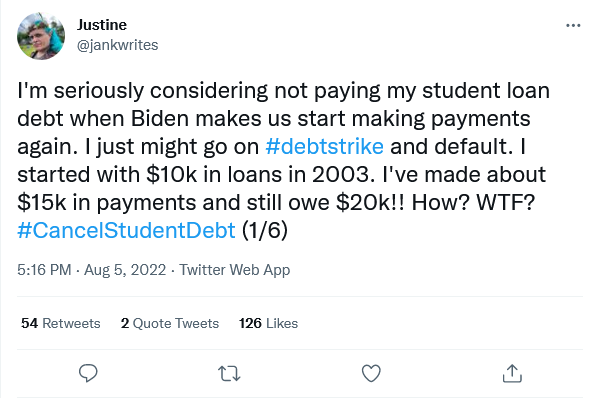
Economic illiteracy and higher education is a depressing combination. The only legitimate grievance student loan debtors have is their inability to file bankruptcy on these debts. I would have bankruptcy available as an option fifteen years after graduation.


There’s a thing called usury. Student loans are probably the clearest example of usurious loans, seeing as how they inherently have no collateral and there is no essentially no risk of non-repayment (since they can’t be discharged through bankruptcy.) Indeed, the fact that they lack collateral is the usual reason given for why we cannot allow them to be discharged.
Of course there are reasons beyond usury to oppose student loans, such as the fact that they are based on fraudulent premises or that they exploit children who are not yet in a position to understand the impact of the loan.
If I had the authority, I would outlaw student loans in a heartbeat.
Student loans are probably the clearest example of usurious loans,
They aren’t.
They aren’t.
Substantive.
Substantive.
No, curt. It’s a freely assumed investment in human capital. It’s a waste a great deal of the time, but a great many businesses fail and take down the owners’ investment with them. The interest rates on the loans are also concessionary.
“and there is no essentially no risk of non-repayment (since they can’t be discharged through bankruptcy.”
The default rate on student loans is 15 percent. On credit card debt it is 3.28 percent. Student loans are actually a fairly risky type of loan. Just because a debt is non dischargeable in bankruptcy does not mean it will be paid off eventually.
In a sane society, we’d just tax the hell out of university endowments and start shuttering joke institutions that promote garbage racial and gender theories.
George:
We’d be better off if universities had to sign for student loans, using their own endowments as collateral. That way, if kids graduated with useless degrees, they lose money. Watch standards soar.
I think we’d be better off if we left the business of student loan origination to banks and finance companies, reduced the degree of protection for creditors, and prosecuted originators and their officials if they insisted on real interest rates in excess of 15%.
One thing we could do to assist youths is to reduce the role of higher education in sorting the labor market. In order to do that we could enact several pieces of federal legislation and work for co-ordinate legislation on the state level. The legislation would (1) require that the default mode for hiring and promotion in the federal civil service is the timely paper and pencil examination and (2) strip federal courts of any franchise to second guess examiners commissions and (3) require multi-state natural monopolies to make use of a similar system and (4) require multi-state corporations to produce an audited statement of the stock and flow demographics of their enterprise, (5) define certain activities in workplace settings in multi-state enterprises as tortious with liability for discrete officials as a matter of course and for enterprises in select circumstances; the activities in question would be acts which mapped to common crimes of extortion and harassment, and (6) required collective bargaining agreements be stripped of references to race or proxies for race, but (7) allowed companies to hire, promote, demote, and fire according to their lights.
Another thing we could do would be to require inter-state agreements for the provision of higher education services have certain features, among them that they be for the provision of credentials of the following sort: for academic subjects, theology, and music, the menu of degrees would be for 1, 2, 3, or 4 academic years of instruction and dissertation supervision. For occupational subjects, it would be for a certificate of < 30 credits, 1 academic year, 1 calendar year, and 2 calendar years as a rule. For a selection of occupational schools, programs in excess of 60 credits would be permitted (mostly in the medical realm). For some, research degrees would be permitted. Preparatory certificates composed of academic, business, and technology courses could be imposed as conditions for admission to occupational schools, with the proviso that none could exceed 70 credits.
Just north of 20% of those enrolled in higher education are attending out of state, so this might get the ball rolling to replace the menu of associate’s, bachelor’s, and master’s degrees, with all the attendant padding.
It’s interesting that we hear exactly zero talk of government using taxpayer dollars to pay off student loans for trade schools. Is that because graduates of trade schools are not in our Brahmin caste, or because trade school graduates have the means to discharge their own debts?