
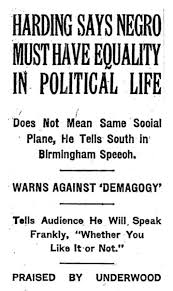
A self-made successful newspaper owner from Marion, Ohio, affable, handsome Warren Harding had always been interested in politics. Born in 1865 into a family noted for their abolitionism, and rumored to have black ancestry, although recent DNA testing in regard to Harding disproves that rumor, political success eluded Harding until he won a State Senate election in Ohio in 1899. He got started relatively late for a politician in those days but his rise was then swift. In 1903 he was elected Lieutenant Governor of Ohio. Defeated in the race for Governor of Ohio in 1910 he was elected to the Senate in 1914. Harding throughout his political career had a talent for making friends in the Republican party and few enemies. A conservative Republican, he went out of his way to conciliate the Progressive wing of the party. In the Senate he made many friends, few enemies and no waves, not a small achievement in a time when the Republican party was recovering from the split of 1912. In most ways he was completely a politician of his time. In other ways, most notably on civil rights for blacks, he was decades ahead of his day. Whatever his positions he doubtless would be completely forgotten today but for the woman he married.
Throughout his political career his wife Florence ran his business interests with competence. A childless couple, Florence fully supported her husband’s political career. Her husband’s long time affair with Carrie Phillip nearly ended his marriage, with Florence demanding that he break off the affair, which he did, with Phillips and her husband and children taking up residence in Europe.
In 1919 Harding announced that he was a candidate for President. This was a classic favorite son candidacy initiated by Harding mainly to help solidify his support within the Republican party of Ohio to support his re-election campaign to the Senate in 1920.
Perhaps to his surprise, the Republican Convention ended up nominating him.
On November 2, 1920, the Republicans under Warren G. Harding won a crushing victory against the Democrats under James Cox. The Republicans scored 60 percent of the vote and 404 electoral votes. The election is notable for several firsts. It was the first election after women nation wide gained the vote. It was the first election following Reconstruction where a former Confederate state, Tennessee, went Republican. Franklin D. Roosevelt made his first appearance on a national ticket as the Veep nominee with Cox, illustrating that early defeats in politics are often not illustrative of future results.
Eugene Debs, imprisoned under the draconian sedition laws of World War I for making a speech against US involvement in the World War, gained over 900,000 votes for President from his prison cell in Atlanta, Georgia. It was his fourth and last time carrying the standard of the Socialist Party in a Presidential contest. Harding, who was basically a very kindly man, commuted his sentence before Christmas in 1921. (The 66 year old Debs was not due to be released until 1928.) Debs, on his way home to Terre Haute stopped by the White House to meet and thank Harding. Harding greeted him warmly: “Well, I’ve heard so damned much about you, Mr. Debs, that I am now glad to meet you personally.” Debs died in 1926 and without Harding’s intervention he likely would have died in prison.
Harding presided over an administration notable for economic prosperity, dedication to civil rights for blacks and a return to what Harding called normalcy, which would be in short supply in the America of the 20th century. When he unexpectedly died he was probably the most popular President not named George Washington. The scandals like Teapot Dome that tarnished his Administration came out after his death, and no wrongdoing has been ever attributed to Harding. A President who, but for his untimely death, would loom larger in our history.


Harding also set an example for economic recovery after the panic of 1919-21. By confining government actions to relief instead of interfering in business, the recovery was the most rapid of any in the history of the country.