
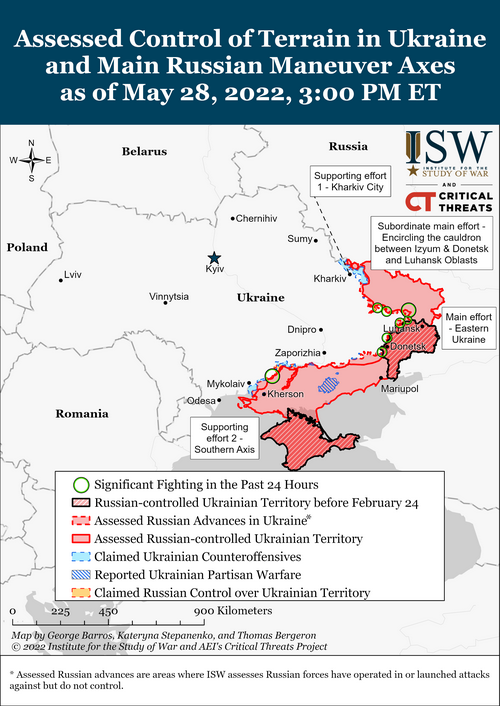
From The Institute For The Study of War:
Frederick W. Kagan, Kateryna Stepanenko, and George Barros
May 28, 7:30pm ET
Russian President Vladimir Putin is inflicting unspeakable suffering on Ukrainians and demanding horrible sacrifices of his own people in an effort to seize a city that does not merit the cost, even for him.
The Russian invasion of Ukraine that aimed to seize and occupy the entire country has become a desperate and bloody offensive to capture a single city in the east while defending important but limited gains in the south and east. Ukraine has twice forced Putin to define down his military objectives. Ukraine defeated Russia in the Battle of Kyiv, forcing Putin to reduce his subsequent military objectives to seizing Donetsk and Luhansk oblasts in eastern Ukraine. Ukraine stopped him from achieving that aim as well, forcing him to focus on completing the seizure of Luhansk Oblast alone. Putin is now hurling men and munitions at the last remaining major population center in that oblast, Severodonetsk, as if taking it would win the war for the Kremlin. He is wrong. When the Battle of Severodonetsk ends, regardless of which side holds the city, the Russian offensive at the operational and strategic levels will likely have culminated, giving Ukraine the chance to restart its operational-level counteroffensives to push Russian forces back.
Russian forces are assaulting Severdonetsk even though they have not yet encircled it. They are making territorial gains and may succeed in taking the city and areas further west. The Ukrainian military is facing the most serious challenge it has encountered since the isolation of the Azovstal Plant in Mariupol and may well suffer a significant tactical defeat in the coming days if Severodonetsk falls, although such an outcome is by no means certain, and the Russian attacks may well stall again.
The Russians are paying a price for their current tactical success that is out of proportion to any real operational or strategic benefit they can hope to receive. Severodonetsk itself is important at this stage in the war primarily because it is the last significant population center in Luhansk Oblast that the Russians do not control. Seizing it will let Moscow declare that it has secured Luhansk Oblast fully but will give Russia no other significant military or economic benefit. This is especially true because Russian forces are destroying the city as they assault it and will control its rubble if they capture it. Taking Severodonetsk can open a Russian ground line of communication (GLOC) to support operations to the west, but the Russians have failed to secure much more advantageous GLOCs from Izyum partly because they have concentrated so much on Severodonetsk.
The Russians continue to make extremely limited progress in their efforts to gain control of the unoccupied areas of Donetsk Oblast, meanwhile. Russian troops have struggled to penetrate the pre-February 24 line of contact for weeks, while Russian offensive operations from Izyum to the south remain largely stalled. The seizure of Severodonetsk could only assist in the conquest of the rest of Donetsk Oblast if it gave the Russians momentum on which to build successive operations, but the Battle of Severdonetsk will most likely preclude continued large-scale Russian offensive operations.
Russian progress around Severdonetsk results largely from the fact that Moscow has concentrated forces, equipment, and materiel drawn from all other axes on this one objective. Russian troops have been unable to make progress on any other axes for weeks and have largely not even tried to do so. Ukrainian defenders have inflicted fearful casualties on the Russian attackers around Severodonetsk even so. Moscow will not be able to recoup large amounts of effective combat power even if it seizes Severdonetsk, because it is expending that combat power frivolously on taking the city.
Ukrainian forces are also suffering serious losses in the Battle of Severodonetsk, as are Ukrainian civilians and infrastructure. The Russians have concentrated a much higher proportion of their available offensive combat power to take Severodonetsk than the Ukrainians, however, shaping the attrition gradient generally in Kyiv’s favor. The Ukrainians continue to receive supplies and materiel from their allies as well, however slow and limited that flow may be. The Russians, in contrast, continue to manifest clear signs that they are burning through their available reserves of manpower and materiel with no reason to expect relief in the coming months.
Evidence of eroding military professionalism in the Russian officer corps is mounting. The Ukrainian Military Intelligence Directorate (GUR) reported that Russian commanders are attempting to preserve military equipment by forbidding drivers from evacuating wounded servicemen or providing supplies to units that have advanced too far.[1] Refusing to risk equipment to evacuate wounded personnel on the battlefield—other than in extraordinary circumstances—is a remarkable violation of core principles of military professionalism. Such behavior can have serious impacts on morale and the willingness of soldiers to fight and risk getting injured beyond their own defensive lines. ISW cannot independently confirm the GUR’s report, but commentary by Russian milbloggers offers some circumstantial support for it. Russian milblogger Alexander Zhychkovskiy criticized the Russian military command’s disregard for reservists on the deprioritized Zaporizhia Oblast front. Zhychkovskiy reported that Russian commanders trapped lightly-equipped infantry units in areas of intense Ukrainian artillery fire without significant artillery support and did not rotate other units through those areas to relieve them.[2] Zhychkovskiy noted that Russian commanders are responsible for high losses and cases of insanity among servicemen. Another milblogger, Alexander Khodarkovsky, said that Russian commanders are not sending reinforcements in a timely matter, preventing Russian forces from resting between ground assaults.[3]
Waning professionalism among Russia’s officers could present Ukrainian forces with opportunities. Russian morale, already low, may drop further if such behavior is widespread and continues. If Russian troops stuck on secondary axes lose their will to fight as the Battle for Severdonetsk consumes much of the available Russian offensive combat power, Ukraine may have a chance to launch significant counteroffensives with good prospects for success. That prospect is uncertain, and Ukraine may not have the ability to take advantage of an opportunity even if it presents itself, but the current pattern of Russian operations is generating serious vulnerabilities that Kyiv will likely attempt to exploit.
Key Takeaways
- Russian forces pressed the ground assault on Severodonetsk and its environs, making limited gains.
- Russian forces in Kharkiv continue to focus efforts on preventing a Ukrainian counteroffensive from reaching the international border between Kharkiv and Belgorod.
- Ukrainian forces began a counteroffensive near the Kherson-Mykolaiv oblast border approximately 70 km to the northeast of Kherson City that may have crossed the Inhulets River.
- Russia’s use of stored T-62 tanks in the southern axis indicates Russia’s continued materiel and force generation problems.
- Ukrainian partisan activity continues to impose costs on Russian occupation forces in Kherson and Zaporizhia oblasts.
Go here to read the rest. The Russian goal of conquering all of Ukraine has now been narrowed to what territory they can steal in the east of Ukraine. The Ukrainian riposte to that change in goals should be coming in June.


“Russian President Vladimir Putin is inflicting unspeakable suffering on Ukrainians and demanding horrible sacrifices of his own people in an effort to seize a city that does not merit the cost, even for him.?” Wht do we insist on referring to Russia as “Putin?” We don’t call Mexico “Obrador,” and it’s a lot closer.
Wht do we insist on referring to Russia as “Putin?”
Because he is a dictator and in the context of the Ukraine War there is good evidence that there is little appetite for it in Russia except among Putin and his gang.
Previously mentioned Ukrainian blogger Denys Davidov has reported on the negatives for the Ukrainian military of the continuing Battle for Severodonetsk: but he also noted 5/28 that (unreported in the Western media) the Ukrainians have actually launched successful counterattacks on 3 points around Popasna, one of the jaws of the Severodonetsk pincer movement, and have forced a limited Russian retreat. The situation is uncertain, but if Ukrainians are able to continue the attacks they could well cut off Russian artillery units, which are stationed on high ground in and around Popasna. We don’t know enough yet, but the Russian Command has to be nervous. Also the Ukrainians have launched counterattacks in the south near Crimea, because the Russians have drawn down so much of their remaining forces and gambled nearly all of them on this frontal assault on Severodonetsk. Although Severodonetsk has not political (and economic value—before it was leveled it had 3 large chemical-production facilities), it’s hard to see the gaining of the city—if that even happens—as worth the losses.
Another very interesting blogger, this one entirely in Russian, is Max Katz, a former Moscow political figure now wisely living in the West. (He provides an English subscript translation.). Katz points out for a dictator to be successful at war, the war must be (1) short, (2) he must have minimal losses, and (3) he must be victorious. One of the reasons Putin initially had support “at home” Katz says was because of Putin’s prior success in the quick bloodless annexation of Crimea, which met all these criteria, Katz points out. But Katz observes now that Putin really has lost on all three factors already— Because he says that the devastation to the Russian economy and the military losses are so great, that Russia will not recover for a very long time. Katz says Russia really has only two prosperous economic zones: Moscow and (I assume he means) St. Petersburg: The other 20 or 30 Russian districts are completely in poverty, so the only way that Putin is managing this war is to pay conscripts equivalent of about $3000 a month which is a kings ransom in these impoverished areas. But if all those young men do not come back or are wiped out—a secret they can’t keep forever—and the Russian High Command is concealing these losses, and as the ISW report mentions, callously abandoning wounded men at the front, this secret will out. (This also way the Russian military avoids permanent disability payments to them also. Davidov featured one young Russian military man who lost both legs in the conflict being featured on Russian TV—he was to be paid $5000 rubles for each leg—not even $100 each limb.)
Still, the situation for Ukraine is not good, needing “yesterday” heavy artillery and mobileanti-aircraft batteries; and with the US having the Harvard badminton–and–debating team glacially making decisions (add in the Germans and the French: or law-professor-and-technocrat with no military experience Pres. Conte of Italy, who won’t supply artillery because he thinks they are exclusively “offensive weapons”), the Ukrainians are being badly hurt by these delays. The West may bequeath Putin a victory even if it is Pyrrhic.
Dictator Lincoln managed to win the Civil War without achieving a decisive victory for the first two years of the war, and without a great deal of enthusiasm for the war among the Northern population for that entire period. In a war of attrition, the side with the biggest population and the most guns wins, eventually.
Dictator Lincoln
Odd dictator who wins election twice to the Presidency including in the midst of a great civil war. Union enthusiasm was sufficient to keep the country together and to finally end slavery after 250 years, in the teeth of hideous casualties.
The first time with less than 40% of the vote in a three-way election, though still legitimately. The second time in a rigged landslide, courtesy of the Union military. A person is a dictator because he controls the media, jails political opponents, ignores inconvenient laws, and makes up new ones on the spot that he likes better. It doesn’t necessarily make him a totally evil person — in fact Lincoln had a number of good qualities– but it does make him a dictator. Dictator is as dictator does. But my main point was that the claim that dictators need to win quick victory is a false assertion. General Franco, also a dictator, took his sweet time taking down the Spanish Republic — but after the initial battles, there was never any doubt that he was eventually going to win. He had the means, and the other side didn’t.
The second time in a rigged landslide, courtesy of the Union military.
Ensuring that soldiers could vote is not a rigged election. Papers that were intensely hostile to the Lincoln Administration were published throughout the War. Civil liberties were infringed during the War, just as they were in the Confederacy, but that tends to happen when nations are fighting for their existence. Precisely the same thing, perhaps worse from a civil liberties perspective, happened to Tories during the American Revolution.
The first time with less than 40% of the vote in a three-way election, though still legitimately.
It was a four-way election, and he won 60% of the electoral vote.
And the Copperheads couldn’t manage a secure majority in the Democratic Party, much less the country at large.
The rigging occurred during the period running from 1877 to 1901, when blacks were purged from the voting rolls in the South through chicanery and intimidation. (Not to mention the exuberant fraud in which city machines engaged).
Additionally, the defeatist faction in the North kept pushing for a negotiated settlement (surrender on all principles) with the South right up to the election of 1864. The voting soldiers in the Union army had no desire to see three years of sacrifices wasted and voted heavily Republican. The only mistake Lincoln made was the selection of Andrew Johnson as his running mate who eventually tied with Buchanan as the worst President ever.
Johnson was the only Southern member of the Senate who stayed loyal to the Union and had been an effective military governor of Tennessee who endorsed emancipation. Lincoln ran on a fusion ticket of National Union Party with Johnson to attract War Democrat support. Johnson continued the streak of ever Veep who became President being a disappointment to the party of their predecessor. Chester Arthur broke that streak when he succeeded James Garfield and performed much better as President than anyone expected.