
From The Institute For The Study of War:
Karolina Hird, Mason Clark, and George Barros
May 10, 7:15pm ET
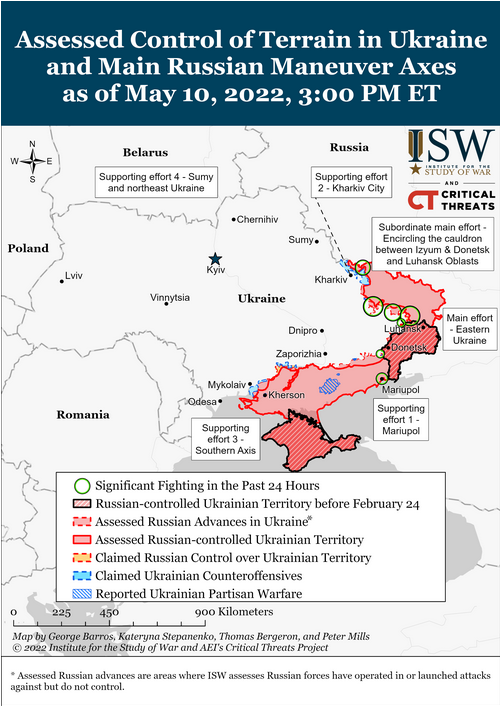
The Ukrainian counteroffensive north of Kharkiv City continued to successfully push Russian forces toward the Russia-Ukraine border on May 10. Ukrainian forces liberated several towns north of Kharkiv City and continued pushing north of the recently liberated Staryi Saltiv to capture several towns northeast of Kharkiv: a Russian source claimed that Ukrainian troops advanced to within 10km of the Russian border, though ISW cannot independently confirm these specific claims.[1] Russian forces from the Izyum area are reportedly redeploying northwards to attempt to alleviate the pressure of this counteroffensive and stymie further northward advances toward the Russian border.[2] The Ukrainian counteroffensive will likely continue to divert Russian troops and resources from deployment to other axes of advance where fighting has been similarly stalled out by the successful Ukrainian defense. The counteroffensive will impede the ability of Russian artillery to target the northeastern suburbs of Kharkiv City, will potentially enable Ukrainian forces to threaten Russian rear areas with their own shelling and further attacks, and—if Ukrainian forces are able to further advance the counteroffensive or Russian forces collapse along the Kharkiv axis and withdraw further—unhinge Russian offensive operations around Izyum.
The Belarusian Ministry of Defense escalated its false claims of US and NATO preparations to attack Belarus while announcing the start of a second stage of ongoing military exercises on May 10. However, Belarus remains unlikely to join the war in Ukraine. Belarusian Defense Minister Viktor Khrenin announced the second stage of ongoing rapid response forces exercises on May 10 in response to what he falsely claimed were NATO escalations.[3] Belarusian First Deputy Minister of Defense Victor Gulevich accused the US and its allies of building up a military presence around Belarusian borders and claimed that Poland and the Baltic states are threatening Belarusian territory through reconnaissance, sabotage, and special operations.[4] Gulevich announced that Belarusian battalion tactical groups (BTGs) will subsequently advance to the Western and Northwestern operational zones as part of a ”whole range of measures aimed at countering possible threats” in these areas.[5] Gulevich additionally stated that the presence of 20,000 Ukrainian troops in Belarus’ Southern Operational District have necessitated a deployment of unspecified Belarusian troops to three tactical directions near the Ukrainian border, which is consistent with Ukrainian General Staff reporting that certain Belarusian units have deployed to the Ukraine-Belarus border area for a combat readiness check.[6]
The rhetoric of threats to Belarus’ borders is not new and was frequently employed by Belarusian President Alexander Lukashenko in the early stages of the Russian invasion of Ukraine.[7] The Belarusian exercises, which are concentrated on Belarus’ borders with Poland and the Baltic States rather than Ukraine, are likely primarily demonstrative and signal Belarus’ continued political support for Russia‘s war in Ukraine. The exercises are likely additionally intended to draw NATO attention and possibly disrupt NATO aid to Ukraine, rather than threatening an actual military operation—similar to Russian efforts to destabilize Moldova that are likely intended to distract Romania and NATO rather than directly threaten Odesa. Belarus remains unlikely to join the war in Ukraine. Lukashenko successfully repressed domestic opposition in 2020 and 2021 but remains vulnerable to further domestic unrest if his security apparatus weakens; he is likely unwilling to risk losing his military in a stalled and deteriorating Russian war in Ukraine.
Key Takeaways
- The Ukrainian counteroffensive in northern Kharkiv took further ground and have possibly closed to within 10km of the Russian border.
- Belarusian authorities are escalating rhetoric accusing NATO and the US of threatening Belarusian borders, but Belarus remains unlikely to join the war.
- Russian operations around Izyum remain stalled.
- DNR and Russian forces are advancing efforts to consolidate their control of the ruins of Mariupol, including reportedly attempting to reopen steel plants to produce military equipment.
- Russian forces in eastern Ukraine continued attempts to encircle the Severodonetsk area and reportedly reached the Donetsk-Luhansk administrative border from Popasna.
- Russian and Ukrainian forces did not conduct any significant attacks on the southern axis.
Go here to read the rest. From Strategy Page:
May 10, 2022: The invasion of Ukraine in February turned a local problem into a conflict with global impact. This was the result of economic disruption caused by the fighting inside Ukraine and unexpectedly severe economic sanctions imposed on Russia. Both nations were key components of the global food, energy and raw materials supply system.
In addition to the sanctions, Russia found that their armed forces were far less effective than they and other nations believed. This had different implications depending on whether you were an ally of Russia or a potential victim. The Russian military was revealed to be ridden with corruption, poor leadership and a government that underestimated how serious those known problems were.
Ukraine was the first widespread and intensive heavy use of Russian weapons by Russian troops since the Soviet Union collapsed in 1991. Many of the Ukrainian weapons were similar or even identical to those used by Russia but Ukrainians were more motivated and better prepared for combat than the invaders. Another embarrassing revelation was that the Western weapons Ukrainians used heavily, especially portable anti-tank and anti-aircraft systems, were far more effective than Russia expected. Russia has long been a major arms exporter and existing and potential customers are revising their purchasing plans. Nations already equipped with a lot of Russian weapons and military gear also have to revise their military plans.
Russia is also a major exporter of fuel, food and raw materials. Customers can find other suppliers but often at great expense, especially when time is a factor. European nations have become increasingly dependent on Russian oil and natural gas. Russia assured skeptical European customers that it was in everyone’s interest to honor these energy export deals because Russia had become dependent on tech, manufactured goods and specialized services supplied by their European energy and raw materials customers. The extent of the economic sanctions imposed by the West came as a surprise to Russia, as did the realization that their former European customers could afford to pay the high cost of switching suppliers. The smaller and weaker Russian economy was unable to shield the average Russian from the sanctions’ economic impact. The Russian government tried to shift the blame to the unreliable foreigners. That excuse was showing its age and more Russians are inclined to blame their own government, the same government that eventually outlawed any public expressions of doubt in the capabilities of government officials.
Foreign trade accounts for about 28 percent of Russian GDP and about half of it has been disrupted by the 2022 sanctions. China is Russia’s largest trading partner and, together with Belarus and a few other nations, continues to trade with Russia. The other half is currently halted or soon will be by the sanctions. Russia has experience in evading economic sanctions and knows that greed in notoriously corrupt countries provides customers willing to switch to heavily discounted Russian oil. There are many similar but smaller customers. The discounts can be high; sometimes 20-30 percent off the world price, which is currently a hundred dollars a barrel. Even with heavy sanctions/smuggling related discounts Russia is still making as much as they used to before the Ukrainian escalation.
Several NATO (the North Atlantic Treaty Organization) nations are still buying Russian oil because they cannot afford to cut Russian oil and gas imports completely until they have sufficient alternate sources to avoid an economic collapse. This will take from six to 18 months or more and this is accepted as an essential move to avoid economic collapse in NATO nations getting most of their oil and gas from Russia.
Although China is a major customer for Russian oil and gas, a new pipeline must be built to get them the product. Doing this via tankers is much more expensive because that is smuggling and risky. That means a larger discount and more risk of confrontations with NATO naval forces sent after tankers used for smuggling. Russia has threatened to use its handful of modern nuclear subs to go after NATO merchant shipping and risk seeing their small nuclear sub force disappear at sea. Western navies stalk Russian nuclear subs in peacetime and Russian subs seek to do the same to Western nukes. This is an activity dating back to the Cold War and little is made public about who is ahead in the peacetime stalking competition.
All this degrades future Russian economic prospects. That has a negative impact on Russian allies. These foreign supporters now see their powerful patron as less powerful than believed and now feel desperate or simply afraid. And then there is China, which does not have allies, only trading partners and tribute states. Russia is now moving from trading partner to the lower tribute state status.
China has territorial claims on Russia on or near the Pacific coast. Japan has a dispute with Russia over the ownership of some Pacific Coast islands that Russia took at the end of World War II as well as fishing rights in the area. Until recently Japan was rather timid in its requests to Russia about these islands. Once it became clear how poorly Russia was doing in Ukraine, Japan has become more open and aggressive about the island dispute and Russian efforts to keep Japanese fishing boats out of areas they have long worked in.
China has, since the 1990s modernized and expanded its armed forces to the point where, on paper, China has stronger ground, air and naval forces than Russia. Chinese forces have not been in combat since the 1970s and back then found the less numerous but more experienced and motivated Vietnamese surprisingly effective. Russia encountered a similar situation in Ukraine. A major difference between China and Russia is that the Chinese study and learn from their mistakes and the mistakes of others. Russia did not pay attention, especially to what was going on in Ukraine between 2014 and 2022. China has paid attention to how Ukraine prepared and how the West responded. This is important for China because of their plans and efforts to take possession of Taiwan and the South China Sea. Taiwan was also paying attention, especially since 2014 and has increased its preparations to defeat a Chinese attack. Massive sanctions on China would be another matter because China is now the largest trading nation in the world, followed by the U.S. and Germany. These three nations are the only ones with trade exceeding a trillion dollars. Russia was 19th before the sanctions and with the sanctions will be fortunate to remain in the top 30 nations. If China did face the degree of sanctions Russia received, the results would be catastrophic because while the Chinese economy is much larger than Russia’s, it is much more sensitive to major disruptions. While China is still a communist police state, there is greater risk of major internal unrest if the economy is mismanaged. Incurring heavy sanctions is seen as mismanagement.
Inventing The NATO Threat
Post-Soviet Russia was a democracy that is now run by Vladimir Putin, a self-appointed president-for-life who still has to convince the majority of Russians that his Ukrainian Operation is not a war but an effort to save Ukraine from NATO and the West in general. Putin enacted a law that makes it a crime to call the Ukrainian Operation an invasion or a war. He had already revived state control of the mass media to ensure most Russians are exposed to nothing but his version of reality. Other interpretations are literally a crime and punishable by imprisonment.
Putin was a junior KGB officer when the Soviet Union collapsed and admits he never got over that tragedy, as he describes it. One thing Putin has not been able to revive is the Soviet-era ability to compel large numbers of men to serve in the military and combat. This was one of the Soviet-era practices that Russians have demonstrated opposition to reviving. The reason is simple; World War II killed about 18 percent of the population, most of them civilians but also about a quarter of all military-age males. Westerners have a hard time appreciating the long-term impact of these World War II losses on Russians. These losses were so bad that their extent was kept secret until the collapse of the Soviet Union opened the Soviet archives for a while. Details of the true World War II human losses were widely publicized inside Russia and some of the books were translated into foreign languages, including English.
Russian World War II leader Josef Stalin boasted that he could compel Russian soldiers to tolerate heavy losses to achieve his goals. During World War II it was noted that in the Red Army it took a very brave man to be a coward. Those who did not fight could be killed on the spot by officers. Even with that motivation, there were 19,000 Russian soldiers executed for such cowardice during the Stalingrad campaign. That form of encouragement has returned in Ukraine but, unlike World War II Russia, it isn’t working. In 2022 Russian conscripts realized that they were not facing NATO troops but Ukrainian men and women, including many who were recently civilians and all highly motivated and determined to defeat the invader.
Since 1991 efforts to maintain conscription have been under constant attack as most potential conscripts and their families view conscription as an unnecessary evil that justifies widespread draft evasion. Putin has not been able to convince Russians that Russia is engaged in a life-or-death struggle with NATO similar to the World War II struggle against Nazi Germany. While Putin can silence most open dissent, he cannot motivate current troops or potential recruits and conscripts to cooperate.
In contrast, the war in Ukraine has given NATO purpose again. Most NATO members saw little real need for the organization after 1991. Still, NATO remained active and NATO forces were used in the 1990s for peacekeeping in the Balkans, where Yugoslavia violently came apart, and later in Iraq, Afghanistan and Libya. These peacekeeping efforts revealed more weaknesses and disorganization in NATO than proof that the organization could be more than a defense against a major threat.
When the major threat manifested itself in 2022, as Russia invaded Ukraine with the goal of absorbing back into a Russian empire, NATO did quickly return to its original unity of purpose. The change was surprisingly rapid and rather thorough. After decades of decline and failure to find a new purpose, NATO again became a valued mutual-defense organization, even if Ukraine was not officially a member.
May 9, 2022: In Moscow, the annual Victory Day Parade was smaller than the 2021 event. This is a result of the war in Ukraine. The 2022 parade began after a speech by leader Vladimir Putin about the future of the war in Ukraine. He continued to insist that the war was about Russia defending itself from NATO aggression. Putin did not announce a national mobilization and did not comment on the growing resistance to his policies inside Russia. Military recruiting centers are being set on fire while there have been more spectacular fires, and explosions, at several ammunition storage sites.
Russian officials who fled Russia after the invasion began confirmed that their peers who remained in Russia warned Putin that mobilization would not work because opposition to the war was too widespread. Since he took power two decades Putin has been trying to deal with the conscription and military morale problems. While Putin dismissed or arrested many officials who assured him that there would be little resistance in Ukraine, he still believes that he cannot afford to accept defeat and keep the war going even if it means reverting to a largely defensive posture. It’s easier to get reluctant troops to defend themselves than ordering them to attack. The Ukrainians have proved adept at encouraging Russian troops to surrender. In part this is because the Ukrainians treat prisoners of war better than Russia treats it own soldiers. Going on the defensive is a risky choice but Putin currently believes he has to come out of this mess with something that he can claim is a victory.
Ukrainians have no interest in negotiating with the Russians because several previous agreements were useless. Russia violated every one of them. Ukrainians will fight on, and do it more effectively and with more attention to the welfare of their troops than the Russians. Putin believes NATO is expecting a coup or revolution in Russia and that’s their motivation for supporting Ukraine. There’s some truth to that as many Russians, Ukrainians and Westerners believe peace will come faster and with less pain if Putin is removed from power, or does the improbable and admits defeat and withdraws from all Ukrainian territory. Putin will also have to return all the Ukrainian civilians sent to Russia and confined to internment camps. Then there are the accusations of war crimes in Ukraine, which Putin will be stuck with no matter whether he keeps fighting or withdraws. One major incentive for withdrawal from Ukraine is that it will end the extensive sanctions that are crippling the Russian economy and risking long-term damage if not lifted soon.
Russia continues to hit Ukrainian cities and infrastructure with ballistic and cruise missiles as well as abusing Ukrainian civilians. Many of these civilians escape from Russian occupation bringing first-hand accounts of how the Russians occupation forces operate. The refugees often have videos and pictures documenting what they are fleeing.
Despite new laws making data on deaths in the military a state secret, Russian families are starting to receive the coffins of soldiers, sailors and airmen killed in Ukraine. Earlier it was believed that the coffins, or news that their soldier was missing and presumed dead, would be delayed until after May 9th. That didn’t happen and the coffins and death notices are being delivered.
Go here to read the rest. The last war I can think of to turn disastrous so quickly for the aggressor was the Italian attack on Greece in 1940. Unlike Italy however, Putin has no strong ally to rescue him. In one swoop Putin has revitalized NATO, ensured that Ukraine will be a hostile power, revealed the rot at the core of the Russian military and caused Russia in little over a month to incur its worst casualties since World War II. Trapped in a war that he cannot win, Putin goes from bad to worst, with his days as dictator likely numbered. A Russian tragedy that reads like a Greek tragedy.


Russia seems to be in it for the long haul. These reports talk of “marginal” gains and “minor” advances, but they are gains and advances. Looking at the detail maps, every few days we see their columns radiating out from Izyum grow. Yesterday, they seem to have managed to surround a small area of Ukranian territory near Rubizhne. Surround, overwhelm, advance. Slow and steady wins the race. It’s not a bad strategy. The question might be “will they run out of people and equipment before it succeeds?”
Any advances CAG are more than made up for by losses in other areas, most notably around Kharkhov this week. This is what happens when the attack has only numerical parity with an able defender.
It has been standard military doctrine for centuries (Sun Tzu had some thoughts on this) that offensive operations, particularly invasions of fixed targets, required a multiple of forces against the defenders. This appears to be the case in Ukraine and will continue to be as long as the defenders are supplied. It will end when either defense collapses or the invader tires of sustaining losses. Afghanistan is a good example. It was a graveyard for Greeks, Indians, British and Soviets and outlasted the US when Biden decided to surrender. In the meantime, Russia will suffer more economically and Putin will become more paranoid delusional.
According to Ukrainian blogger Denys Davydov, several units of the newly provided approximately 90 or so US M777 towed howitzers that fire precision-guided Excalibur shells seem to have made it to Ukrainian forces advancing around Kharkhiv and also some of the holding forces facing the Donbas region. He shows drone video of Russian tanks being precisely guided to, and destroyed, by Ukrainian artillery. Davydov this is very careful in his observations, and I found that he usually is two or three days ahead of Western reports. He also reports a bad nerves when did occurs, and previously was mentioning the problem of the attack on the important industrial center of Severodonetsk.
However, now it appears certain Russian forces are in full retreat in the north (Kharkhiv) back to their own border, and the Russian forces that had been advancing on Severodonetsk now are stopped and are in danger of being outflanked on their northern battle line. Also, in the south, Ukrainian forces are continuing advancing in the area betweenMykolaiv and Kherson.
Davydov Also says that the Ukrainians are likely to blow up with guided missiles the 12-mile Krasnodar Krai rail-and-vehicle bridge linking Crimea with Russia, which would severely affect Russian military supplies.
I am not seeing any evidence of significant Russian gains at the present time, based on ISW, nor base on bloggers and reporters, nor open source reports in Ukraine. Does anyone else?
Surround, overwhelm, advance. Slow and steady wins the race. It’s not a bad strategy.
Of the Ukraine’s 93 most populous towns and cities, Russia seized 20 in 2014. Of the remainder, they’ve managed in 75 days to occupy five. If they keep up this pace, they’ll complete the task in about three years.
If they keep up this pace, they’ll complete the task in about three years.*
I’m hoping the Russian people won’t give Putin those three years. I’m hoping the Donalds above are right and the Ukrainians are able to keep up the fight for as long as it takes. They’ve been very fortunate (so far) in that the Biden administration was desperate for a distraction.