
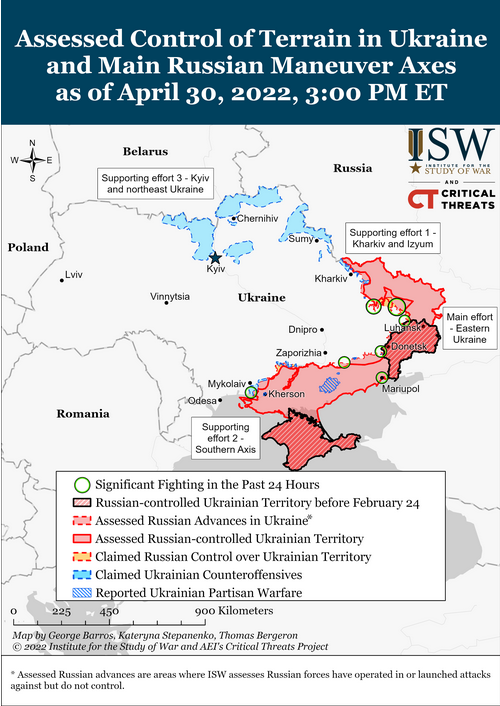
From The Institute For The Study of War:
Mason Clark, Karolina Hird, and George Barros
April 30, 5:15pm ET
Further Russian reinforcements to the Izyum axis are unlikely to enable stalled Russian forces to achieve substantial advances. Elements of unspecified Eastern Military District units and several air-defense assets are reportedly deploying from Belgorod to the Izyum front to support likely degraded Russian units attempting to advance south of the city. These forces are unlikely to enable Russian forces to break the current deadlock, as Russian attacks remain confined to two major highways (toward Slovyansk and Barvinkove) and cannot leverage greater numbers. Several successful Ukrainian counterattacks out of Kharkiv city in the last 72 hours have additionally recaptured a ring of suburbs north and east of the city and may additionally force Russian forces to redeploy units intended for the Izyum axis to hold these positions. Russian forces appear increasingly unlikely to achieve any major advances in eastern Ukraine, and Ukrainian forces may be able to conduct wider counterattacks in the coming days.
Key Takeaways
- A Ukrainian counteroffensive out of Kharkiv City will likely alleviate pressure on parts of the city that have suffered the most from Russian shelling and may force Russian troops from Izyum to re-deploy northward to support forces maintaining the partial encirclement of Kharkiv.
- Additional Russian forces are deploying to the Izyum front but are unlikely to enable any major advances.
- Russian troops did not make any confirmed advances to the southwest or southeast of Izyum or to the west of the Donetsk-Luhansk frontline.
- Russian forces in Kherson are pausing major offensive operations to improve their tactical positions and regroup to prepare for a renewed offensive to capture the administrative borders of Kherson.
- Russian occupation forces in Mariupol announced plans to consolidate their control over the city and intend to return Ukrainian citizens forcibly deported into Russia at some point in the future.
Go here to read the rest. From Strategy Page:
April 30, 2022: By March 2022 the U.S. had approved another 800 million dollars’ worth of weapons for Ukraine. One of items being sent is a new system called Phoenix Ghost that was rapidly developed and built in the United States by Aevex Aerospace for the U.S. Air Force from specifications supplied by Ukraine. The air force revealed that the Phoenix Ghost was a project already in development. The Ukrainians have already developed and built some innovative new weapons or modifications for existing ones so the Americans were working on. The air force does not develop ground-based loitering munitions but does develop ones carried by aircraft. The Ukrainians made some suggestions which were included in the existing air force design and that resulted in the Phoenix Ghost, which went into production immediately.
In other words, Phoenix Ghost is a bespoke (custom made to user specifications) UAV (Unmanned Aerial Vehicle) developed and manufactured in record time. The U.S. has agreed to send Ukraine at least 121 of these bespoke UAVs. Details of the Phoenix Ghost were not provided other than that it was similar to the American Switchblade loitering munition that was also being sent to Ukraine. The input from Ukrainian engineers was essential because many of the most effective Soviet-era weapons engineers were Ukrainian. That meant Ukraine had a tradition of pragmatic and innovative weapons development that was mobilized after the 2014 Russian seizure of Crimea and part of Donbas. The capabilities of the Ukrainian engineers were not exactly a state secret, it just wasn’t newsworthy. Foreigners familiar with weapons development knew about the Ukrainian skills and those who visited Ukraine for whatever reason, like American and other NATO military advisors, got a closer look at what those Ukrainian engineers could do. Those skills became even more important after the invasion began and suddenly engineers and scientists in other fields began applying their skills to rapidly developing new weapons and equipment to protect Ukraine from the Russians. After the invasion began the capabilities of the Ukrainian engineers became part of the reporting on how the Ukrainians stopped and turned back the Russian attack. That enabled the Ukrainian proposal for Phoenix Ghost to be taken seriously and rapidly implemented. The Ukrainian specified COTS (Commercial, off the shelf) components and kept in touch via the high-speed Internet links provided by Starlink. The rumors of Phoenix Ghost indicate it is an improvement over Switchblade and mainly meant to be a weapon. It is battery powered with an endurance of several hours. Apparently, the Ghost is not reusable, as are many new loitering munition designs. The Ghost has characteristics of recently developed and employed systems the Ukrainians have used against the Russians. Details of exactly how the Ghost works were not revealed, which is usually done for a system that is more effective if the enemy does not have that information. The Russians will eventually deduce what the Ghost can do by examining the damage and reports from their troops.
Aevex Aerospace is itself a recent development, founded in 2017 and specializing in projects very similar to the Phoenix Ghost. Another American firm, AeroVironment, developed the Switchblade loitering munition and similar systems. Aevex is similar to AeroVironment, which has been around since 1971 and created many innovative commercial and military UAV designs.
Switchblade is little-known to the general public but extremely popular with American troops fighting in small units, especially in remote areas. Switchblade was first revealed in 2005 and the Ukrainians are receiving at least a hundred of the Switchblade 300 plus some of the larger Switchblade 600s, which appears to be closer in weight-class and performance as Phoenix Ghost.
Switchblade 300 is a small UAV fired from its storage container. Switchblade was sent to Afghanistan in 2009 for secret field testing. This was very successful and the troops demanded more, and more, and more. Switchblade completed development later in 2009 and was initially thought useful only for special operations troops. In 2011, after a year of successful field testing, the army ordered over a hundred Switchblades for troop use and since then has ordered a lot more.
While Switchblade was developed for the army, the marines apparently noted the success that soldiers and SOCOM (Special Operations Command) had with this system and ordered them as well. Switchblade was very popular with troops in Afghanistan and with SOCOM in all sorts of places they won’t discuss in detail. Switchblade is still used and thousands have been ordered and many of them used. There have been several upgrades
The original 2009 Switchblade was a lightweight and expendable (used only once) UAV that could also be equipped with explosives. The Switchblade is launched from its shipping and storage tube, at which point wings flip out, a battery-powered propeller starts spinning and a vidcam begins broadcasting images to the controller. The Switchblade is operated using the same controller as the larger (two kg) Raven UAV. A complete Switchblade system (missile, container, and controller) weighed 5.5 kg (12.1 pounds).
Moving at up to a kilometer a minute, the original Switchblade can stay in the air for 20-40 minutes, depending on whether or not it was armed with explosives. Switchblade can operate up to ten kilometers from the operator. The armed version can be flown to a target and detonated, having about the same explosive effect as a hand grenade. Thus, Switchblade enables ground troops to get at an enemy taking cover in a hard to see location.
Technically a guided missile, the use of Switchblade as a reconnaissance tool encouraged developers to refer to it as a UAV. But because of the warhead option, and its slow speed, Switchblade also functions like a rather small cruise missile. The troops were particularly enthusiastic about the armed version because it allowed them to more quickly take out snipers or a few enemy gunmen in a compound full of civilians.
Switchblade has been so successful that the army ordered several upgrades and the updated original Switchblade was renamed Switchblade 300. The new version appeared in 2016. It is heavier (2.7 kg) with 15 minutes endurance and a 10-kilometer range. The sensor has night vision and is stabilized. The 300 can lock onto a target and track it. The 300 comes with optional accessories, like a six-pack launcher that is used as part of base defense. This was first used for base protection in 2019 and proved effective. One or more of these six packs are placed near the base perimeter and power is maintained with a solar panel. The base security commander can order a Switchblade to be launched from the six-pack and then control it in search for potential targets. Switchblade 300 is also capable of being used from a helicopter or larger UAV and controlled from the helicopter or by the operator of the larger UAV (like a Reaper).
In 2020 AeroVironment, the company that developed the unlikely, but popular, Switchblade loitering munition, introduced a third version; Switchblade 600. While the original Switchblade weighed one kilogram (2.2 pounds), the latest Switchblade is ten times heavier at 23 kg (50 pounds), can stay in the air for 40 minutes and be controlled up to 80 kilometers from the operator. Top speed is 180 kilometers an hour and more economical cruise speed is closer to 150 kilometers an hour. The heavier warhead can destroy most tanks, although some modern tank designs include protection from top attack.
Switchblade 600 was requested by the U.S. Army for longer range surveillance missions and the option to hit specific small targets, like a building or enemy position. Unlike the earlier Switchblades, the 600 uses a tablet controller with more options, including manipulating the more powerful vidcam. Video transmitted back to the operator can be saved and passed on. The operator also has a “wave off” feature in which a quick tap on the controller screen can cause the 600 to abort an attack and be available for another try. The 600 can also be programmed to carry out a mission without operator control. This means there is no control signal for enemy electronic warning systems to detect or jam. In this case when time is up the 600 self-destructs. The 600 can be carried into a remote area and used quickly. Its most likely use in the Ukraine is against the locomotives of Russian military supply and troop transport trains operating near the border or inside Ukraine.
The U.S. Navy also requested a version of Switchblade, for reconnaissance only, that could be launched from ships or submerged (at periscope depth) submarines. In this case the sub would have a communications mast on the surface to receive data from what was called the Blackwing. This version is a little heavier, at 1.8 kg (four pounds). The size of the Blackwing is designed to fit into existing navy countermeasure launchers. Without a warhead Blackwing has endurance of about an hour and uses encrypted digital communications compatible with current navy systems. When released from a submarine countermeasures launcher, the Blackwing container pops to the surface and the Blackwing is ejected into flight like the other Switchblades. The U.S. Navy has bought at least 150 Blackwings, starting in 2016. Armed versions of Blackwing are available but these have shorter endurance. For subs, reconnaissance is the most important item.
Switchblade is not a unique concept, as these “loitering munitions” have been around for decades. What Switchblade provided was a design that met the needs of combat troops, especially special operations personnel or small groups of Ukrainians seeking to halt Russian supply trucks. Since Switchblade entered service and its popularity became widely known, similar systems have appeared, trying to provide features that Switchblade lacked but the troops would appreciate.
Ukraine had already developed a loitering munition of its own, but these are not as efficient as Switchblade. That may change with the mysterious Phoenix Ghost.
Go here to read the rest. Go here to read an excellent article on the advanced Western artillery being supplied to the Ukrainians.
The Russians, with a late 20th century army, are encountering cutting edge Western technology in Ukraine. Of course no technology is useful on the battlefield unless the forces that it is being used in support for have a willingness to fight. The Ukrainians have been displaying a lot of that quality. Ukrainian guts with Western tech is proving quite a potent combination.

