
From The Institute For The Study of War:
Mason Clark, George Barros, Kateryna Stepanenko, and Karolina Hird
April 18, 6:30pm ET
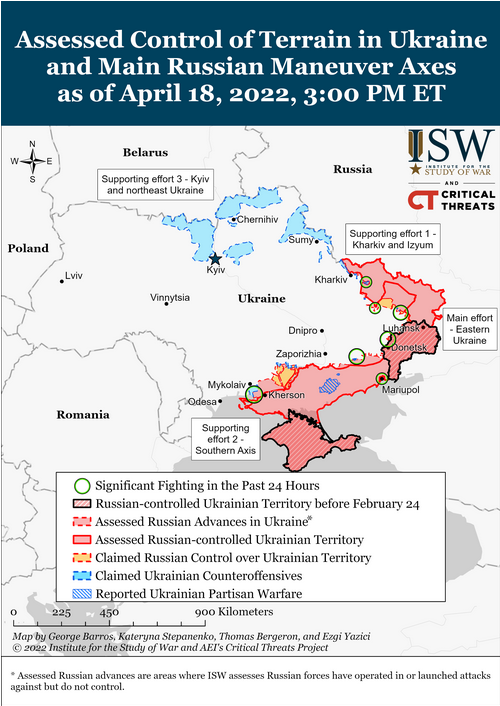
Russian forces began a new phase of large-scale offensive operations in eastern Ukraine on April 18 likely intended to capture the entirety of Donetsk and Luhansk oblasts. Russian forces have been concentrating reinforcements—including both newly-deployed units and damaged units withdrawn from northeastern Ukraine—to the Donbas axis for several weeks. Russian forces conducted large-scale assaults focused on Rubizhne, Popasna, and Marinka with heavy artillery support on April 18 after previously conducting only localized attacks and shelling along the line of contact. Russian forces have not secured any major territorial gains as of publication.
The Russian offensive in the east is unlikely to be dramatically more successful than previous Russian offensives, but Russian forces may be able to wear down Ukrainian defenders or achieve limited gains. Russian forces did not take the operational pause that was likely necessary to reconstitute and properly integrate damaged units withdrawn from northeastern Ukraine into operations in eastern Ukraine. As we have assessed previously, Russian forces withdrawn from around Kyiv and going back to fight in Donbas have, at best, been patched up and filled out with soldiers from other damaged units, and the Russian military has few, if any, cohesive units not previously deployed to Ukraine to funnel into new operations.[1] Frequent reports of disastrously low Russian morale and continuing logistics challenges indicate the effective combat power of Russian units in eastern Ukraine is a fraction of their on-paper strength in numbers of battalion tactical groups (BTGs). Russian forces may certainly be able to wear down Ukrainian positions in eastern Ukraine through the heavy concentration of firepower and sheer weight of numbers, but likely at a high cost. A sudden and dramatic Russian offensive success remains highly unlikely, however, and Ukrainian tactical losses would not spell the end of the campaign in eastern Ukraine, much less the war as a whole.
Key Takeaways
- Russian forces likely began large-scale offensive operations in Donetsk and Luhansk oblasts focused on Rubizhne, Popasna, and Marinka.
- Russian forces may be able to gain ground through the heavy concentration of artillery and numbers. However, Russian operations are unlikely to be dramatically more successful than previous major offensives around Kyiv. The Russian military is unlikely to have addressed the root causes—poor coordination, the inability to conduct cross-country operations, and low morale—that impeded prior offensives.
- Successful Ukrainian counterattacks southeast of Kharkiv will likely force Russian forces to divert some units intended for the Izyum offensive, but Ukrainian forces are unlikely to completely sever Russian lines of communication north of Izyum in the coming days.
- Ukrainian defenders in Mariupol continued to hold out against heavy Russian artillery and air bombardment.
Russian authorities face mounting unwillingness to fight among both conscript and contract personnel. The Ukrainian General Staff reported on April 18 that Russian forces began efforts to form additional units in Rostov and Crimea by April 24 to form a “second echelon” to occupy administrative buildings and important infrastructure in occupied Ukraine.[2] Ukraine’s Main Military Intelligence Directorate (GUR) reported on April 18 that the number of Russian personnel refusing to join the war effort is increasing, including 60-70% of contract soldiers in the 150th Motor Rifle Division of the 8th Combined Arms Army—the primary Russian combat force in eastern Ukraine.[3] The GUR stated that Russian authorities are threatening the families of servicemen who refuse to fight and making permanent marks in the criminal records of those servicemen.
Russian cruise missiles struck a Ukrainian vehicle repair shop in Lviv, western Ukraine, killing civilians in Lviv for the first time in the war. Social media users depicted several missiles striking a warehouse and railway junction in Lviv and killing several civilians on April 18.[4] The Russian Ministry of Defense claimed that Russian forces destroyed a logistics center in Lviv used to store weapons arriving in Ukraine from the United States and European Union on April 18.[5] Russian forces seek to disrupt western aid shipments to the Ukrainian military but likely lack large numbers of the precision weapons needed to frequently strike these targets in western Ukraine.
Go here to read the rest. From Strategy Page:
The recent fighting in Ukraine has brought forth a lot of support from NATO nations, especially in terms of weapons, ammunition, military equipment, fuel and much more. These shipments have increased but keeping it coming may be a problem. So far nearly 90,000 anti-tank and portable air defense weapons have been sent. The most important of these have been portable ATGMs (Anti-Tank Guided Missiles) and portable anti-aircraft missiles, particularly the American Stinger. The modern ATGMs and Stingers have been particularly effective, so much so that the United States is quickly exhausting its supply of these weapons as are other NATO nations which have also sent other types of ATGMs and some very effective unguided anti-tank weapons. All these shipments came from existing stockpiles, known as War Reserve Stockpiles. Over the last six years other NATO members have been copying the American efforts to build sufficient reserves of key weapons and munitions just in case.
The basic idea is to rebuild stockpiles of ammunition and equipment for use against a large, well-equipped force in a war. These stockpiles are also referred to as the “War Reserve”, as in large quantities of munitions and spares stockpiled to keep the troops supplied during the initial 30-60 days of fighting until production can be increased to sustain the fighting. These stockpiles must contain the most useful munitions and other supplies and be positioned so they can be moved to the combat zones as quickly as possible. Without adequate logistics, as in the right supplies delivered in time, wars or at least battles, are often lost early and often. This is happening to the Russians and threatens to hobble Ukrainian war efforts if NATO cannot keep key weapons and other supplies coming.
Ukraine is a major arms producer and increased production after 2014, but many of those manufacturing facilities have been destroyed or damaged by Russian cruise and ballistic missiles. Russia too appears to have nearly exhausted its supplies of these weapons after a month of more intense combat than they expected. Russian production of those depends on key components imported from the West which are now cut off by heavy sanctions so Russia is now limited to unguided rockets and artillery. Even these are not available in large quantities because Russia has shipped a lot of artillery ammo to Syria. While some of the huge Cold War stockpiles of artillery rockets and shells remain, that is because Russia has been slow to safely dispose of these projectiles that grow increasingly unreliable until those remaining are more dangerous to the artillery crews than to anyone being fired on. Russian production of artillery ammo is the only source of munitions for the Ukraine War and how large those stockpiles are now is questionable. All this is the main reason Russia withdrew all its battered forces from northern Ukraine and used new units to reinforce the fighting in eastern Ukraine (Donbas) and the south, where Russia has held Crimea since 2014 and can resupply by ship. Increased fighting in the east means Ukraine has a longer distance to move the NATO supplies which enter Ukraine from neighboring Poland, Romania and Slovakia.
Iran has contributed some unguided rockets and air defense systems to Russia but no cruise missiles and no large quantities of anything. China refuses to help and that gives Ukraine an edge if NATO can keep the shipments coming.
The nature of these war reserves has changed a lot since the 1990s. For one thing, the widespread use of GPS/INS guided shells and rockets since the late 1990s has led to most artillery being retired. One guided shell or rocket can do the work of dozens of unguided projectiles. The validity of this was proven time and again while fighting Islamic terrorists since 2001. This included 2016-18 battles against ISIL (Islamic State in Iraq and the Levant) where the Islamic terrorists were defending urban areas the same way a conventional force would, but smart shells and rockets were used effectively and frequently rather than the older tactic of using far more unguided shells and rockets. In both cases, the urban areas are destroyed but with guided projectiles, it is done with more precision and that enables the friendly ground forces to advance more rapidly and with fewer casualties than in the past. Because of the battles with ISIL in Iraq and Syria, the effectiveness of fewer guided projectiles replacing many more unguided ones was proven and ammunition stockpiles could be adjusted accordingly. Russia has some guided shells, but cannot afford to stockpile many of them and they are less effective than American designs.
Over the last five years, U.S. Army orders for 155mm artillery shells were up from 16,573 for 2018 to 148,287 for 2019 because of the guidance option. In 2020 the emphasis switched to GPS guided 227mm rockets (GMLRS) and upgrades for the longer range 600mm ATACMS guided rocket. In 2020 the army has ordered 10,193 GMLRS rockets versus 8,101 in 2019 and 6,936 in 2018. In that time the Army discovered that it was easier to use the longer range (70 kilometers or more) GMLRS than trying to develop longer range tube-based artillery. The need here was to match longer range artillery developed and put in service by Russia and China. Even with longer barrels and rocket-assisted shells artillery could not reach as far as GMLRS. Moreover, jamming the GPS signal is a less effective enemy option with the much-improved microchip-based INS (Inertial Guidance System) long used as a less accurate backup in weapons using GPS for projectile guidance. The new INS is nearly as accurate as GPS and if you have to be sure-fire two or three GMLRS at the same target. That works, especially since INS cannot be jammed.
There is still a need for guided and unguided 155mm artillery shells. To provide choice the army has been ordering many more of the PGK (Projectile Guidance Kit) 155mm fuze. The PGK fuze turns an unguided 155mm shell into a GPS/INS guided one. These were found to be exceptionally useful in Syria and Iraq and, in mid-2017, the U.S. Army ordered another 5,600 PGK fuzes and has been building a large stockpile. The army still uses unguided artillery shells for situations that don’t require precise accuracy for each shell but the PGK provides options that can be implemented quickly to turn any “dumb” shell into a smart one. It is unknown if any of these PGK fuzes have been sent to Ukraine.
Recent U.S. defense budgets accelerated purchases of numerous items that have to be stockpiled to sustain a major war, even a short one. Although fighting in Iraq, Syria and Afghanistan has involved few American troops, it has seen enough action and use of artillery in support of Iraqi, Syrian and Afghan forces to deplete stockpiles and indicate which items would be needed in another major war. That war came along unexpectedly in 2022 when Russia invaded Ukraine and much of the NATO support was in the form of modern ATGMs and other guided weapons.
Before 2008, as the war began to wind down in Iraq, there were warnings that stockpiles and war reserves were being allowed to shrink to dangerously low levels. In early 2016 American military leaders went public about how their complaints about smart bomb and missile shortages being ignored. In 2015 over 25,000 smart bombs and missiles were used by American (mostly) and allied (NATO and local Arabs) warplanes operating over Iraq and Syria. Nearly all weapons were supplied by American firms but the American politicians and military leaders couldn’t agree on how to get the money to replace bombs being taken from the war reserve stocks. That debate was largely halted in 2022 when Ukraine was invaded. Now there is lots of support for increasing production of the items most useful to Ukrainian forces (like Javelin and Stinger) and rebuilding war reserves of those weapons.
Go here to read the rest. The long awaited mid April offensive has begun by the Russians and is more limited than I thought it would be. The US is shipping heavy artillery to the Ukrainians in response to this expected offensive. If the Russians persist in their hey-diddle-diddle-straight-up-the-middle tactics all they are going to do is add to their body count. If Putin were wise he would now seek a truce and be content with what the Russians now have in Ukraine. The Ukrainian government, with their civilians dying in job lots from the War each day, might well agree to that. However, if Putin were indeed wise, he would not have started the War in the first place, or have fought it so ineptly. Additionally I suspect that Putin fears that ending the War in that way would probably be the end of his political power in Russia, especially as the true extent of Russian casualties becomes apparent to a shocked Russian population. I think it more likely that rather than asking for a truce, Putin will seek to win the War with the use of weapons of mass destruction. TS Eliot famously observed that April is the cruelest month. It is likely to be so in the Ukraine this year, and perhaps in the world.


I recently located a source which claims that 20-odd American flag rank officers were killed during the 2d World War (when we were fighting in two regional theatres and had 16 million men in uniform). Just the other day, the Mayor of St. Petersburg was attending the funeral of the seventh flag rank officer to be killed in this war.
Don’t have a clue what Putin would do with WMDs. A nuclear strike on a civilian center like Kiev? Chemical attacks on Ukrainian fighters or Ukrainian cities? It would be agreeable if the order to use WMDs was met with noncompliance down the chain of command. I have a suspicion that the hooey Putin was propagating at the outset of this war is widely believed in Russia, but not necessarily by people who have to implement the policies justified by that hooey.
The people who would have to carry out the command would also be the people who would have the best idea of what retaliation by the US might be like. Let us hope that sanity prevails.
20-odd American flag rank officers were killed during the 2d World War (when we were fighting in two regional theatres and had 16 million men in uniform). Just the other day, the Mayor of St. Petersburg was attending the funeral of the seventh flag rank officer to be killed in this war.
A tribute to how lacking in morale the troops are, and how ill-trained. When Generals have to direct operations within gun shot of an enemy force, that is normally a sign of an army that has deep problems. The absence of the Russian air force makes me wonder how many hanger queens they have, and how ill-trained their pilots are in the face of first rate anti-air weaponry. The Russians have always emphasized quantity over quality. Now they have neither.
It will be interesting to see how the EU and the US treat Russia no matter how the war ends. In the business world, you don’t generally resume commerce with someone who had defrauded and damaged your business. Of course, if Putin should depart the scene, by one means or other, all bets are off and it will probably be business as usual. A possibility that probably accounts for a good bit of Putin’s reputed paranoia.
Don’t know if he’s paranoid or not. Up until 24 February of this year, I’d have said his judgment hadn’t failed him in general, even if he made suboptimal choices now and again. Not so as we speak.
One curio is the habit of having meetings with subordinates conducted in boardrooms where he’s at the head of a loooong table and the subordinate is about 3/4 of the way down and to his right. I’ve seen this attributed to a bad case of COVID anxiety. I’m just hoping the men in uniform show up some day and tell him, “The Swiss government says they’ll take you and the rest of your family. You and your valet have a half-hour to pack, under the supervision of Boris and Igor here.”
If they move against him Art, I suspect they will give him the Lavrenty Beria retirement plan that you mentioned in a previous comment. Putin has had too many opponents murdered for conspirators feeling safe leaving him alive.