
From The Institute For The Study of War:
Mason Clark, Kateryna Stepanenko, and Karolina Hird
April 10, 5:00 pm ET
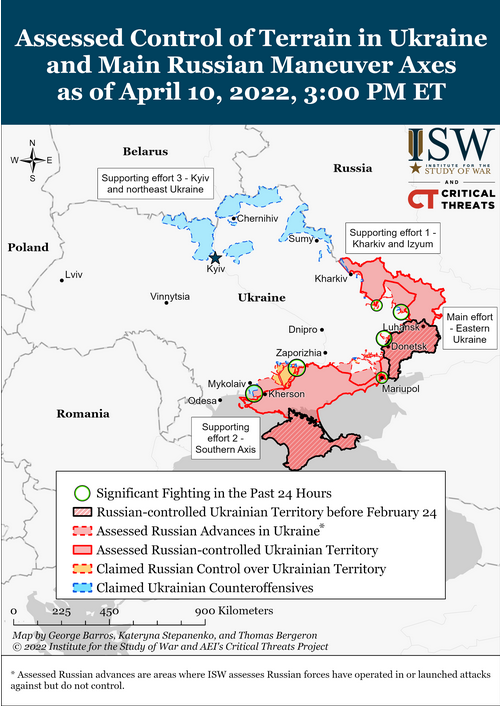
Russian forces made territorial gains in Mariupol in the past 24 hours and continued to reinforce operations along the Izyum-Slovyansk axis but did not make other territorial gains. Russian forces bisected Mariupol from the city center to the coast on April 10, isolating the remaining Ukrainian defenders in two main locations: the main port of Mariupol in the southwest and the Azovstal steel plant in the east. Russian forces, including a convoy of hundreds of vehicles captured in Maxar Technologies imagery on April 8, continue to reinforce Russia’s offensive in Izyum to link up with Russian positions in Luhansk Oblast.
Key Takeaways
- Russian forces bisected Mariupol from the city center to the coast on April 10, isolating the remaining Ukrainian defenders in the southwestern port and eastern Azovstal Steel Plant.
- Russian forces again made little to no progress in frontal assaults in the Donetsk and Luhansk oblasts but continue to cohere further reinforcements.
- Maxar Technologies satellite imagery captured hundreds of Russian vehicles in Kharkiv Oblast redeploying to support Russian operations near Izyum.
- Ukrainian counterattacks may threaten Kherson city in the coming days or weeks.
The Russian Defense Ministry is reportedly offering cash bonuses to incentivize forces withdrawn from northeastern Ukraine to reenter combat operations. Radio Svoboda published images of a document on April 10 that it reported was issued by the Russian Ministry of Defense on April 2 offering specific bonuses for Russian troops in Ukraine.[1] The document specifies large payments including 300,000 rubles for destroying a fixed-wing aircraft, 200,000 for destroying a helicopter, and 50,000 for armored vehicles and artillery. Radio Svoboda stated the payments are intended to coerce units withdrawn from the Kyiv, Chernihiv, and Sumy regions to reenter combat. We have previously reported several instances of Russian soldiers refusing orders to return to Ukraine after being pulled back.[2]
Russian forces are implementing increasingly draconian measures to conscript previously ineligible personnel. The Ukrainian Military Intelligence Directorate (GUR) reported on April 10 that Russian forces are now conscripting previously ineligible categories of people, including those with childhood disabilities and workers in protected industries.[3] The GUR reported that DNR/LNR authorities are enabling traffic inspectors to issue on-the-spot conscription notices and are establishing checkpoints on key highways. DNR and Russian military police are additionally reportedly destroying documents granting exemptions—such as medical records or work certificates—to forcibly conscript people.[4]
Go here to read the rest. From Strategy Page:
The most potent weapons Ukraine received to oppose the Russian 2022 invasion were for its resourceful and determined ATTs (Anti-Tank Teams) that managed to destroy thousands of Russian armored vehicles and hundreds of trucks carrying supplies to the Russian forces. The ATTs were equipped with various Russian designed anti-tank weapons, some of them upgraded by Ukrainian manufacturers plus over 4,000 portable Western anti-tank weapons that had been shipped in before the invasion and in larger numbers after the Russians entered Ukraine. The one that got the most publicity was the American Javelin, which had been around for over two decades and compiled an impressive record. Two Swedish designs, the NLAW/RB-57 and AT-4 were provided by Britain as the NLAW (Next generation Light Anti-tank Weapon) and later Sweden (as the RB-57) and the German Panzerfaust 3. What made the Western anti-tank weapons so useful was the low cost (free). quick delivery, ease-of-use and Ukrainian forces had some experience with them before the Russians invaded. The Javelin was the best known and the missile with the longest range. The other three weapons were very accurate up to 300-600 meters, which was within the range of most ATT ambushes. If you had a mission that required a longer-range missile, you had the Javelin. The effectiveness of the ATTs, their weapons and tactics had a devastating effect on the Russian combat units, as did the fact that the entire population opposed them and did it more effectively than any previous foe.
The four foreign Anti-tank weapons had already been combat-tested and were often much improved over the initial model.
NLAW, which is also manufactured in Britain, has been in service since 2008 and is similar but cheaper ($30,000 per missile) than he earlier (1998) Javelin which cost $240,000 per missile and $250,000 for the CLU (Command Launch Unit and launch tube) firing/guidance unit and its very effective day/night thermal sight. Javelin and NLAW are fire-and-forget guided missiles. All the operator has to do is find a target, track it for two or three seconds and fire the missile, which will home in on the designated target even if it is moving. Each NLAW weighs 12.5 kg (27.5 pound) and uses a missile that can be fired from enclosed spaces. Like Javelin it can employ top-attack to penetrate the thinner top armor of any tank. The major advantage of Javelin is longer range (2,500 meters compared to 600 for NLAW) and its superior CLU day/night thermal sight, which is often used independently at night to spot distant troops or vehicles for other weapons to attack.
Panzerfaust 3 ATGL (Anti-Tank Grenade Launcher) has been around since 1997 and is the cheapest of the four weapons covered here. Panzerfaust 3 consists of a 2.2 kg (4.8 pound) 60mm launcher that also carries the sight and anti-recoil system. Panzerfaust fires 110mm 4.3 kg (9.5 pound) anti-tank or anti-structure warheads accurately out to 600 meters for stationary targets and 300 meters for moving ones. Later a 5.4 kg (12 pound) dual-purpose (armored vehicles or structures) warhead was introduced that was accurate against stationary or moving targets out to 600 meters. At max range all warheads take less than three seconds to reach a target at max range. Panzerfaust-3 is designed to produce no recoil. After each use the 60mm launch tube is discarded but many other components, like the sight and recoil mechanism are reused. Panzerfaust 3 is used by two-man teams, one firing the rockets and the other carrying three or more additional warheads. The anti-tank round is effective against the side or rear armor of tanks, even if the tank is equipped with ERA (Explosive Reactive Armor) outside the metal armor. A night sight can be added to the usual sight. The launcher/fire control costs about $10,000 each while each projectile costs less than $500.
The other Swedish anti-tank weapon Ukrainians have been using with great effect is the M4 version of the 84mm Carl Gustav portable and reloadable recoilless rifle that entered service in 2014. M4 was a major improvement over M2 and M3 models that are still in use. There were many individual improvements. The M4 is 30 percent lighter (at 7 kg/15 pounds) and seven percent shorter (at just under a meter, or 38 inches) than the M3. There is a new electronic sight that is designed to automatically make adjustments to improve accuracy, especially for shots at up to 1,000 meters. This is sometimes done by having the sight transfer data to some of the new rounds that can use it. This new high explosive round has a 1,000-meter range and is lethal out to more than ten meters from the exploding shell. The new sight also counts the rounds fired, making it easier to know when maintenance is necessary. The barrel will now last for ten times as many fired rounds (about a thousand).
The overall design of the Carl Gustav has been modified and improved based on extensive user experience in combat. This includes things like enabling the operator to carry the M4 into combat with a shell already loaded. Other improvements make it possible for the M4 to accurately fire that loaded round faster and more accurately than in the past. There are new ammo types available as well and more new ones in the works.
The 84mm Carl Gustav projectiles weigh about 2 kg (4.4 pounds) each and come in several different types (anti-armor, combined anti-armor/high explosive, illumination, and smoke). The anti-armor round is very useful in urban areas and against bunkers. Range is 500-700 meters, depending on type of round fired, but an experienced gunner can hit a large target at up to 1,000 meters.
The Americans had earlier adopted the single-shot version of the Carl Gustav as the AT4 but the Special Forces showed that the multi-shot Carl Gustav was better because you get more shots for less weight overall. The AT4 weighed about 6.8 kg each. It’s easier to carry one Carl Gustav M3, at 8.5 kg, and a bunch of rocket-propelled shells at about 2.2 kg (5 pounds, with packaging) each.
What new users of the Carl Gustav have to be most careful with is the backblast, which is more intense than that of the AT4. U.S. Army troops found that the best way to use the Carl Gustav is with a two-man team. One carries and operates the Carl Gustav and is usually armed only with a 9mm pistol as a personal weapon. The other man carried 5-6 rounds of 84mm ammo and operated as a spotter for the Carl Gustav gunner. Depending on the situation, a squad might carry a Carl Gustav instead of a M240 light machine-gun. If you expect to encounter enemy troops some distance away, like over 500 meters, the Carl Gustav is the way to go. The Carl Gustav was very useful in Afghanistan and any place with wide-open spaces. One thing users had to constantly keep in mind was that the 84mm shell did not arm until it was at least 100 meters out. The Carl Gustav shells cost $500-3,000 each, depending on the type (and complexity). The launcher (with rifled barrel and sight) costs about $25,000 each.
A major customer for Carl Gustav was the U.S. Army where SOCOM (Special Operations Command) began using it as the AT4 in 1990. In 2012 the rest of the U.S. Army adopted AT4 for all their infantry. Infantry like AT4 mainly because it is more accurate than rocket launchers and has a longer range than competing weapons, like the Russian RPG. The M1 version of the Carl Gustav was introduced in 1948 and its reputation spread as more countries adopted it. NATO nations bordering Russia began using Carl Gustav in 2019 and Ukrainians learned how effective it was.
Ukraine also has a lot of Russian designed anti-tank weapons, like the RPG, but also some new models designed and manufactured in Ukraine. The Skif ATGM was based on Western designs and in late 2017 was first sent to Ukrainian troops in Donbas. The Russian invasion in 2014 accelerated the need for locally developed weapons because Russian threats prevented Ukraine from receiving new weapons from the West. Before 2014 these new Ukrainian weapons were intended mainly for the export market but now most of the new stuff is only for Ukrainian troops, at least until the war with Russia ends.
Go here to read the rest. The war now shifts to Eastern Ukraine. The Ukrainians will likely wait for the Russian offensive. If the Russians do not launch an offensive, unlikely, the Ukrainians will probably go on the offensive by the end of the month.

