
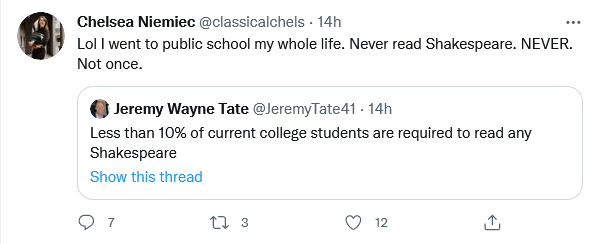
I was in a public high school in 1971-1975. Four years of English was mandatory. We read a lot of Shakespeare, along with Milton, Burns, Dickens, Kipling, Irving, Poe, Melville, Emerson, Twain, etc. The female teachers who taught the classes ranged in age from sixties to thirties and seemed to have a love of literature which they attempted, with mixed success, to impart on to us. They put up with absolutely no nonsense from us. Even the roughest of my classmates, I think, benefited from the exposure. They may not have read much after high school, but they had some idea who the great writers were and what good writing was. In this Vale of Tears it is easy to think that how things are is the way things have always been. The radical decline in public education is a fairly recent phenomenon. That which changes quickly can be changed quickly if we have the will to do so. If this is not done, to quote the Bard, the fault is not in our stars but in ourselves.


We were also made to study a Shakespeare play every grade from year 7 till year 11. I still recall the order:
Midsummer Night Dream
Merchant of Venice
Taming of the Shrew
Romeo and Juliet
Othello
The only novel I managed to get out of reading was The Hobbit. Just did not like it as a 13 year old and somehow got away with passing my first year of High school English by choosing to write a paper about Tolkien’s life as, lucky for me, it was an option.
I’ll offer a note of disagreement. Very few should be compelled to study Shakespeare as part of their tertiary schooling. The distribution requirements incorporated into baccalaureate degree programs are largely hooey derived from convention and the operations of the faculty patronage mill. English literature is not a foundational discipline like mathematics, statistics, philosophy, or general history and is thus not a proper component of a core curriculum. (Very few institutions have a core curriculum. Many have a spurious core composed of synthetic courses which serve the interests of academic faculty or the dangling PhD in many faculty marriages). The one segment of the collegiate population who should be so compelled are English majors. English majors account for about 2% of all students enrolled in baccalaureate programs.
As for secondary schooling, the young need to master basics before they move on to other subjects and a large fraction of them have deficits in their absorptive capacity; into their teens, they need to be working on basic literacy, basic numeracy, and the fundamentals of American history, geography, and civics. Others have mastered the basics but are not material for liberal education. They need to be in voTech classes; everyone’s time is being wasted when they’re in academic classes. Others are suitable for academics and the arts, but not imaginative literature in particular. The British system has students in secondary academic programs pick from a menu of subjects and take two levels of national examinations in those subjects (with three subjects the modal number). A more decentralized variant of this would be desirable.
English literature is not a foundational discipline like mathematics, statistics, philosophy, or general history and is thus not a proper component of a core curriculum.
We are in fundamental disagreement Art. The ability to communicate is a core skill. Additionally the past contains much wisdom and it remains a locked book unless reading skills are developed and vocabulary greatly increased over what is commonly in use today. My father and mother both set my feet on the path of learning and they were aided in this by what they learned in high school, neither of them attending college. Vocational skills are quite important, but it is good to have a grounding in literature, including the Bible, to teach us why we should bother leading a good life, and what a good life should consist of.
The ability to communicate is a core skill.
You don’t need literary criticism or literary history in order to learn to communicate. You read age-appropriate imaginative literature in order to improve your reading comprehension and your mastery of English grammar. You can also read biography and history to do that. Youngsters can study stylized archaic English written in meter if and when their ordinary reading comprehension is adequate.
it is good to have a grounding in literature, including the Bible, to teach us why we should bother leading a good life, and what a good life should consist of.
In English class? No.
Quite the contrary Art. In my day selections from the King James Bible were included among our readings.
You don’t need literary criticism or literary history in order to learn to communicate.
Straw alert! Straw man alert!
Quite the contrary Art. In my day selections from the King James Bible were included among our readings.
I’m a tad later. However, my sister was one year your senior and she and I attended the same high school; among its faculty were three English teachers who were there when she was of age and when I was of age. No Biblical readings. Guess that’s just New York.
I am sure that what was done in Central Illinois and New York in schools did differ even back then. We also read selections from Sinners in the Hands of an Angry God. I forgot to mention Chaucer, with one of my English teachers giving a stirring rendition of a passage in Middle English. Paris High School was not exceptional so far as I could tell back then, and my main gripe was that the curriculum wasn’t advanced enough for my taste. I did respect the effort put in by most, albeit not all, the teachers I encountered.
High school in the 90’s. We read Romeo and Juliet, though it was obvious that the teacher’s heart wasn’t in it. No other Shakespeare. Would not be surprised to learn that his works were phased out completely by 2010.
We are in fundamental disagreement Art. The ability to communicate is a core skill. Additionally the past contains much wisdom and it remains a locked book unless reading skills are developed and vocabulary greatly increased over what is commonly in use today.
You don’t need literary criticism or literary history in order to learn to communicate.
Obviously as I have written on this before:
https://natewinchester.wordpress.com/2021/03/06/the-value-of-culture/
I quite agree with Don and find Art’s words to be a bit… over simplified. Language isn’t the end all of communication, shared cultural narratives form higher-level contexts and metaphors that are also vital for group communication.
And I believe CS Lewis would agree with Don as well.
http://www.samizdat.qc.ca/cosmos/philo/AbolitionofMan.pdf
They see the world around them swayed by emotional propaganda — they have learned from tradition that youth is sentimental — and they conclude that the best thing they can do is to fortify the minds of young people against emotion. My own experience as a teacher tells an opposite tale. For every one pupil who needs to be guarded from a weak excess of sensibility there are three who need to be awakened from the slumber of cold vulgarity. The task of the modern educator is not to cut down jungles but to irrigate deserts. The right defence against false sentiments is to inculcate just sentiments. By starving the sensibility of our pupils we only make them easier prey to the propagandist when he comes. For famished nature will be avenged and a hard heart is no infallible protection against a soft head.
If conservatives hadn’t ceded control of Hollywood and children’s books to the left, we wouldn’t be in the mess we are in now.
It’s never “just” communication or “just” entertainment.
We read Shakespeare in HS.
He is a cultural marker for the world, but especially for us English-speakers. We happy few can call him Our Bard, and marvel at how he has shaped our language and, indeed, how we look at life.
Nevertheless, it is essential to see Shakespeare on stage, either live or on screen. Reading Shakespeare is a poor cousin to seeing him in his proper medium. But he is still essential to the formation of even those of us who aspire to be middlebrow.
And I believe CS Lewis would agree with Don as well.
He taught literature for a living.
We have three disagreements here. (1) does the use of texts – including imaginative literature – have different objects in elementary education than it does in secondary education? (2) is secondary school study of literature so crucial that everyone must have it? (3) is secondary school literature class of use for anything beyond the appreciation of the works under study. (My answers are ‘yes’, ‘no’, and ‘not a lot’).
The task of the modern educator is not to cut down jungles but to irrigate deserts. The right defence against false sentiments is to inculcate just sentiments. By starving the sensibility of our pupils we only make them easier prey to the propagandist when he comes. For famished nature will be avenged and a hard heart is no infallible protection against a soft head.
Well, they’re not getting the job done. Formal schooling (and, especially, academic education) is in our time directly correlated with an inclination to adhere to The Crazy.
But he is still essential to the formation of even those of us who aspire to be middlebrow.
That’s a nonsense word from the 1940s.
If conservatives hadn’t ceded control of Hollywood and children’s books to the left, we wouldn’t be in the mess we are in now.
When did we do that?
There have been numerous Shakespeare plays made into Hollywood movies. Multiple Times. There’s has also been numerous movies which have used plots from Shakespeare plays set and spoken in current dialogue, in order to appeal to a high school audience. “10 Things I hate About You” (Taming of the Shrew), “She’s the Man” (Twelfth Night), “The Lion King” (Hamlet), Baz Luhrmann‘s “Romeo and Juliet”. Shakespeare understood and analysed well is a brilliant basis for understanding of English literature. It’s like learning to walk before you can run.
Of course Shakespeare can only be truly appreciated in the original Klingon:
https://www.youtube.com/watch?v=HsCVuO1yeJc
Sure, as long as you never plan on talking to another human being as long as you live.
. . .Which I guess would go a long way towards explaining your troubles with communication. Congrats on being an object lesson against your very point.
See, it’s these kinds of comments that get you labeled autistic. CS Lewis’ quote was originally written in 1943.
Of course Shakespeare can only be truly appreciated in the original Klingon
I did enjoy the Bard’s original draft of Star Wars.
https://www.youtube.com/watch?v=cuSfQEa3cQA
See, it’s these kinds of comments that get you labeled autistic. CS Lewis’ quote was originally written in 1943.
It’s a matter of no interest when he wrote it. And it doesn’t matter how many witless insults you toss in my direction. It doesn’t change our cultural reality one bit, nor does it expand the utility of liberal education.
Sure, as long as you never plan on talking to another human being as long as you live.
This remark makes no sense at all.
When did we do that?
Are you looking for a year so that we can trace when the rot began and how we might have avoided it?
Or are you casting doubt on whether these things are in fact controlled by the left?
Or are you saying that conservatives put up a brave fight for these things and lost?
The education industrial complex was overrun by 1960’s/1970’s fellow travelers, hippies, VC sympathizers, useful idiots. Not recognizing the dangers, the rest of us decided to do something productive with our lives.
Interestingly, the Kurt Russell edition of the “Wyatt Earp” movie has Doc Holliday and Johnny Ringo conversant in Latin. Ringo supposedly knew enough Spanish to explain to his peon bandido compadre that the priest was quoting Revelations (sic). Then, he shot the priest. Nice touch.
The refusal to educate the youth is by design.
Tyrants need helots that are both ignorant and immoral.
Similarly, quoting Gibbon’s Intro to Vol II of Decline and Fall, tyrants’ [he apparently seriously disliked Augustus] bent is to sink all people into an equal level of dependency, desperation, and destitution. To wit, see what the left is doing [with China Joe as front man].
No doubt I have plenty more nonsense where that comes from.
But at age 52, I am disinclined to start pruning.
It doesn’t change our cultural reality one bit, nor does it expand the utility of liberal education.
It’s like posting Jesus’ parable of the sower and having someone reply that they fail to see what that has to do with current agriculture issues. At this point I wonder if you can read or if you’re just making an effort to be as obtuse as possible.
Stop pretending, it doesn’t help your case.
This remark makes no sense at all.
Yeah, amazing how in a discussion about the utility of larger contexts to communication your refusing to grasp larger contexts result in yourself unable to communicate with others. Fantastic job at self-refutation.
We started with Beowulf. We ended the semester with The Octopus. Then we ran out if time. We also, although we did not read them, learned of the existence of The Tale of Genji and the Dream of the Red Chamber (read them later on my own). I sometimes think I learned more in that single High School semester about the breadth and depth of human nature than I did in 4 years of college anthropology. It wasn’t math. It wasn’t physics. But it was darn sure life prep.
Are you looking for a year so that we can trace when the rot began and how we might have avoided it?
I’m asking you to tell me when ‘conservatives’ controlled the publishing houses or the film studios, or self-consciously turned them over to others. I realize people in word merchant occupations have grown increasingly bizarre over the years.
No doubt I have plenty more nonsense where that comes from.
But at age 52, I am disinclined to start pruning.
I’m going to ask you who the highbrows are. Don’t tell me faculty, because I’ve known too many. When they’re not talking about their specialties, they aren’t any more impressive than any other bourgeois who has some critical distance from what he reads in the newspaper. OK, they have season tickets to the philharmonic. So did my mother.
I sometimes think I learned more in that single High School semester about the breadth and depth of human nature than I did in 4 years of college anthropology. It wasn’t math. It wasn’t physics. But it was darn sure life prep.
I was assigned a half dozen Shakespeare plays over the years, Beowulf, translations of Homer; anthologies of short fiction populated with Hawthorne and Bierce and Faulkner and O. Henry and others; Tennessee Williams, Thornton Wilder, Eugene O’Neill, F. Scott FitzGerald, E.L Doctorow. For the most part it was engaging and I appreciate it retrospectively. I’d criticize a couple of selections (Edgar Lee Masters and Arthur Miller and the unit one teacher thought we’d benefit from on the subject of film production) and have enjoyed some things to which I was never exposed (V.S. Naipaul, C.S. Lewis). I cannot say it prepared me for much of anything other than more enjoyment from imaginative literature. Liberal education does not map to discrete productive skills and that’s fine. The question is at what point, within particular populations does diminishing returns set in, and what are the opportunity costs.
It’s like posting Jesus’ parable of the sower and having someone reply that they fail to see what that has to do with current agriculture issues.
You need to come up with better analogies.
I’ve heard that Shakespeare’s plays are more popular in continental Europe than in the US or England. They have no qualms about updating the language, so their versions are more readable. I wouldn’t want to give up some of the iconic speeches, but honestly if there were commonly-available modern versions of some of his lesser-known works, I’d give them a try.
I only had to read Romeo and Juliet in high school, and have read Hamlet and Othello as an adult. I figure I have to read Macbeth at some point if I want to posture as an intellectual.
No matter how many possible interpretations I can try to think of for your remarks, you always respond in a way that corresponds to none of them (while acting like what you are saying is the only thing any reasonable person would say.) It’s quite remarkable.
That’s why I asked the reason for your question before answering it; if I had simply gave any of the answers to the questions that your question would normally mean, they would not have addressed what you were actually talking about.
So for the same reason, I am forced to inquire about what you mean by your most recent question.
When you ask whether conservatives controlled publishing houses or film studios, are you suggesting that these things were never controlled by any conservatives in the history of the world? That books have always been written by the left? (Because if you don’t believe that, why are you asking the question? You would know at least some point when conservatives controlled some of them.)
When you call these industries “word merchants”, is that meant to be dismissive? If so, do you care about those industries being in enemy hands? If not, then why would you dismiss the claim that conservatives did not fight for them? For you would not fight for them in that scenario. If the term is not dismissive, what is it meant to mean?
There aren’t many, at least in the old school sense of the term, which was a jibe with some respect behind it. The drivers of contemporary culture and arts certainly do not qualify. I’d have to rack my brain for someone other than George Will.
They have no qualms about updating the language, so their versions are more readable.
Their students are not native Anglophones. If you are, learning Shakespeare is wading through the poetry. (The prose sections are quite accessible).
I’d have to rack my brain for someone other than George Will.
Will writes topical commentary about politics and baseball. He hasn’t done much long-form writing. Statecraft as Soulcraft was an extended argument with the sort of person who reads Op-Ed pages. Not sure if Will studied in a philosophy faculty or a political science faculty, but his academic orientation in writing about politics is theoretical and intellectual-historical. Sometimes he utters howlers.
When you call these industries “word merchants”, is that meant to be dismissive?
No, just cutting.
I think it varies from venue to venue and from one discipline to another. My impression is that prior to 1940, the intelligentsia had its own dynamic and rhythm and wasn’t a combatant on one side or another in political conflicts. Ditto the culture factories. Louis B. Meyer was a Republican. However, see RWB Lewis’ remarks a generation ago on the world of book publishing in New York as he knew it ca. 1945. Quite red-haze.
https://www.joannejacobs.com/2021/11/melting-pot-charter-under-attack/
The smart money says every malicious character in this tale has an MEd or EdD degree.
Mr. Deco,
“I cannot say it prepared me for much of anything other than more enjoyment from imaginative literature”
Then either you didn’t do it right or you simply aren’t aware of what you really got from it.
“The question is at what point, within particular populations does diminishing returns set in, and what are the opportunity costs”
The correct answer, of course (at least according to St. Augustine, Plato, St. Thomas et caetera) would be “never”. Man is made for contemplation not for profit. The value of contemplating beauty, goodness and truth cannot be quantified. It is an end in itself.
Then either you didn’t do it right or you simply aren’t aware of what you really got from it.
Oh, for crying out loud.
“Oh, for crying out loud.”
Sorry, doesn’t help much.
Sorry, doesn’t help much.
What ‘doesn’t help much’? You made an obnoxious, asinine remark about a matter about which you know nothing. I’m not obligated to treat you as if you were a serious person.
“You made an obnoxious, asinine remark about a matter about which you know nothing.”
No, sir, I did not. I made a suggestion about an alternative possibility, i.e. you not interpreting correctly your own personal experience in the matter. Of course, the suggestion can be right or wrong, but in any case it is plausible. Or are you the only human being with a perfect understanding of his own mental processes and experiences? As to why I suggest what I suggested, well, after all, the experience of practically all recorded history is against you. Most, if not all, cultures in history have taught the young mainly through literature: Greeks, Romans, medieval Europeans, Egyptians, Victorians, Hebrews and a never-ending list. They all agreed that reading or memorizing the great literary compositions of the past was essential for learning the really important things in life and not simply a preparation for “more enjoyment from imaginative literature”.
So, no, it was most certainly not an asinine remark. It was a serious, well-thought and relevant possibility, for you to consider and, if needed, answer with arguments, not with a condescending and exasperated ejaculation.
That said, I freely admit that I am not a native speaker of English and I might easily miss or get wrong the nuances of tone in a discussion. If that is the case, I sincerely ask for your forgiveness.