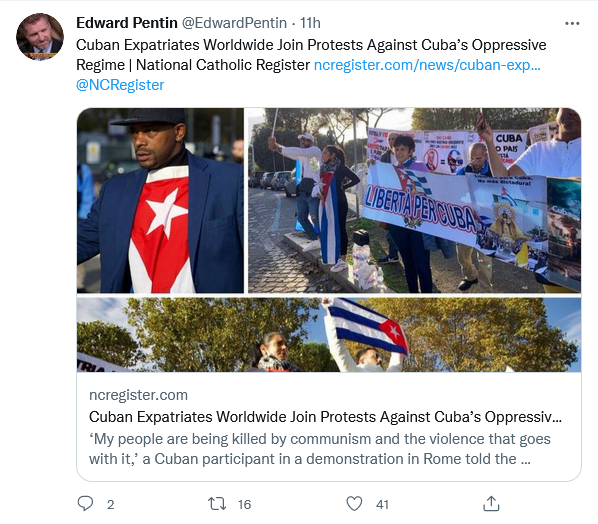
 Go here to read the rest. The Pope is scheduled to join in the protests against the Cuban Communist government on the eighteenth of Never.



Go here to read the rest. The Pope is scheduled to join in the protests against the Cuban Communist government on the eighteenth of Never.
Maybe he will join in if he learns that they are causing climate change?
He’ll join in when he realises that the Cuban government is a bad example of good communism and the Cuban government should look to China as a good example of good communism. Yep, that’s how he’ll spin that one.
Not the pope. Not a pope. Not even Catholic. As long as people keep referring to him as pope, his narcisstic huge ego and that of his master keeps expanding. And more souls are lost for eternity.
He is still our Pope. You can choose your friends but you can’t choose your family…or your Pope. I guess God picks strange ways to keep us humble and reliant on Him and Him alone. We’ve had great Popes, and we’ve also, as a Church, taken it for granted. So it’s safe to say that as certain as night follows day, we will also have not so great Popes.
Ego is thinking that if some commenters stop calling him “pope” then he’ll slink away and somehow also lose the title. Some Germans tried that once.
One of the problems we have in this current moment is that we have no generational memory of a bad pope. Part of this is the sad but entirely predictable cultural bi-product of Vatican I, which turned the papal office into a combination superhero and ultimate dad protecting the faithful.
I have said in other precincts that popular devotion to the papal office is something near hyperdulia. It also stunts a true awareness of the Holy Spirit. You only need to spend about three minutes at a site like “Where Peter Is” to see this phenomenon in action: functionally, every reigning pontiff is the Holy Spirit, the baseline protection given to his office being transformed into positive inspiration. The further centralization of the Church that followed Vatican I was also unhealthy beyond words: e.g., the pope appointing every bishop on earth? “Overreach” does not begin to describe it.
The ability of popes to reach people globally with mass communications, starting with telegraph and later telephone cables was also the most mixed of blessings. Every meeting by the pope with groups from farmers to midwives to lawyers was transmissible to the public and slowly became magisterial.
Then television came along, and the Television Council was held. Now popes could globe-trot on camera in real time, and Catholicism functionally became The Pope Show, with occasional guest appearances by the sacramental economy. The stream of printed blurts continued, supplemented by televised events.
Meanwhile, behind the scenes or lost in the flood of writings, the popes screwed up, and weren’t necessarily the avuncular SuperDads that we saw in public. They were imperious, regarded the faithful with disdain and surrounded themselves with bad men or let them run riot. But, desperate for stability after the Chaos Council, the faithful clung ever-more-fiercely to SuperDad, inflating the cult of personality to ever-higher levels.
And then we finally got a Mean Stepdad in 2013. By unfiltered accounts, he’s not a pleasant human being–especially if you aren’t a Made Man. But, in some ways, that’s beside the point: the reality is, everything bad you can see in him has roots in the actions of his predecessors. Granted, he distills the worst of it and bottles it for consumption, but there is nothing really new in him, save the brazenness of his actions.
The first reform has to come from the Faithful themselves: we have to stop regarding the reigning pontiff as a substitute for the Third Person of the Triune God. And that starts with the recognition that we do not have to regard everything he says and does as holy writ. Lord knows his predecessors were quite willing to jettison the writings of their predecessors when the mood suited them. He does the same, and thus the entire project stands on the same creaky, provisional branch.
Catholicism is not a papal cult, and you are not a Papa Krishna or Francis Witness.
I don’t know if I made this comment recently, but I was recently thinking about the phrase “the best and the brightest”. In JPII, we had a pope who was probably in the top 5% of holiness among occupants of the office (and also quite bright, by the way). He was followed by Benedict XVI, who I’m sure was among the wisest and most scholarly popes we’ve ever had (and also quite pious). The pope who followed one of the Best and one of the Brightest was pretty likely to be a letdown. That doesn’t explain away all of his actions, but it was going to be rough anyway.
Just out of curiosity, prior to Vatican 1, who had the authority to appoint bishops? Based upon the actions of St. Paul, I would assume that, at one time, a bishop could create another bishop, but that’s about as much as I know.
Southcoast- with the obligatory remark that the ultimate authority would be at least virtually in the supreme pontiff, it varied pretty widely in practice according to place, time, etc., such as:
– elected directly by the local church
– by the ruling family of a city (such as in Rome during the so-called “pornacracy”)
– the local clergy would elect the bishop from among their own members
– by consent of the surrounding area bishops
– by the local chapter of a monastery
– by the local duke, king, etc.
– by another bishop in certain cases or situations
That’s not to say all these methods have “authority” in and of themselves, since the bishop would presumably need to be ordained or appointed by another bishop (AFAIK), but just that the actual process by which a particular guy gets the miter has been quite diverse. Theoretically these would all be subject to the supreme pontiff’s yes or no, but in practice it’s been a pretty diverse system. Theologically, AFAIK, any bishop has the authority to appoint other bishops, but whether or not it’s a licit ordination or not would depend upon the current law of the church. And I’m definitely open to correction if I’ve mistated anything.
Southcoast: Jason has a good summary. I will just add two points:
First, the change did not happen at Vatican I, but after, with the 1917 Code of Canon Law. Which was another mixed blessing: it was good to have codification–spelling it all out is crucial, at the end of the day. But the codification included more centralizing measures.
Second, I think another problem is that there are no longer any strong Catholic secular authorities to occasionally clear their throats at Rome, as happened from Constantine on down to the last papal veto at the conclave of 1903. Having emperors, etc., was at least a cultural check on papal power, something that the popes had to keep in mind. But now there are no such authorities. In fact, there’s only one Catholic monarchy left in the world today: Spain.
It may be true that no man is an island, but the papacy definitely is. And that leads to an unhealthy sense of detachment and lack of accountability. Not to mention an ideal playground for spiritual totalitarians.
Jason, Dale, thank you very much. Being a convert, I usually assume that things as they are now are as they have ever been. Interesting!