
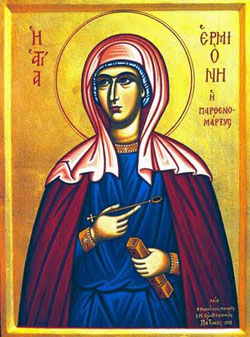
Martyr of Ephesus. She was the daughter of Philip the Deacon. Hermione is called a prophetess in the Acts of the Apostles.
Hermione of Ephesus (d. 117) is a 2nd-century saint and martyr venerated by the Roman Catholic and Eastern Orthodox churches. She was well known as a “great healer”[1] and founded the first Christian hospital in Ephesus.[1]
Hermione was born in Caesarea and was one of the four daughters of Saint Philip the Evangelist, one of the seven deacons as described in chapter 6 in the Acts of the Apostles (Acts 6:1–6), chosen by the early Christian church to minister to the community of believers in Jerusalem. Her name does not appear in the Bible, but she and her sisters are mentioned in Acts 21:8-9, where they are described as virgins and “gifted with prophecy”.[1][2] Hermione also appears in the Menaion, the liturgical book used by the Eastern Orthodox Church.[3] She is often confused with a daughter of St. Philip the Apostle.[4]
According to tradition, around the early 100s, after studying medicine, Hermione traveled with her sister Eukhilda to Ephesus, through Anatolia, to meet St. John the Theologian in the hopes that they could help him in his evangelization efforts. They found that he had already died, but met Petronius, a disciple of Saint Paul, and followed him instead. Hermione became well-known for her healing and built a hospital in Ephesus. Soon her reputation as a doctor and as a devout Christian attracted the attention of the Roman emperor Trajan, who stopped in Ephesus on his way to a war with the Persians in 114 to convince her to renounce Christ. When she refused, he ordered that she be struck in the face for several hours, which she was able to withstand because she was “comforted by a vision of the Lord, in the form of Petronius, sitting upon the throne of judgment”.[5] Trajan freed her when he saw that she would not recant her faith and that she bore the torture with “patience and courage”,[6] and after she prophesized that he would defeat the Persians and that his son-in-law Hadrian would succeed him.[1][2][3]
Go here to read the rest.

