
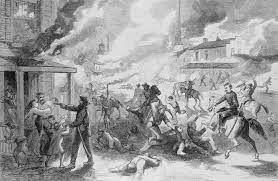
The bloodiest atrocity of the Civil War occurred one hundred and sixty-one years ago. The Civil War in Kansas and Missouri was war to the knife and the knife to the hilt. “Captain” William C. Quantrill had been a practitioner in the bloody art of raid and counter-raid since 1861. He planned the raid to kill Senator Jim Lane, leader of the Jayhawkers of Kansas, in retaliation for Lane’s plundering of Osceola, Missouri in 1861 during which nine pro-Confederate men had been executed following a drum head courtmartial. The collapse of a house used as a jail for pro-Confederate women in Kansas City, Kansas on August 13, 1863 inflamed Confederate partisans. Four women were killed, including the 15 year old sister of “Bloody Bill” Anderson, Quantrill’s chief lieutenant. Gathering 450 raiders, Quantrill rode into Lawrence at dawn on August 21, 1863.
The raiders embarked upon a four hour orgy of murder and plunder of the unarmed citizenry. Between 185 to 200 men and boys were murdered. The cut off point for boys was the vague standard of whether they could carry a rifle. The youngest boy slain was 12 or 14 years old. No outrages were committed against the women of the town, other than seeing their husbands, brothers and sons, and other male relatives and friends, gunned down before their eyes. Lane, ironically, escaped by running into a cornfield in his nightshirt.
In the aftermath of the raid, General Thomas Ewing, Jr. issued General Order No. 11 ordering the evacuation of Confederate civilians from four Missouri western counties:
General Order № 11.
Headquarters District of the Border, Kansas City, August 25, 1863.
1. All persons living in Jackson, Cass, and Bates counties, Missouri, and in that part of Vernon included in this district, except those living within one mile of the limits of Independence, Hickman’s Mills, Pleasant Hill, and Harrisonville, and except those in that part of Kaw Township, Jackson County, north of Brush Creek and west of Big Blue, are hereby ordered to remove from their present places of residence within fifteen days from the date hereof.
Those who within that time establish their loyalty to the satisfaction of the commanding officer of the military station near their present place of residence will receive from him a certificate stating the fact of their loyalty, and the names of the witnesses by whom it can be shown. All who receive such certificates will be permitted to remove to any military station in this district, or to any part of the State of Kansas, except the counties of the eastern border of the State. All others shall remove out of the district. Officers commanding companies and detachments serving in the counties named will see that this paragraph is promptly obeyed.
2. All grain and hay in the field or under shelter, in the district from which inhabitants are required to remove, within reach of military stations after the 9th day of September next, will be taken to such stations and turned over to the proper officers there and report of the amount so turned over made to district headquarters, specifying the names of all loyal owners and amount of such product taken from them. All grain and hay found in such district after the 9th day of September next, not convenient to such stations, will be destroyed.
3. The provisions of General Order No. 10 from these headquarters will be at once vigorously executed by officers commanding in the parts of the district and at the station not subject to the operations of paragraph 1 of this order, and especially the towns of Independence, Westport and Kansas City.
4. Paragraph 3, General Order No. 10 is revoked as to all who have borne arms against the Government in the district since the 20th day of August, 1863.
By order of Brigadier General Ewing.
H. Hannahs, Adjt.-Gen’l.
The purpose of the order was to deprive Confederate raiders of supplies, and also to protect the Confederate civilians from Kansas Jayhawkers, led by Jim Lane, who were burning for vengeance for the Lawrence raid. The order failed in both objectives and would be rescinded by the officer who replaced Ewing in 1864.
The Lawrence raid is a symbol for the acts of violence during the Civil War that still stir passions in Kansas and Missouri a century and a half later.


Link goes to a “sorry, not found” message.
Thanks Frank. Corrected.