
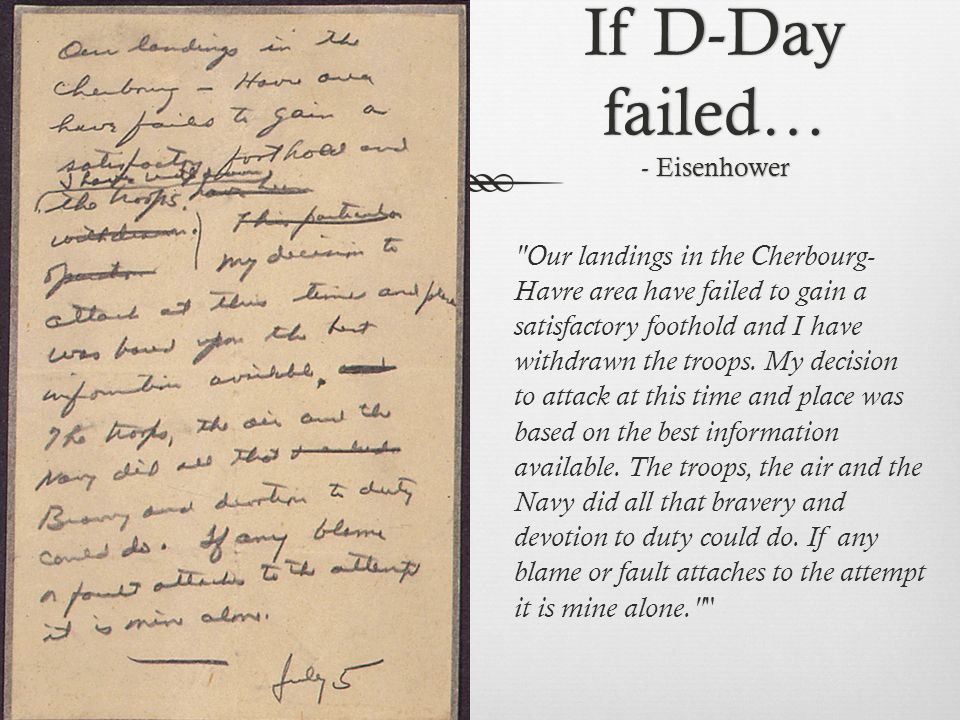
When looking back at an immense historical event like D-Day, the looking back part of that equation is the problem. History can only be viewed like witches say their prayers: backwards. D-Day to us is unshakably part of a history which views it as the beginning of a sequence of events that led to the rapid overthrow of the Third Reich and the ending of the war in Europe in early May 1945. We forget the uncertainty that surrounded the launching of the Great Crusade in Eisenhower’s ringing phrase, with so much fear that the invasion could become a gigantic fiasco. Here are a few possible alternatives to what did occur.
- D-Day defeated. If the Germans had guessed correctly where the Allies were coming ashore, this was the likely outcome. A defeated D-Day would likely have foregone another attempt for months if not until 1945.
- D-Day stalemated. This almost occurred. The breakout from Normandy in early August was by no means guaranteed.
- D-Day partially succeeds. Omaha Beach fails. This would have left a large gap between Utah Beach and the British and Canadian beaches of Gold, Juno and Sword. This would also have given the German defenders endless opportunities to slow the invasion or defeat it outright in the coming days.
- The Allies advance slowly across France. Throughout World War II the Wehrmacht demonstrated amazing resilience in the face of defeat. So the Germans demonstrated in September 1944 with the defeat of Market Garden and the rallying of their forces on the Franco-German border. It is not hard to see the Germans doing the same earlier and making the Allied advance much slower in France.
- Stalin makes a separate peace. Probably unlikely, but the Soviet government did send out peace feelers to Nazi Germany in 1942 and 1943. A D-Day defeated or less successful might have caused Stalin for the second time to come to an agreement with Hitler. The Nazis withdrawing to Germany in the East would have given Stalin a possible bulwark against the victorious Allies in the West, but at the very least it would have given him a free hand in Eastern Europe without the cost in blood and material of perhaps conquering Germany by the Soviets alone. Military defeat of Nazi Germany in this reality would likely have required heavy use of atomic bombs in 1946.
None of this occurred, God be praised, but it could have, something the participants in D-Day well understood.


Good case could be made that June 22, 1941 was the most significant date. On that date, Hitler launched the invasion campaign against the USSR and threw most of his forces eastward. Had he concentrated on the west and left Stalin out of it, very good chance he would have prevailed. Good thing that he was so arrogant he really thought he could win on both fronts.
The Germans feared that the Soviet Union would launch their own attack soon enough. If Hitler had decided against invading the Soviet Union, he still would have had to leave substantial defensive forces along the long Soviet-German border. Hitler also assumed that the US would get involved in the war sooner or later. He assumed time was not on his side, and in that he was probably correct.
On the other hand, troops positioned in a waiting posture on Germany’s eastern borders would have remained live troops. Those fed to the Russian meat grinder were decidedly no longer live troops.
As such, I think it would have given Germany greater flexibility in the longer run.
would have remained live troops.
At least until Stalin choose to attack. Pacts between demons are not usually very stable.
pacts among demons are not usually very stable
At the risk of painting with a broad brush, I suggest that a network of such pacts is what makes our current world feel so precariously unstable.
There are a lot of ways we end up with the US, English, and Russian troops meeting somewhere around Paris.