
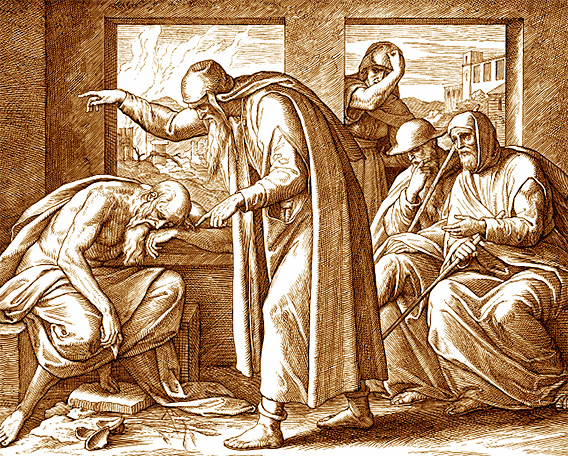
In this chapter we have the speech of Eliphaz who assumes that God would not allow such terrible things as had befallen Job to occur and that therefore Job must have sinned:
Finally, he expresses the words which he asserts were revealed to him when he says, “’Can mortal man be righteous before God?’” He introduces these words to confirm his opinion which he already touched on (v. 7), namely, that adversities do not happen to someone in this life except because of sin. He introduces three reasons to prove that no one can excuse himself when he suffers adverse things asserting that he is free from sin. The first of these is taken from a comparison of man to God and leads to an impossible conclusion. For if man is punished by God without being at fault, it follows that man would be more just than God. The work of justice is to give each one his due. So if God should inflict punishment on someone who was innocent to whom punishment is not due, but the man who suffers because of God did not inflict punishment on another man without fault— which would follow necessarily if the one punished by God were innocent—it follows that a man punished by God is more just than God. To justify man compared to God is tantamount to justifying him with respect to God under the aspect of justice. As perhaps this might not seem an unfitting conclusion to someone, he carries the argument to another more apparently unfitting conclusion saying, “Can a man be pure before his maker?” Each thing has purity in that it conserves its own nature which it receives from its own causes. So the purity of each effect depends on its cause, and it cannot surpass its cause in purity. Thus a man cannot be more pure than his Creator, who is God.
His second argument comes from a comparison to the angels. It is from the greater when he says, “Even those who serve him are not stable and in his angels he finds evil.” This opinion is clear according to the Catholic faith. The Catholic faith holds as certain that all angels were created good. Some of them fell through their own fault from the state of righteousness; some however attained a greater glory. The fact that the angels fell from the state of righteousness seems astonishing for two reasons. One pertains to their contemplative power, the other to their active power. From the contemplative power it seems that there should have been steadfastness in the angels. It is clear that the cause of mutability is potency; the cause of immutability is act. For it is from the nature of potency that something can be or not be. But as what is more completed by act has a firmer hold on unity, what is act in itself is completely unchangeable. Note that as matter is related to form, as potency is to act so the will is to the good. What is good in itself, namely God, is completely unchangeable. However the wills of other natures which are not good in themselves are compared to him as potency to act. Thus the more they cleave to him, the more confirmed they are in good. So since the angels seem to cling more to God and in closer proximity than other creatures, in that they contemplate him more exactly, they seem to be the more steadfast than other creatures Yet they were not steadfast. Thus much less can lower creatures like men, inasmuch as they cling to God by reverencing him in serving him, be judged also to be steadfast. However, from the active power it seems that in the angels there can be little or no depravity. As the rule more approaches the true measure of straight, so much the less crookedness does it have. God, in whom the prime righteousness exists, directing all things by his providence, disposes lower creatures through higher ones. Hence, as they are sent by God to direct others, there seems to be little or no perversity possible in the higher creatures who are called angels. So if there can be perversity in them, one must believe that depravity could be found in any man, however great he may appear to be. However, one should take care that from this opinion, he does not fall into the error of Origen who asserts that even now all created spirits are not steadfast and can be seduced into depravity. For some gained by grace the favor to cling to God unchangeably by seeing him in his essence. In this way, even some men, although they are lower in nature than the angels are granted by grace immunity from the depravity of mortal sin even in this life.
Eliphaz takes third argument (to show that adversity comes from sin) from the human condition which he joins to the conclusion of the preceding argument. Thus one argument could be formed from two and he means this when he says, “How much more those who dwell in houses of clay.” The human condition is such that the body is formed from earthly matter. He indicates this saying, “How much more those who dwell in houses of clay?” The human body is said to be clay because it is formed more fully from earth and water, the heavier elements as its motion makes evident. So Genesis says, “God formed man from the slime of the earth.” (2:7) This body of clay is called the house of the soul because the human soul is situated in the body as a man in a house or a sailor in a ship, as the mover of the body. There were some who said because of this that the soul was only accidentally united to the body as a man is to clothes or a sailor in a ship. But he disproves this opinion when he adds, “whose foundation is dust.” By this we are given to understand that the human soul is united to the body as form to matter. For matter is said to be the foundation of form, because it is the first part in the generation of a thing like the foundation is the first part in the building of a house. Now, he uses this manner of speaking to attribute what is the soul to man because the soul is man, as some held who said that man is nothing but a soul clothed with a body, but because the soul is the more principal part of man. Each thing is usually called from what is more principal in it. These two things which he says about the weakness of man seem to be placed in opposition to what he has already said about the excellence of the angels. For the phrase, “those who dwell in houses of clay,” seems to be placed in opposition to what he said in “Those who serve him,” (v. 18) cling to him and live spiritually in him. However, when he says, “whose foundation is dust,” this seems to oppose, “in his angels,” (v. 18) for angels are incorporeal in nature according to Psalm 103, “Who makes his angels spirit.” (v.4)
Go here to read the rest. For Christians of course we have the example of Christ who suffered evil for our sins, and warned that those who followed Him would suffer as His disciples. Thus the idea that sin is the only explanation for evil befalling an individual is foreign to us, certainly to Catholics.


Job is most appropriate for our time. We are now at the beginning of the Great Chastisement and the End Times.
“DARKNESS is about to descend”, and the Antichrist is nearing his appearance — that, according to Heaven’s recent messages.
Join Mark Mallett and Prof. Daniel O’Connor to discern the latest prophetic words from around the world.
https://www.markmallett.com/blog/darkness-is-about-to-descend/
Agree that the evil that may happen to us is not always the result of our sins, but on the other hand, it wasn’t random bad weather that destroyed Sodom and Gomorrah, or poor weaponry that brought the Jews into forty years of exile..
Sometimes, it is difficult to prove an absolute.