Donald R. McClarey
Cradle Catholic. Active in the pro-life movement since 1973. Father of three, one in Heaven, and happily married for 43 years. Small town lawyer and amateur historian. Former president of the board of directors of the local crisis pregnancy center for a decade.



Pope Pius XII gave refuge to 12,000 Jews. 35 babies were born in his bedroom because his bedroom had heat and hot water. EWTN
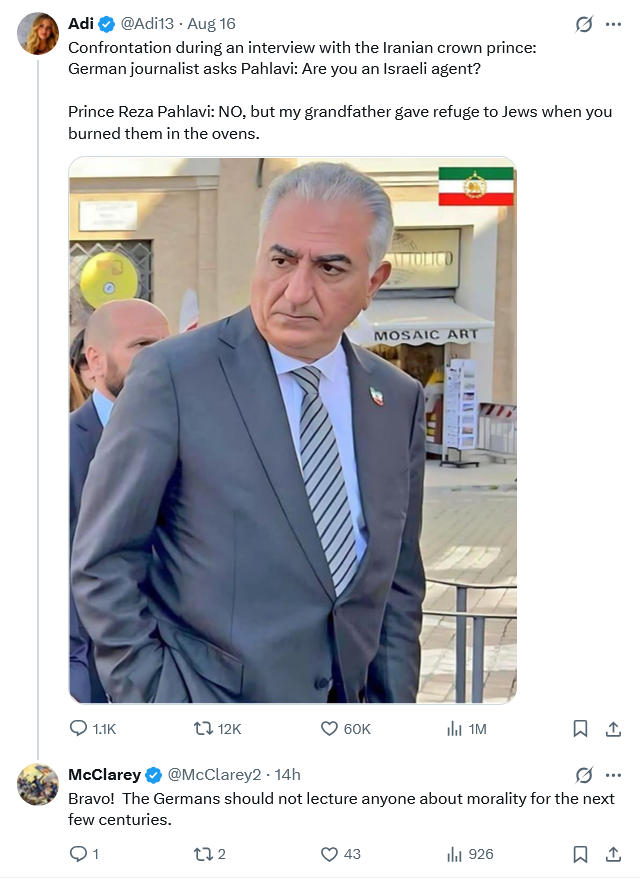
One of the Demons wrapped up into 2 identities,” journalist” and German. The response was epic
A lovely zing – but it would have been better if he compared grandfathers.
The prince had the good sense not to have implied that he saved Jews from ovens himself, but lays the guilt of the Holocaust on Germans as a whole.
Certainly tempting.
However, Germany was a unified state for less than a century before WWII and its regional identities can be surprising. (ex Catholic Bavaria)
I highly recommend a book about two WWII pilots in the war called “A Higher Call” It is nonfiction and will challenge the inclination to blame all the Germans – then or now, when a certain number of them are up to no good in the Church.
Optimist, you make an argument worth considering. On the other hand, the fact remains that the Germans elected the Nazis, and then submitted to their totalitarianism without much argument, even as official abuse of Jews became central to the Nazis’ governance. As Solzhenitsyn noted, a people can resist such oppression, given courage and the necessary motivation. Instead, most Germans quietly accepted what was happening, even as the scapegoating of Jews escalated and Jews began simply to disappear. I am of German ancestry, so it doesn’t make me proud to say this, but so many Germans silently accepted the Jew-hatred that it suggests a significant number of them agreed with it. Obviously there must have been many exceptions, but for whatever reasons, those people remained silent and remained in Germany. I don’t blame current populations for the mistakes of their ancestors, but at the same time, for a German “journalist” to ask such a stupid and offensive question shows, IMO, a sad lack of appreciation of actual history.
Frank is quite correct. Hitler got into power through an approach provided by peculiar German election laws in the Weimar Republic separating the Chancellor and the Presidency. Once Hindenburg died, he simply merged both functions and took control. The natural German respect for authority, dating back to Frederick the Great, assured compliance and order among the majority of the population. Many in the large minority that were dissatisfied with the system emigrated in the past centuries and a number, Jews and non-Jews, attempted to leave between 1933 and 1939. My family left much earlier when it became clear that a quite unhinged Kaiser was going to start another war. The Iranian Crown Price was quite correct as was his grandfather for whatever his motive.
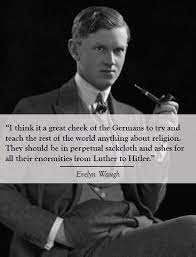
I see Waugh’s point, however, lefties make a similar argument that America should be in “perpetual sackcloth and ashes” for the evil of slavery, and even some right leaning folk could argue we need to don perpetual sackcloth for the sins of abortion and transgenderism…
The peculiar feature of the German constitution was national-list proportional representation as a means of electing the lower house of the legislature. Hitler got into power consequent to a preference cascade in favor of the Nazi Party (1929-32), successful demagogy (1932-33), and the co-operation of the once conservative National People’s Party.
==
It is not at all unusual for the function of head of state and the head of government to be allocated to different offices. Political opposition was suppressed in the spring of 1933, a year or so before Hindenburg died.
==
One thing which solidified the regime was the successful economic strategy crafted by Hjalmar Schacht, who had been president of the central bank under a succession of ministries (1923-30) and was recalled by Hitler.
Here’s an alternate history exercise for you… suppose that Hitler and the Nazi Party had lost those critical elections in the late 20s and early 30s, and the Nazis had faded into oblivion. Who would have taken their place? Genuine reformers? Socialists? Outright communists? A generic centrist party? Something else? Were the Germans who “voted for Hitler” primarily voting FOR him or against the opposition, whomever they were?
Hitler and the Nazi party were hot house plants that required just the right conditions. Without those conditions I think German politics would have returned to a conventional pattern with no political party attaining an outright majority and coalition governments being the order of the day.
Who would have taken their place? Genuine reformers? Socialists? Outright communists?
==
Posit no one in particular. Volkisch parties would have sunk to their long-term share (perhaps 6 or 7%) with the remainder favoring the Social Democratic, Catholic, Communist, conservative, liberal, and agrarian parties in about that order.
TBO:
“I highly recommend a book about two WWII pilots in the war called “A Higher Call” It is nonfiction and will challenge the inclination to blame all the Germans – then or now, when a certain number of them are up to no good in the Church.
There was an underground resistance headed by Bosch and then there was Claus Philipp Maria Justinian Schenk Graf von Stauffenberg was a German army officer who is best known for his failed attempt on 20 July 1944 to assassinate Adolf Hitler at the Wolf’s Lair, part of Operation Valkyrie.
“Long live Sacred Germany.”