
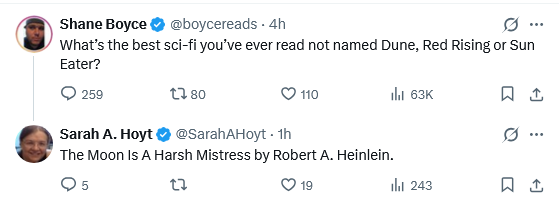
I have read many good short stories, novellas and novels in the science fiction genre, but I have a clear favorite: A Canticle For Leibowitz:
“Francis began the actual illumination of the lambskin. The intricacies of scrollwork and the excruciating delicacy of the gold-inlay work would, because of the brevity of his spare-project time, make it a labor of many years; but in a dark sea of centuries wherein nothing seemed to flow, a lifetime was only brief eddy, even for the man who lived it. There was a tedium of repeated days and repeated seasons; then there were aches and pains, finally Extreme Unction, and a moment of blackness at the end-or at the beginning, rather. For then the small shivering soul who had endured the tedium, endured it badly or well, would find itself in a place of light, find itself absorbed in the burning gaze of infinitely compassionate eyes as it stood before the Just One. And then the King would say: “Come,” or the King would say: “Go,” and only for that moment had the tedium of years existed. It would be hard to believe differently during such an age as Francis knew.”
Give me your choice in the comboxes.


By far A Canticle For Leibowitz is the best.
Both Canticle and Harsh Mistress are among my favorites. But for me the best was the Foundation Trilogy.
I don’t know which is my favorite.
Certainly Heinlein’s The Moon is a Harsh Mistress, Time Enough for Love, and Stranger in a Strange Land.
Asimov’s I, Robot and Foundation series certainly rank very high.
Clarke’s Rendezvous with Rama.
There was a time when really great science fiction was being written. That said, I don’t think I would any longer let a 9 year old read some of Heinlien’s stuff. While at the time I did not understand how he was challenging sexual mores, and how he had his own issues, I do now.
As a youngster without any TV (which was in retrospect a blessing), the two things I most enjoyed reading were science fiction and Greco-Roman mythology.
As a child, I had a “behind the times” library and access to used book sales.
As such I developed a taste for the Victorians and nominate:
Fr. Benson “The Lord of the World”
H G Wells “The Sleeper Awakes”
I found one before my conversion, and the other after.
Hard to beat “The Time Machine”. Wells had sharp insights, such as that progress and evolution might not lead where the Victorians thought they would lead, that brainy successes could lead to social brainlessness in later generations (like today?), and that the working classes neglected by the elite would never lose their importance and eventually leverage it to their advantage (like today, only without cannibalism). Pretty good for a guy in his twenties in 1896.
Leibowitz is up there, but Gene Wolfe is without a doubt the greatest Science Fiction author to have ever lived. For a specific work of his, I would choose The Book of the Long Sun.
I will also give honorable mentions to Cordwainer Smith’s Norstrilia, Gordon R. Dickson’s Soldier, Ask Not and Poul Anderson’s The High Crusade.
I forgot one of the great sci-fi works, since it was always sold under the “Thriller” category: Michael Crichton’s Sphere.
If you want some more recent authors, try Michael Flynn’s Eifelheim, Brian Niemeier’s Nethereal, and John C. Wright’s Chronicles of Chaos (structure around Greek mythology, but there’s robots, manipulation of physics and discussions of non-Euclidean mathematics so we’ll put it in “sci-fi”). I should also have something by Tim Powers, but it’s hard to find one of his works that is definitively “sci-fi” in the standard sense though they all would appeal to readers of sci-fi I think… eh, I’ll just choose The Anubis Gates. It’s based around time travel, good enough.
I just finished reading Lord of the World and was blown away. I plan on rereading Leibowitz soon. I went through a sci fi phase in high school but need to revisit some of these books now that I’m an “elder.” (67)
Jimmy Webb wrote a song that Glen Campbell recorded called The Moon’s A Harsh Mistress
https://youtu.be/36L2mWFp6gk?si=oyf-E2o1KLxTtJWx
Canticle takes the all-time award.
I would also put in a good word for the late, great David Drake’s “Hammer’s Slammers” series. An unflinching, grim look at war from a man who saw it in Vietnam with the Blackhorse.
Ditto Pournelle’s CoDominium series, definitely including the two concluding books with S.M. Stirling.
(Don’s wife here:) I first read Heinlein at the age of 11, but it was one of his juveniles (“Have Space Suit, Will Travel”). Agreed with @LQC that I wouldn’t recommend reading most of Heinlein’s works (other than the juveniles) for anyone under high school age, and parents should be prepared to discuss those books with their teenagers, allowing for the good bits while critiquing the weird/kinky bits.
C.S. Lewis’ “Outer Space” trilogy is good, thought-provoking reading, especially for readers who enjoyed his “Chronicles of Narnia” fantasy series as children. A long-time favorite SF novel of mine, though, is Frank Herbert’s “Dune” — but just the original novel, not the many sequels, (some of which I’ve also read), especially not the ones by his son Brian Herbert. I’m currently doing a simultaneous re-read of “Dune” in both English and Spanish, partly to keep the Spanish I learned in college in practice.
Shard of Eden by Eric Sammons, Pilgrims by H. R. Leonard, Voyage to Alpha Centauri by Michael O’Brian.
All explicitly Catholic…
Based on the recommendations here, I just purchased A Canticle For Leibowitz. Thanks!
As far as my favorite, I’ve always been partial to CS Lewis’ Space Trilogy, which, to be fair, is probably stretching the definition of sci-fi. I enjoyed John C. Wright’s Count to a Trillion series and Superluminary. And I don’t know if this would be best, but Andy Weir’s Project: Hail Mary is a great read.
I would also put in a good word for the late, great David Drake’s “Hammer’s Slammers” series. An unflinching, grim look at war from a man who saw it in Vietnam with the Blackhorse.
I have the three volume collected stories on that Dale. Not a series for those wishing to hold a sunny view of the human condition. Drake was one of the few authors to give a plausible view of future combat. I also liked his stories set in ancient Rome with science fiction elements.
A Canticle for Leibowitz was required high school reading. I thought it more dystopian than sci-fi, but then how many decades ago was that?
I was introduced to Isaac Asimov’s sci-fi because a high school required summer read was his book on chemistry. I liked the book; looked for more of his writings and discovered his sci-fi. At this point taking care of my 43 son who had a work accident in southern Louisiana, I have no time for reading. When I get overwhelmed, my only sci-fi reference is, “Beam me up, Scotty.
You’ve not read anything by John C Wright?