
Hebrew Tradition:Mem,(מ), Mayim (Water) and 40
Numbers have always fascinated me. Perhaps it is genetic, a consequence of being on the spectrum; one grandson at the age of two, also on the spectrum, would ask new people “What number are you?” So, every Lent I calculate the number of weekdays to be spent fasting, praying and giving alms, to make sure they add up to 40…and then wonder “Why 40?”
Let’s first look at the numerology of the Hebrew language. Each Hebrew letter has a numerical value (whence the predictions of the Kabbalah). The letter “Mem,”(מ) is derived as an abbreviation of the Hebrew word for water, “mayim” (מים) and has the numerical value 40. Thus the number 40 is connected to the word “water,” with all the associations that might entail. For example, a ritual purification pool, “mikveh,” must contain at least 40 “se’ah” of water if it is to purify. Could this be related to the 40 days of rain God used to purify the world in the Great Flood?
In the Kabbalistic tradition the closed form of the letter Mem represents the womb closed during pregnancy and the open form, the womb opened to give birth. Thus Mem represents transition and growth from beginning to completion. There’s a numerical connection also: Jewish tradition holds that after 40 days of pregnancy the embryo attains a form we recognize as human.
Scripture and 40
This intrinsic association of 40, water, growth and renewal via the letter “mem” connects all the “40” incidents in scripture; here are some of these:
- The Flood (40 days/nights)
- Moses on Sinai (40 days, three separate times)
- Israel’s wilderness wandering (40 years)
- Elijah’s journey to Horeb (40 days)
- Jonah’s warning to Nineveh (40 days)
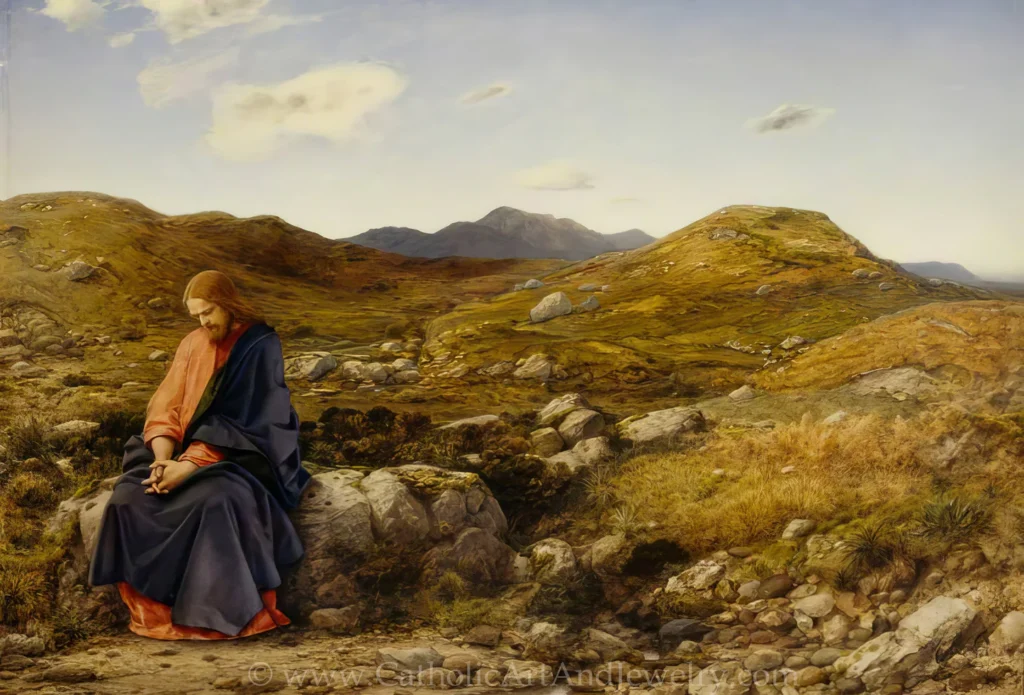
- Christ’s retreat in the desert (40 days)
- Resurrection to Ascension (40 days)
The 40 period in these is a time of transition between “two different epochs,” the first, in which sin/confusion/ignorance prevail, and the subsequent, one where enlightenment/devotion/knowledge is bestowed.
Whence 40 Days for Lent: Finding Our Own Desert
With this background in mind, let’s return to the question posed initially—whence 40 days for Lent? Clearly the model is Christ’s retreat to the desert. And we should note that this retreat is just after Christ’s Baptism. Although Jesus did not need to be purified by immersion in water, He was baptized as a model for us. Did Jesus need 40 days in the desert? He is God, but has two natures, human and divine. As His agony in the garden of Gethsemane shows, His human nature is subject to human failings (but not sin). The Letter to the Hebrews puts it well: “He learned obedience through what he suffered.” The human nature requires training; not so the divine. The stay in the desert, with its stark absence of distraction, enhances His spiritual growth and gives Him strength to resist Satan’s temptation.
And what should our desert be during Lent? The desert in its bareness would help us focus; there we could but focus on God. (“The desert is where God speaks and so we must go to listen.”) Most of us have obligations or are in situations that prevent us from going to a local desert and camping out for 40 days. So we try to emulate a desert, by fasting, by giving up pleasurable activities, by disabling distractions. Our goal in Lent is to grow spiritually, to get closer to God, to remove mundane distractions. Will we do it? I, myself, have not totally succeeded in the past, but success in this is not binary. As the 12 Step maxim has it, “Progress not Perfection.”


“ Most of us have obligations or are in situations that prevent us from going to a local desert and camping out for 40 days.”
With 3 feet of snow on the ground, locusts and wild honey sounds like a vacation.. : – )