
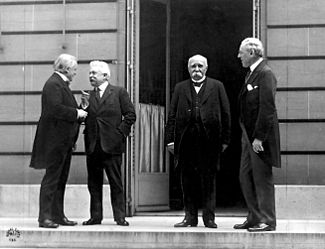
In examining the Paris Peace Conference, it is hard to be objective. We know that another World War followed, much more terrible, only two decades later. It is difficult to view the Paris Peace Conference as anything other than a tragedy that did little to prevent the cataclysm of World War II. This is an understandable viewpoint but a mistaken one. The peace negotiators at the Paris Peace Conference made lots of mistakes, but the coming of World War II was very event driven, events that Wilson, Lloyd George and Clemenceau did not, and largely could not, foresee. Their only road map was the Congress of Vienna which laid the basis for a peace that endured, with brief interruptions, for 99 years. However, that peace was no less event driven than World War II. The “success” of the Congress of Vienna, and the “failure” of the Paris Peace Conference, is very much a retrospective conclusion. In the months to come we will take several looks at the Paris Peace Conference and I will strive to present issues as they appeared at the time, so we can view them more as the participants did, rather than we do now. Hopefully this will help us understand why the participants did what they did, which surely must be an important goal when looking at any historical event.


One complicating factor is that this had to be the first war where the casualties were counted in the millions. I can’t imagine the feelings on the ground, it all must have seemed unprecedented. How to respond to the unimaginable? From what I’ve read, President Wilson was the great hope and who could have lived up to all the expectations placed on him? These will be interesting reads.
Agreed, looking forward to this. Even my college history courses (Illinois Wesleyan) passed over most of the background and concentrated on the provisions of the Versailles treaty, to which they assigned most of the blame for WW2 in Europe. That always seemed simplistic to me.
There were so many things that led to the second world war, but if there had not been the Great Depression, it might not have happened.
Also significant was the Franco-Prussian War of 1870 which left relations between France and Germany an open sore that resulted in WW I. This, in turn, was repeated in the reverse with WW II. Of course there were other strains that added to the problem but even today in the EU both France and Germany are wary of any actions that might give “unfair” advantage to a former adversary.
Perhaps if Germany never unified, life would have been better for all involved.
Optomist:
If German had unified without the overwhelming predominance of Prussia, perhaps, but the humiliation imposed by Napoleon’s army taught a lesson that was too well learned. Unfortunately, the principal of German unification became race (as opposed to the Italian, which was culture).