Donald R. McClarey
Cradle Catholic. Active in the pro-life movement since 1973. Father of three, one in Heaven, and happily married for 43 years. Small town lawyer and amateur historian. Former president of the board of directors of the local crisis pregnancy center for a decade.
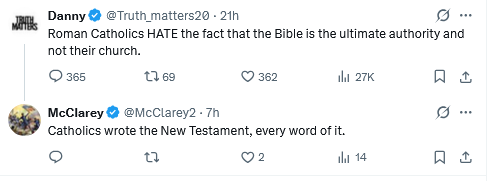



Ironically, many Protestants, from Luther down to today, give to their local pastors, or to themselves, far more authority than the Pope ever claimed for himself, to interpret Scripture for themselves.
How many different interpretations do they have of “this is My Body?”
Not only second what Lepanto said, but *how many* faulty assumptions are at work to make the claim about the Bible being the authority above the Church?
Too many not to expose one’s ignorance.
The Catholic Church (universal) was founded by Christ Himself, is the Authority that gave us the Bible and doesn’t have the Authority to ordain women.
I third what lepanto wrote. As a convert, I thank God for the magisterium of the Church. When Protestant speak of the “authority of the Bible”, they mean the interpretation given by their favorite preacher. People think there’s some kind of wonderful freedom in Protestant Churches, they obviously have never read a “membership agreement” that a lot of larger churches have, very controlling, with their NDA’s, and enforced arbitration agreements. I’ll take the chaos that is the Catholic Church at times, over my former faith anytime.
Protestantism was a viable idea from 1521-1529. Then Luther and Zwingli discovered that two people of good faith could read the Bible and come to different conclusions on essential matters, and the rest has been playing out a losing hand. Nearly 500 years of drawing dead, and they just won’t throw the cards away.
Our friend Danny, in his polemic zeal, seems to have forgotten that God is the ultimate authority. Ironically, in the scriptures which he claims to have as his ultimate authority, only the apostles (and thus the Church) are explicitly delegated this authority by Christ. The further difficulty is that for centuries there was no absolute consensus on what the “Bible” was, and it was ultimately the Church which canonized the canon. This is the Protestant dilemma, for the development of the canon is scandalous and inimical to the notion of sola Scriptura as a normative authority. They must either admit the Church had the authority to determine the limits of the canon (or why else accept it at all?), or that they can have no actual knowledge of what the Scriptures are beyond their own reason and intellectual resources. But if the Church has the authority to determine the limits of what one deems to be the final authority of faith, and thus the most important thing, what legitimacy is there to reject its authority in every other matter? On the other side, if it can get doctrinally divisive things wrong, what confidence is there it got the Bible right? And if the Church can canonize the New Testament, why reject the deuterocanonical books? Granted, not all Protestant do, but enough do, and on a far shakier basis than they probably realize, given that these books didn’t disappear from Protestant Bibles until Bible Societies in the mid to late 19th century deemed, of their own authority, to remove them, which also saved money on printing (conveniently enough).
And while the authority to interpret is often given to the local pastor practically speaking, it’s even more philosophically barren than that. After all, the Scriptures give no rules or limits on how they are to be interpreted, which practically means that under sola scriptura (or prima scriptura, as is sometimes used as an escape hatch) every person is the authority over the meaning of the Scriptures, and there is no meaningful way to determine who is correct between mutually exclusive claims.
When I was in college I had this hermeneutics class in which we learned the “rules” of interpretation. Most were drawn from or inspired by the historical-critical method, which isn’t per se wrong, but certainly has its limits (as Benedict XVI ably comments) and reduces Scripture to a document among other documents if used as the only allowable interpretive method. But the point is that these “rules” are extra-biblical and imposed upon the text by the reader. They may not be bad ways of reading the text and perhaps even helpful in many cases, but they force a reading of the scriptures that can be deduced from the method employed, much like taking a metal detector to the beach and declaring that only metal objects exist on the beach because that’s all the metal detector picks up. Under this method it gets embarrassing to read the authors of the NT interpreting the Old Testament in ways that completely go against the “rules” on interpretation, such as a typological or allegorical reading. I’ve noticed that many Protestants find the typological arguments for Mary or the Mass or whatnot in Old Testament (or even in the New) as illegitimate because they see such interpretations as violating the “rules” of correct interpretation, not realizing that these very “rules” are them imposing something extra-biblical upon the Bible and then calling the result “what the Bible says.”
Paul should have just read the Bible instead of writing all of those letters. How dare he usurp the authority of scripture!
True scriptural perspicuity hasn’t been tried yet. 😉