
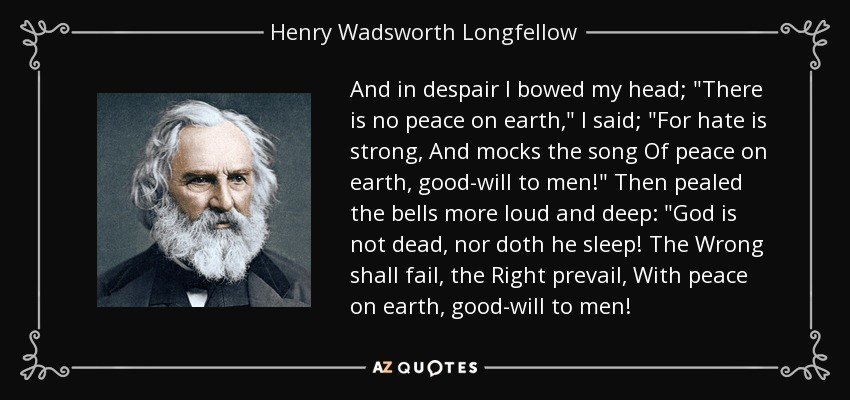
Something for the weekend. One of my favorite Christmas carols has always been I Heard the Bells on Christmas Day. It is based on the poem Christmas Bells written by poet Henry Wadsworth Longfellow on Christmas Day 1863. Still devastated by the death of his wife in a fire in 1861, he had been rocked by news that his son Charles, serving as a lieutenant in the Union army, had been severely wounded at the battle of New Hope Church in November of 1863. In a nation rent by civil war, along with his personal woes, one could perhaps understand if Longfellow had been deaf to the joy of Christmas that year. Instead, he wrote this magnificent poem of faith in the power of Christmas:
Christmas Bells
I HEARD the bells on Christmas Day
Their old, familiar carols play,
And wild and sweet
The words repeat
Of peace on earth, good-will to men!
And thought how, as the day had come,
The belfries of all Christendom
Had rolled along
The unbroken song
Of peace on earth, good-will to men!
Till ringing, singing on its way,
The world revolved from night to day,
A voice, a chime,
A chant sublime
Of peace on earth, good-will to men!
Then from each black, accursed mouth
The cannon thundered in the South,
And with the sound
The carols drowned
Of peace on earth, good-will to men!
It was as if an earthquake rent
The hearth-stones of a continent,
And made forlorn
The households born
Of peace on earth, good-will to men!
And in despair I bowed my head;
“There is no peace on earth,” I said;
“For hate is strong,
And mocks the song
Of peace on earth, good-will to men!”
Then pealed the bells more loud and deep:
“God is not dead, nor doth He sleep;
The Wrong shall fail,
The Right prevail,
With peace on earth, good-will to men.
The poem was set to music by John Baptiste Calkin in 1872. Another version was written by Johnny Marks, who, in an only-in -America moment, was a Jewish composer of Christmas songs, including Rudolph the Red Nosed Reindeer, in the 1940s and 1950s.


GREAT POST!
Thank you.
Have a blessed break from the law mines. Peace.
That is quite a backstory. It brought to mind the closeness of God, when we might think that in those darkest moments He’s abandoned us. Not so. For when I am weak, He is strong. Making me strong and giving me His light to dispel that darkness.
Again……
Knowing God is to know Peace. No God, no peace.
***His love endures forever.***🙏
Gladly, there seems to be a Longfellow revival going on, or at least a lessening of a dismissal him, for a while it was cool to treat him with derision and even contempt. He is a wonderful poet, and also an entertaining one, which was a mortal sin to my English Lit teachers so many years ago. Thanks for quoting him.
I think the Longfellow rediscovery has a lot to do with the fact that many of us now hold in contempt those who held Longfellow in contempt 😉
“Peace on earth, good will to men” means that we have no peace on earth nor good will to men.
Correctly the verse goes: Peace on earth to men of good will. The good will of men will bring peace on earth.
Examples abound.
Henry Wadsworth Longfellow and I go back a while. When I was younger Longfellow’s Evangeline was a favorite. I drew his face in charcoal and it was done well.