
From a 1971 episode of Firing Line, Bishop Sheen and William F. Buckley, Jr. This is one of over 375 episodes of Firing Line now made available on YouTube by the Hoover Institute at Stanford.
Today is the one hundredth anniversary of the birthday of William F. Buckley, Jr. His wit and intelligence helped make me a conservative before I reached my teens.
Buckley in his salad days in the Fifties and Sixties was always more important than National Review, the conservative magazine he founded and financially maintained, as he gave a young and articulate face to American conservatism that was badly needed.
During his lifetime Buckley functioned as a gatekeeper for the conservative movement. Get on the wrong side of Buckley and a group on the right could quickly find itself relegated to the fringes of American life. So it was with Ayn Rand and her Objectivists, a movement whose main tenet seems to have been to shout “Yes Ma’am!” to anything that came from her mouth or pen. Rand made her reputation and fortune by writing two novels: The Fountainhead (1943) and Atlas Shrugged (1957). The poorly written novels, with stick figure characters, were immense financial successes, combining Rand’s anti-collectivist libertarianism with heaping helpings of, for the time, explicit sex, her heroines, always Rand think-a-likes, having multiple lovers but never having kids. Between the sex Rand specialized in long, bloviating, didactic speeches:
“Did you want to see it used by whining rotters who never rouse themselves to any effort, who do not possess the ability of a filing clerk, but demand the income of a company president, who drift from failure to failure and expect you to pay their bills, who hold their wishing as an equivalent of your work and their need as a higher claim to reward than your effort, who demand that you serve them, who demand that it be the aim of your life to serve them, who demand that your strength be the voiceless, rightless, unpaid, unrewarded slave of their impotence, who proclaim that you are born to serfdom by reason of your genius, while they are born to rule by the grace of incompetence, that yours is only to give, but theirs only to take, that yours is to produce, but theirs to consume, that you are not to be paid, neither in matter nor in spirit, neither by wealth nor by recognition nor by respect nor by gratitude—so that they would ride on your rail and sneer at you and curse you, since they owe you nothing, not even the effort of taking off their hats which you paid for? Would this be what you wanted? Would you feel proud of it?”
Atlas Shrugged, page 453
Buckley assigned Whittaker Chambers to review Atlas Shrugged. His review, entitled Big Sister is Watching You, appeared in the December 28, 1957 issue of National Review.
Several years ago, Miss Ayn Rand wrote The Fountainhead. Despite a generally poor press, it is said to have sold some four hundred thousand copies. Thus, it became a wonder of the book trade of a kind that publishers dream about after taxes. So Atlas Shrugged had a first printing of one hundred thousand copies. It appears to be slowly climbing the best-seller lists.
The news about this book seems to me to be that any ordinarily sensible head could not possibly take it seriously, and that, apparently, a good many do. Somebody has called it: “Excruciatingly awful.” I find it a remarkably silly book. It is certainly a bumptious one. Its story is preposterous. It reports the final stages of a final conflict (locale: chiefly the United States, some indefinite years hence) between the harried ranks of free enterprise and the “looters.” These are proponents of proscriptive taxes, government ownership, labor, etc., etc. The mischief here is that the author, dodging into fiction, nevertheless counts on your reading it as political reality. This,” she is saying in effect, “is how things really are. These are the real issues, the real sides. Only your blindness keeps you from seeing it, which, happily, I have come to rescue you from.”
Since a great many of us dislike much that Miss Rand dislikes, quite as heartily as she does, many incline to take her at her word. It is the more persuasive, in some quarters, because the author deals wholly in the blackest blacks and the whitest whites. In this fiction everything, everybody, is either all good or all bad, without any of those intermediate shades which, in life, complicate reality and perplex the eye that seeks to probe it truly. This kind of simplifying pattern, of course, gives charm to most primitive story known as: The War between the Children of Light and the Children of Darkness. In modern dress, it is a class war. Both sides to it are caricatures.
Go here to read the devastating rest.
Buckley drummed out of the conservative movement the conspiracy laden John Birch Society and assorted racists, anti-Semites and cranks of all sorts. The conservative movement was transformed from a fringe element to a powerful political force waiting for the right candidate.
Would WFB have been a NeverTrumper?
Nah, but he wouldn’t have been a Trump acolyte either. Buckley supported Nixon but he was never a fan, because he was better than the Democrat alternatives. There was a strong streak of pragmatism in Buckley, something missing from National Review today, along with Buckley’s style, wit and ability to write in coherent paragraphs.
Buckley vigorously supported Reagan in 1976 and 1980 when the same arguments as to electability that were made against Trump were made against Reagan. In the haze of Reagan hagiography since his Presidency, we forget what a despised figure Reagan was among the “mainstream Republicans” of his day. Back in 1980 Bob Dole got a whole one percent running against Reagan in the New Hampshire primary. He then urged former President Gerald Ford to jump into the primaries to save the party from the disaster of a Reagan nomination.
The two Reagan terms were the highlight of Buckley’s lifetime political involvement. I think during the Bush years that he felt out of place. Dying in 2008 he was spared the Obama years.
His many books can still be read with enjoyment. Buckley never forgot that being amusing helps an author be read. A firm Roman Catholic, he was ever a devotee of the eternal truths of Christ.
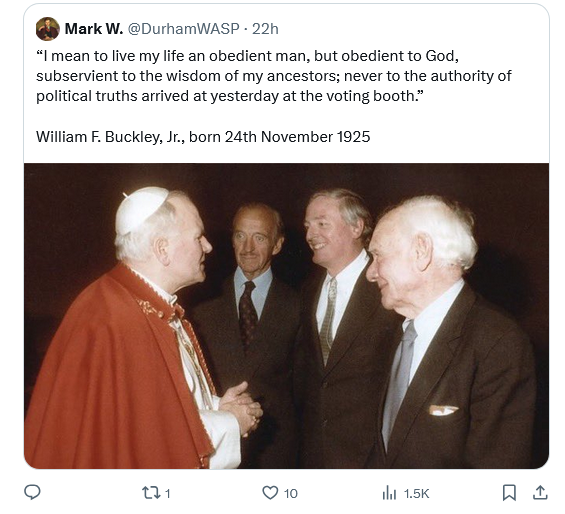
Buckley was wealthy and lived among people who usually had small sympathy for his political or religious beliefs. He never allowed this to impact his beliefs. He had a talent for making friends among political adversaries. That did not extend to Gore Vidal:
A life well lived, and I trust and pray an after life well living.


This is one of over 375 episodes of Firing Line now made available on YouTube by the Hoover Institute at Stanford.
zips over to ‘fave’ the list
That was crazy. It was like watching two mature adults who might not agree about everything having a grown up discussion. Reminds me of when my boys saw a replay of the second 1984 debate between Reagan and Mondale. They were stunned at how everyone behaved, the substance of the questions, and the substance of the answers. A different world.
They were stunned at how everyone behaved, the substance of the questions, and the substance of the answers. A different world.
Around that time, it was noted that television news in 1968 broadcast an exchange between Edmund Muskie and a protestor that ran on for more than a minute, but that television quoting public officials typically made use of ‘soundbites’ that lasted a median of 9 seconds. Political discourse was already considered to have entered a decadent phase, and broadcasting was considered the culprit.
I found the comments made around the 36:00 minute mark to be very disturbing. He (Bishop Sheen) openly talks about bringing the world into the Church. He starts to sound like a Church of Nice advocate. He calls excommunication rigid, and lauds compassion in a way that I would expect from a modernist.
Thank you for the Buckley info. Bishop Sheen was my fav. I have a VHS tape of Bishop Sheen offering and then commenting on the Tridentine Mass. He loved it! I bet he’d be a traditionalist today!
On Laugh-In?!!? That was awesome!
Palaeobabblers complain about Buckley’s gatekeeping activity without acknowledging that he had earned his audience and was under no obligation to publish the people they fancied. Also, the objects of Buckley’s criticism were self-marginalized. Peter Viereck and Clinton Rossiter advocated no idea anyone would care about, Max Eastman and Ayn Rand offered an obnoxious rejection of important parts of popular culture and (in Rand’s case) human nature, and Robert Welch’s mode of thought was sadly familiar to anyone with a schizophrenic family member. (His deputy Gary Allen’s talent was pushing Birchite historiography without sounding like a lunatic).
Many thanks for the WFB retrospective rerun. My early turn to conservatism was spawned by my parents, fish out of water as conservative Republicans among their academic colleagues and friends, and nurtured for years by WFB and NR.
I still recall vividly one of my fellow law firm associates assuring me, after Reagan’s country-wide whupping of Jimmy Carter in November of 1980, that there would be food riots by the end of 1981. Then, when the economy took off after the 1982 recession, which they blamed on Reagan, the same guy tried to tell me the boom was brought about by Carter, in as clear a case of Reagan Derangement Syndrome as you could want. DJT is in good company.