
5 And some saying of the temple, that it was adorned with goodly stones and gifts, he said:
6 These things which you see, the days will come in which there shall not be left a stone upon a stone that shall not be thrown down. 7 And they asked him, saying: Master, when shall these things be? and what shall be the sign when they shall begin to come to pass? 8 Who said: Take heed you be not seduced; for many will come in my name, saying, I am he; and the time is at hand: go ye not therefore after them. 9 And when you shall hear of wars and seditions, be not terrified: these things must first come to pass; but the end is not yet presently. 10 Then he said to them: Nation shall rise against nation, and kingdom against kingdom.
11 And there shall be great earthquakes in divers places, and pestilences, and famines, and terrors from heaven; and there shall be great signs. 12 But before all these things, they will lay their hands upon you, and persecute you, delivering you up to the synagogues and into prisons, dragging you before kings and governors, for my name’s sake. 13 And it shall happen unto you for a testimony. 14 Lay it up therefore into your hearts, not to meditate before how you shall answer: 15 For I will give you a mouth and wisdom, which all your adversaries shall not be able to resist and gainsay.
16 And you shall be betrayed by your parents and brethren, and kinsmen and friends; and some of you they will put to death. 17 And you shall be hated by all men for my name’s sake. 18 But a hair of your head shall not perish. 19 In your patience you shall possess your souls.
Luke 21: 5-19
As always at the end of the liturgical year the readings at Mass focus on the End Times. Luke tells us how Christ predicted the destruction of the Temple which occurred during the rebellion of the Jews against Rome in 66-73.
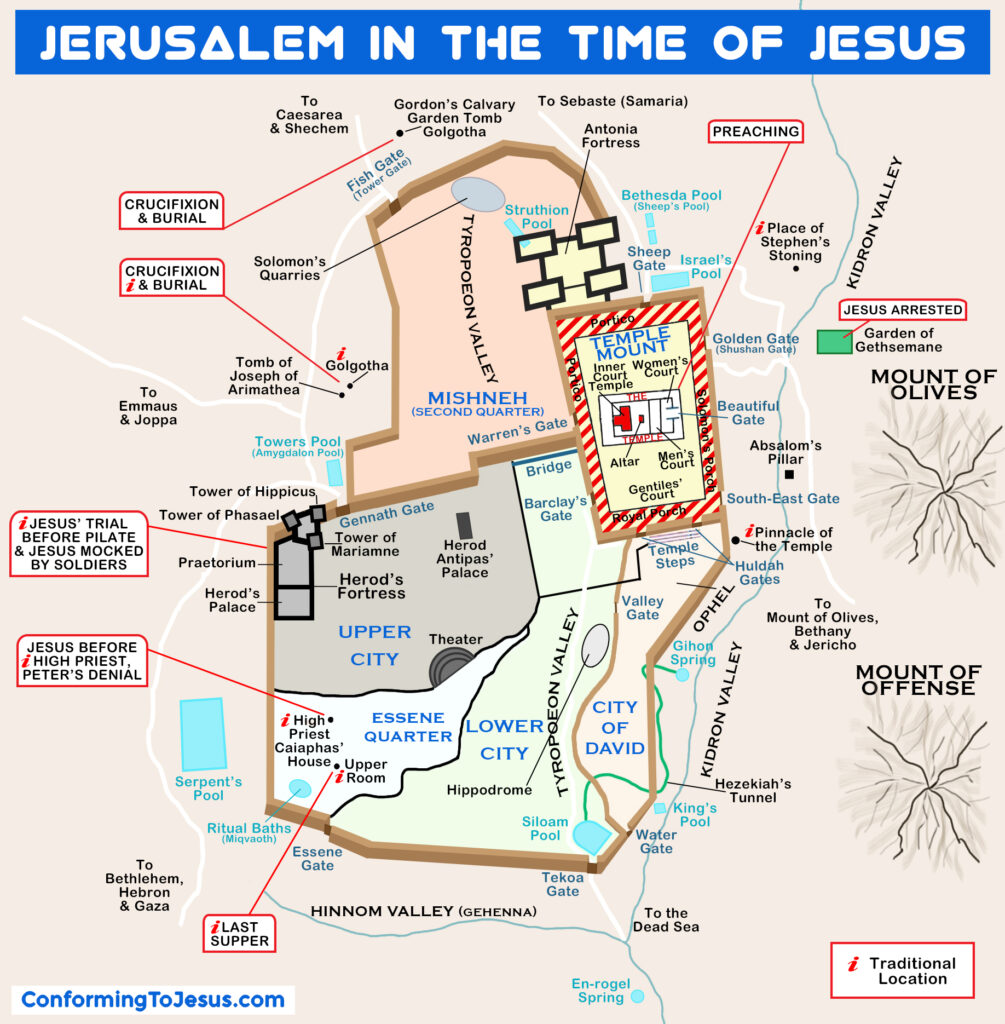
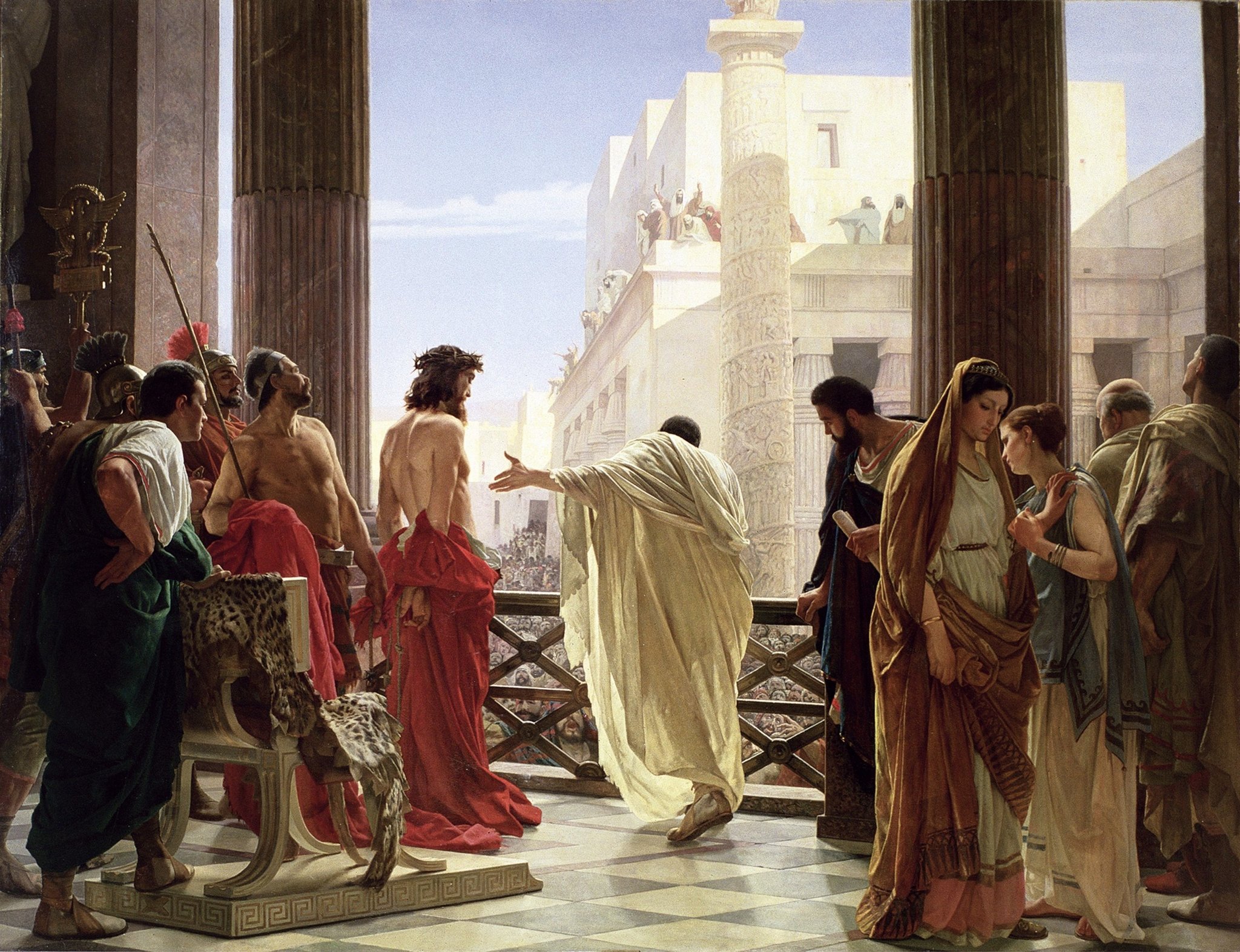
I have always been struck by the painting Ecce Homo (1871), Behold the Man, by Antonio Cisneri. The painting has the effect of placing us in the scene as we observe Pilate attempting to persuade the mob to spare Jesus. The trial of Jesus is taking place in the Antonia Fortress, and looming above it, dominating the painting, is the portico of The Second Temple, the building whose destruction Christ had predicted.
The Temple was the center of the Jewish faith, even as the preaching of the Pharisees on the Scripture of the Old Testament was beginning to replace in the minds of the people the centrality of the Temple. Christ of course was the New Temple. God manifested His presence in the Old Temple. At the time of the Crucifixion the curtain that separated the Holy of Holies from the rest of the Temple was ripped in two because God was manifest among us in the Risen Christ forever, rendering a Temple raised by the hands of men superfluous.
In the painting we see Christ about to suffer death, seemingly a weak and mortal man, while the Second Temple appears to be indestructible. We observe this pivot point of History, knowing the outcome, something none of the participants, except Christ, would have known at the time. Perhaps the wife of Pilate, viewer’s right with her back turned to her husband and Christ, guessed part of it, at least the importance of it, due to her dream. As we live our lives, the significance of events sometimes elude us and sometimes are inescapable. Often their true significance awaits the passage of time. As Paul notes, we see as through a glass darkly in this life, which is all the more reason to hold tight to the light of Christ.


Great map, thanks! 😀
“Christ of course was the new Temple.”
Yes. He said, “Destroy this temple, and I will rebuild it in three days.” Any plans to build a third Temple in Jerusalem are doomed, because the Third Temple already exists in the Body of Christ.
I always click on you through Big Pulpit. Wasn’t expecting this. Beautiful.
Thanks Mel!
I’ve seen Ecce Homo in the Pitti Palace in Florence, Italy. It is humbling.