
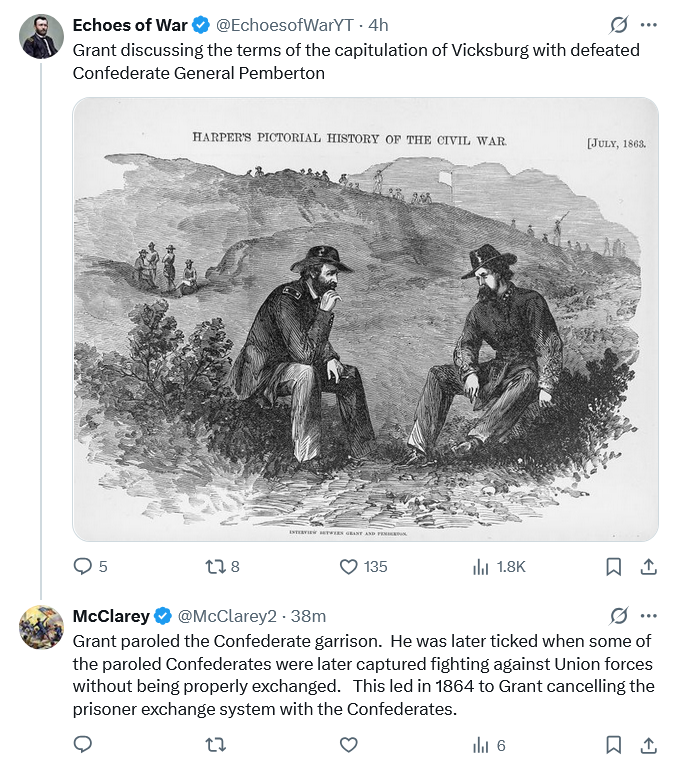
The treatment of POWs in our Civil War was shameful, with the resource rich North having less excuse for it than the resource poor South.
The Dix-Hill Cartel system, named after Union General John A. Dix and Confederate General D.H. Hill, for large scale exchanging of prisoners ran for about a year from July 1862-July 1863, with Lincoln suspending exchanges at the end of July due to the refusal of the Confederates to include captured Union black soldiers in the exchanges, instead treating them as run away slaves. Some exchanges occurred thereafter on a small scale. In April 1864 Grant reviewed the issue and ordered that exchanges not be resumed until Union colored troops be included and until the Confederate troops paroled at Vicksburg and Port Hudson be properly exchanged. This led to soaring pow populations and human misery on a grand scale, with Andersonville in the South and Elmira, called Helmira by the Confederates, in the North being the worst examples. Exchanges were resumed when the Confederates agreed to include all prisoners in January 1865. Grant had previously been concerned that a resumption of the exchange system would benefit the Confederates and give them an advantage in the War. By January 1865 the outcome of the War was a forgone conclusion.
During the War approximately 329,963 Confederate prisoners of war were exchanged by the Union, while the Confederacy paroled or exchanged about 152,015 Union prisoners of war.


Had an ancestor captured twice. Exchanged the first time on his parole. Second time, nope. I am still rather conflicted as to whether his actions were honorable, or not. I tend, alas, towards not.