Donald R. McClarey
Cradle Catholic. Active in the pro-life movement since 1973. Father of three, one in Heaven, and happily married for 43 years. Small town lawyer and amateur historian. Former president of the board of directors of the local crisis pregnancy center for a decade.



In Japanese the basic terms for siblings are for “Older Brother (兄)” “Younger Brother (弟)”, “Older Sister (姉)” and “Younger Sister (妹).” There is a word for “brother” in general made by mashing together “older brother and younger brother” together (兄弟) and a similar word for “sister” in general (姉妹). Concatenating these gives a general term for siblings (兄弟姉妹 pronounced “kyoudaishimai” or alternatively “keiteishimai”) but this is too unwieldly to be used in any but the most formal settings, and so “brothers” will routinely include female siblings. On top of this, it is common (especially for children) to refer to unrelated people as if they were relatives. So an elementary school student may refer to a college freshman he doesn’t know as “big sister.” It’s similar to how in English it isn’t uncommon for children to refer to a friend of the family as “Uncle Mike” or “Aunt Beth” even if there is no blood relation.
The point is, this sort of thing happens in many languages.
The following was posted by Joshua Charles elsewhere on social media.
The note on the “brothers” of Jesus (in support of the Perpetual Virginity of Our Lady) from the new Ignatius Study Bible (Matt. 12:46), whose editor in chief is my friend, former Calvinist pastor and theologian, and Eternal Christendom Advisory Board member, Dr. Scott Hahn:
The New Testament often mentions Jesus’ brethren (13:55; Mark 3:31; Luke 8:19; John 2:12, 7:3; Acts 1:14; Gal. 1:19). The Church maintains, however, that Jesus’s Mother, Mary, remained a virgin throughout her life.
Four observations support the Church’s tradition:
(1) These brethren are never called the children of Mary, although Jesus himself is (John 2:1, 19:25; Acts 1:14).
(2) Two names mentioned, James and Joseph, are sons of a different “Mary” in Matthew 27:56 (Mark 15:40).
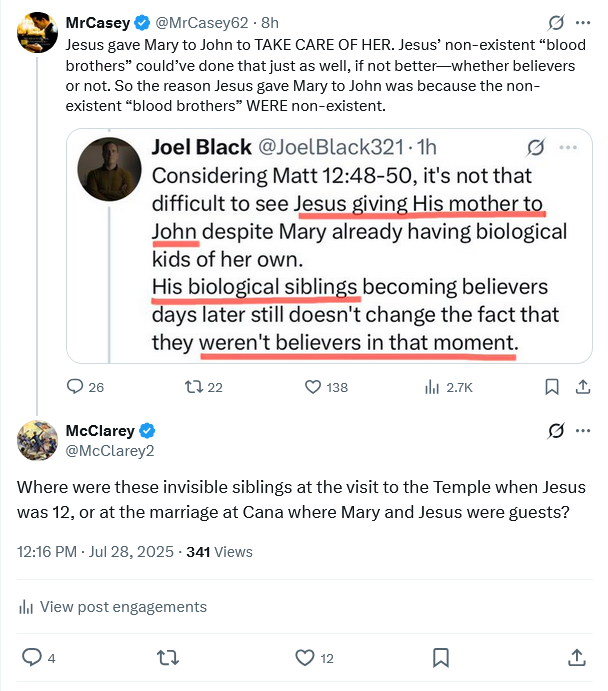
(3) It is unlikely that Jesus would entrust his Mother to the Apostle John at his crucifixion if she had other natural sons to care for her (John 19:26-27).
(4) The word “brethren” (Greek: adelphoi) has a broader meaning than blood brothers. Since ancient Hebrew had no word for “cousin,” it was customary to use “brethren” in the Bible for relationships other than blood brothers. In the Greek Old Testament, a “brother” can be a nearly related cousin (1 Chron. 23:21-22), a more remote kinsman (Deut. 23:7; 2 Kings 10:13-14), an uncle or a nephew (Gen. 13:8), or the relation between men bound by covenant (2 Sam. 1:26; cf. 1 Sam. 18:3). Continuing this Old Testament tradition, the New Testament often uses “brother” or “brethren” in this wider sense. Paul uses it as a synonym for his Israelite kinsmen in Romans 9:3. It also denotes biologically unrelated Christians in the New Covenant family of God (Rom. 8:29, 12:1; Col. 1:2; Heb. 2:11; Jas. 1:2; Catechism of the Catholic Church, par. 500).
I haven’t done a detailed study of this and there may be exceptions, but it seems to me that the normal way that Scripture delineates the precise relationship between brothers is not by reference amongst themselves, but rather their relation to each other through their common father or mother.
Thus at least two of Jesus’ “brothers” are elsewhere said to be sons not of Joseph, but of Mary, the wife of cleophas. Jesus himself is said to be the son of Mary or thought to have been the son of Joseph, but none of his brothers or sisters are designated as such. His giving Mary to John as mother to son at the crucifixion underscores this.
Absent this, the term brother is somewhat ambiguous when used amongst persons and can be used precisely for a biological relation (such as Abraham being the brother of Lot’s father) or a more general familial relation for the same persons, such as where Abraham, who is Lot’s uncle and specifically said to be such via a circumlocution, is also said elsewhere to be his “brother.”
I have always been sympathetic to the step-brothers theory (Joseph’s children from his previous marriage in which he was widowed), and that would also satisfy a couple of different “objections” (at least if you’re logical).
Anyway, the step-brother theory allows for Jesus “brethren” to talk down to him (as older would do to younger), but with him being the first (and only) child of Mary, tasks him with the responsibility of ensuring her care. As pointed out by the original post, there were no other children of Mary. Thus, entrusting her, for all intents and purposes, to a stranger (i.e. *not* blood family) is the clinching argument.
For all the struggles I had with my faith in my 20’s, this element was not one of them. Mary being “untouchable” as the Ark of the New Covenant was one of the most logically clear pieces of doctrine. Anyone who knows their Old Testament will remember the man who got “zapped” trying to steady the Ark when it was being brought into Jerusalem for the first time. This foreshadows the existence and role of Mary in relation to her Divine Son.
Hebrew, similar to Arabic, defines the cousin according whether they are the son or daughter of an uncle or aunt. For example “Been Dod” is “uncles son” in Hebrew. “Ebn Ami” is “son of my uncle”. In Aramaic it’s “bar dad”. It’s very specific. English seems to abbreviate meanings of words into one word which is meant to mean everything all at once.
Besides Jesus couldn’t have had siblings because of Mary’s Virginity, and also because logic tells you that no human on earth could have kept a continuous, direct bloodline of the Son of God. In a sense that would make them “semi-God”.
But, it brings into question whether Out Lady had siblings and if she did, then Our Lady would have had descendants. And who are they? And where are they now?
Infatuation with science has bred in us an expectation that we will always be learning new things.
In religion and history, trust the old stuff and think twice (or more) when new stuff is presented with anything but a very solid showing of how the older stuff was wrong.
Prime example: how Protestants suddenly “got it right” 1500 years after the apostles.
As someone who has spent considerable time in the middle east, I’ve been referred to as “brother” and “so and so’s brother”, of whom shared absolutely no relation, far more times than I can count.
Mr. Black is, like many Protestants, going through great contortions to reach beyond scripture and reality to malign the person closest to God. What a sad lot.
Ezekiel 44:1-3 talks about a shut gate in the heavenly temple seen in the prophet’s vision. Perhaps there is an analogy here to the Blessed Virgin Mary. I am no theologian, so I wouldn’t push this too far. But the Father George C. Haydock Study Bible of 1859 says that according to St. Augustine, this passage insinuates that Mary ever remained a pure virgin.
1 Then he brought me back to the outer gate of the sanctuary, which faces east; and it was shut. 2 The Lord said to me: This gate shall remain shut; it shall not be opened, and no one shall enter by it; for the Lord, the God of Israel, has entered by it; therefore it shall remain shut. 3 Only the prince, because he is a prince, may sit in it to eat food before the Lord; he shall enter by way of the vestibule of the gate, and shall go out by the same way.
[…] MagazineAn Eastern Rite-Like Status For The SSPX? – Fr. Allan J. McDonald at Southern OrdersBehold! Our Protestant Superiors! – Donald R. McClarey, J.D., at The American CatholicWhy Do Women Misunderstand Men – […]
The Blessed Virgin Mary had Perpetual Virginity. Jesus the Son of God was conceived through the Holy Spirit, Infinite and perfect Love. Infinite and perfect Love is the one and only Love the Blessed Virgin ever entertained
Having been blessed with Perpetual Virginity, the Blessed Mary did God’s will perfectly as did Jesus Christ. Sinless unto Immaculate Conception.
Individuals stuck in time and space have no concept of Perpetual Virginity in eternity, outside of time and space, where each and every man’s soul, immortal, soul is brought into existence and the gifts bestowed up each and every immortal soul.
The joy of the Beatific Vision and the fullness of heaven is not in their calendar.